
Google FAQ Structured Data Guidelines 2026: Rich Results Removed

Google's FAQPage structured data guidelines in 2026: FAQ rich results ended in May, even for government and health sites. What changed and what to do now.
At a glance
- On 7 May 2026, FAQ rich results stopped appearing in Google Search. Google says it will remove the FAQ search appearance filter, FAQ rich result report, and FAQ support in the Rich Results Test in June 2026, and remove FAQ rich result support from the Search Console API in August 2026.
- This is the final step in a longer retreat. In August 2023, Google had already restricted FAQ rich results to well-known, authoritative government and health websites, while later fully deprecating HowTo rich results.
- The biggest operational impact is reporting and governance, not surprise SEO loss for most sites. By Google’s own 2023 rules, the majority of commercial publishers had effectively lost FAQ rich-result visibility years ago.
- For AEO and AI-driven search, the lesson is narrower than many hot takes suggest. Google’s AI features guidance says there is no special schema needed for AI Overviews or AI Mode, although any structured data you do use should match visible page content.
Update, 9 October 2026: the June and August 2026 dates in this post have passed. On 15 June 2026, Google removed its FAQ structured data documentation, stating that the FAQ rich result is no longer shown in Google Search (Search Central documentation updates). Google's changelog has no separate entry for the Search Console report, Rich Results Test or Search Console API changes.
Are FAQ rich results still shown in Google?
No. Google stopped showing FAQ rich results in Search on 7 May 2026, including for the government and health sites that had kept them since August 2023. On 15 June 2026, Google removed its FAQ structured data documentation, stating that the FAQ rich result is no longer shown in Google Search.
What actually changed
Google stopped showing FAQ rich results in Search on 7 May 2026, including for the government and health publishers it had kept eligible since 2023. The affected markup is FAQPage built from Question and Answer nodes. QAPage, for pages where users submit several answers to one question, is a separate type.
The clearest primary-source reading comes from Google Search Central’s documentation updates and the feature-specific FAQ structured data documentation . Google’s notice says FAQ rich results no longer appear in Search as of 7 May 2026; supporting UI and reporting layers will be retired in stages through June and August. The official record is a documentation update added on 8 May 2026, not a dedicated explanatory blog post. Crucially, this removes the last remaining FAQ rich-result eligibility even for the government and health publishers Google had preserved in 2023. The affected markup is FAQPage built from Question and Answer nodes. Google still distinguishes that from QAPage, which is intended for pages where users submit multiple answers to a question. In other words, this is not a blanket removal of all question-oriented structured data.
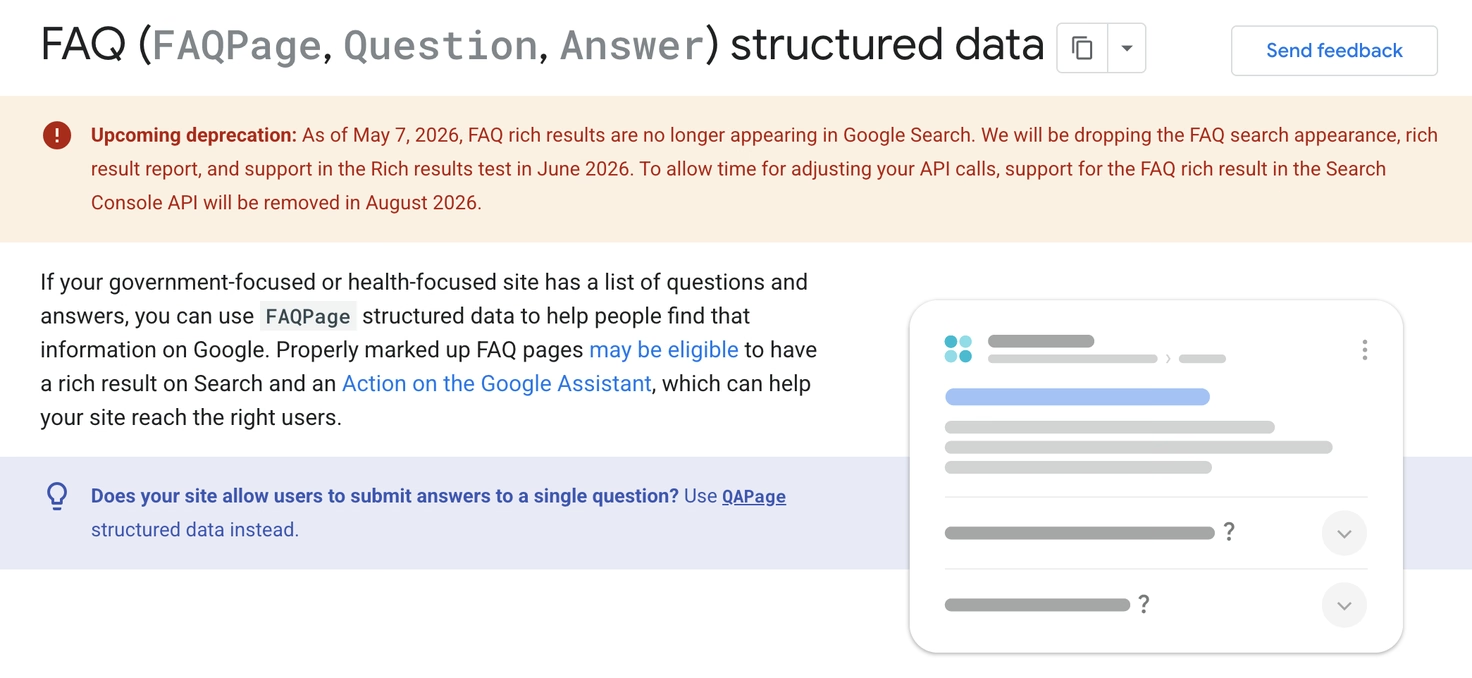
The JSON-LD pattern itself has not changed. What changed is Google’s willingness to render it as a visible FAQ enhancement in the SERP.
Timeline of the removal
Google removed FAQ rich results in steps: FAQ support launched in May 2019, visibility narrowed to authoritative government and health sites in August 2023, FAQ rich results stopped appearing on 7 May 2026, and the FAQ report, the Rich Results Test support and the Search Console API support followed in June and August 2026.

The timeline matters because it shows this is not a sudden reversal. Google launched FAQ and HowTo support in May 2019, along with a dedicated FAQ report in Search Console. In August 2023, it rolled FAQ visibility back to a narrow class of authoritative government and health sites. In June 2025, it separately announced the retirement of seven other structured-data-driven Search displays as part of a broader simplification effort. FAQ joins that pattern in May 2026, even though Google did not publish a fresh rationale this time.
| When | What changed |
|---|---|
| May 2019 | Google launched FAQ and HowTo support, along with a dedicated FAQ report in Search Console. |
| August 2023 | FAQ visibility rolled back to a narrow class of authoritative government and health sites. |
| June 2025 | Google announced the retirement of seven other structured-data-driven Search displays. |
| 7 May 2026 | FAQ rich results no longer appear in Search (documentation update added on 8 May 2026). |
| June 2026 | The FAQ search appearance filter, the FAQ rich result report and FAQ support in the Rich Results Test are removed. |
| August 2026 | FAQ rich result support is removed from the Search Console API. |
Who still got FAQ rich results before May 2026?
From August 2023 until May 2026, only well-known, authoritative government and health websites were eligible for FAQ rich results in Google Search. Every other site could keep its FAQPage markup, but Google no longer showed the FAQ expansion for it.
Since 7 May 2026 that last group has lost them too: Google shows no FAQ rich results for any site. On 15 June 2026 Google removed the FAQ structured data documentation itself, so Search Central no longer has FAQPage guidelines for rich results to follow.
What still applies is the general rule in Google's AI features guidance: any structured data you use should match the visible text on the page. Google has also said that unused structured data does not cause problems for Search.
The real impact on traffic and reporting
For most commercial sites, the traffic effect of the FAQ removal is probably small: almost half of FAQ snippets had already disappeared by mid-June 2023, and Google said the feature served only a tiny set of site types. The more concrete effect is on reporting, where the FAQ report and API support were retired.
For most commercial sites, the practical shock is probably smaller than the headline. An industry analysis reported in August 2023 that almost half of FAQ snippets had already disappeared by mid-June, with the rest following soon after. And as Barry Schwartz reported at Search Engine Roundtable, John Mueller said that the feature had been used for only “a tiny set of site types”, meaning most sites were already seeing no visible FAQ effect from their markup.
That does not make the change irrelevant. Any publisher still earning FAQ expansions, principally the authoritative government and health sites Google had left eligible, loses a SERP treatment that increased visual prominence and likely helped CTR. But Google has not published a fresh May 2026 case study quantifying impression, CTR, or traffic loss from the final removal, so any forecast beyond “expect fewer FAQ appearances” should be treated as an estimate, not a known fact.
The reporting fallout is more concrete. Teams should export historical FAQ search-appearance data before June, update any Search Console API pipelines before August, and use caution with long-window before/after comparisons because Google also says a Search Console logging issue affected impression reporting until 27 April 2026.
What this means for schema, SEO, and AEO
The FAQ removal ends a Search display, not structured data. Google's AI features guidance says no special schema.org markup is required for AI Overviews or AI Mode, and that structured data should match the visible text on the page. FAQPage is not an AI shortcut, but it can still make visible answers cleaner for machines. Markup is one input among several; to see where else a company can drop out of AI answers, check each of the eight stages in turn.
Google did not publish a new why for the May 2026 FAQ deprecation. Still, the move fits a documented pattern. In 2023, Google said that it was reducing FAQ and HowTo visibility to create a cleaner, more consistent results page. In 2025, it retired several other structured-data features because they were not commonly used and no longer added enough value for users. The fairest reading is that Google is pruning low-value visual treatments, not declaring structured data irrelevant. That is an inference, but it is strongly supported by Google’s own historical language.
That distinction matters for AEO. Google’s current AI features guidance says there is no special schema.org markup required for AI Overviews or AI Mode, but it also says structured data should match the visible text on the page. So FAQPage is not an AI shortcut. It is, at most, one way of making already-visible answers cleaner for machines to interpret. That is also where the practitioner debate has landed. In one LinkedIn reaction, Akash Sehgal framed the change as a quality reset against overused, low-value FAQ sections. In another, Gianluca Fiorelli argued that people are confusing the death of a rich result with the death of schema as information architecture. Google’s own AI guidance leans closer to the second reading.
As of 12 May 2026, Google's broader documentation still listed FAQ as a feature guide, while the dedicated FAQ documentation carries the deprecation banner. That looks like documentation lag rather than continued eligibility, so treat the feature-specific FAQ page and changelog as the source of truth.
Frequently asked questions
Does Google still publish FAQPage structured data guidelines?
No. On 15 June 2026, Google removed its FAQ structured data documentation, stating that the FAQ rich result is no longer shown in Google Search. What still applies is the general rule in Google's AI features guidance: any structured data you use should match the visible text on the page.
Should you keep or remove FAQPage markup?
Keep or remove existing FAQ markup based on governance cost, not panic. Google has already said unused structured data does not cause problems for Search. Stop adding FAQPage solely to win more SERP real estate in Google: that use case is now gone.
Do FAQ sections still help in Google AI Overviews and AI Mode?
Not through markup. Google's AI features guidance says there is no special schema.org markup needed for AI Overviews or AI Mode. Keep FAQ content where it genuinely helps users, but make the answers strong in visible HTML first.
What to do next
- Stop adding
FAQPagesolely to win more SERP real estate in Google. That use case is now gone. - Keep FAQ content where it genuinely helps users, but make the answers strong in visible HTML first. In Google’s AI guidance, visible content still comes before any special markup theory.
- Keep or remove existing FAQ markup based on governance cost, not panic. Google has already said unused structured data does not cause problems for Search.
- Archive historical FAQ appearance data now, and update dashboards, Looker Studio connectors, or internal API pulls before the June and August sunsets arrive.
- Separate
FAQPagefromQAPagein your templates and audits so you do not accidentally remove or misclassify valid question-and-answer content types that Google still documents and continues to refine.
The broader strategy lesson is straightforward. Schema should be justified by durable outcomes, entity clarity, cleaner extraction, valid markup, and eligibility for features Google still actively supports, not by the hope of squeezing one more accordion under a blue link. FAQ rich results are gone. Machine-readable clarity is not. Our free AI search tools check what crawlers and markup tell machines about you, and a free Lenz report shows whether AI engines name you for your buyers' questions.
Sources
- Google Search Central, documentation updates.
- Google Search Central, FAQ structured data documentation.
- Google, AI features guidance.
- Barry Schwartz, Search Engine Roundtable, reporting John Mueller's comment on FAQ rich results.

Sr. Engineering Leader with 15+ years of experience. Ex-ApplyBoard. AWS Certified Solutions Architect.

AI/ML scientist with 20+ years of research & industry experience. Ex-Google DeepMind, MIT, Harvard, Mila. McGill-Mila PhD.
Related articles
- Google Preferred Sources and AEO: what it is and how it affects your AI visibility
- What You Might Have Missed From Google I/O 2026 (And Why It Matters for AEO and AI Search)
- A new browser war is brewing but this time, it’s powered by AI
- Introducing CAILIN: The Corporate AI Literacy Index by Elementera
- OpenAI × Broadcom: From Sand to Intelligence
Latest articles
- Dental Practice Software in 2026: A Practical Guide to PMS Platforms and AI Tools (US and Canada)
- What an AI Visibility Audit Actually Covers for SMBs
- Inside Google’s First Year of AI Mode: What 1 Billion Users Reveal About How Americans Search Now
- What Is llms.txt and How to Implement It for AI Bots (2026 Guide)
- What We Know About Paid Ads in AI: A Practical, Evidence-Based Guide for 2026