
Google Preferred Sources and AEO: what it is and how it affects your AI visibility
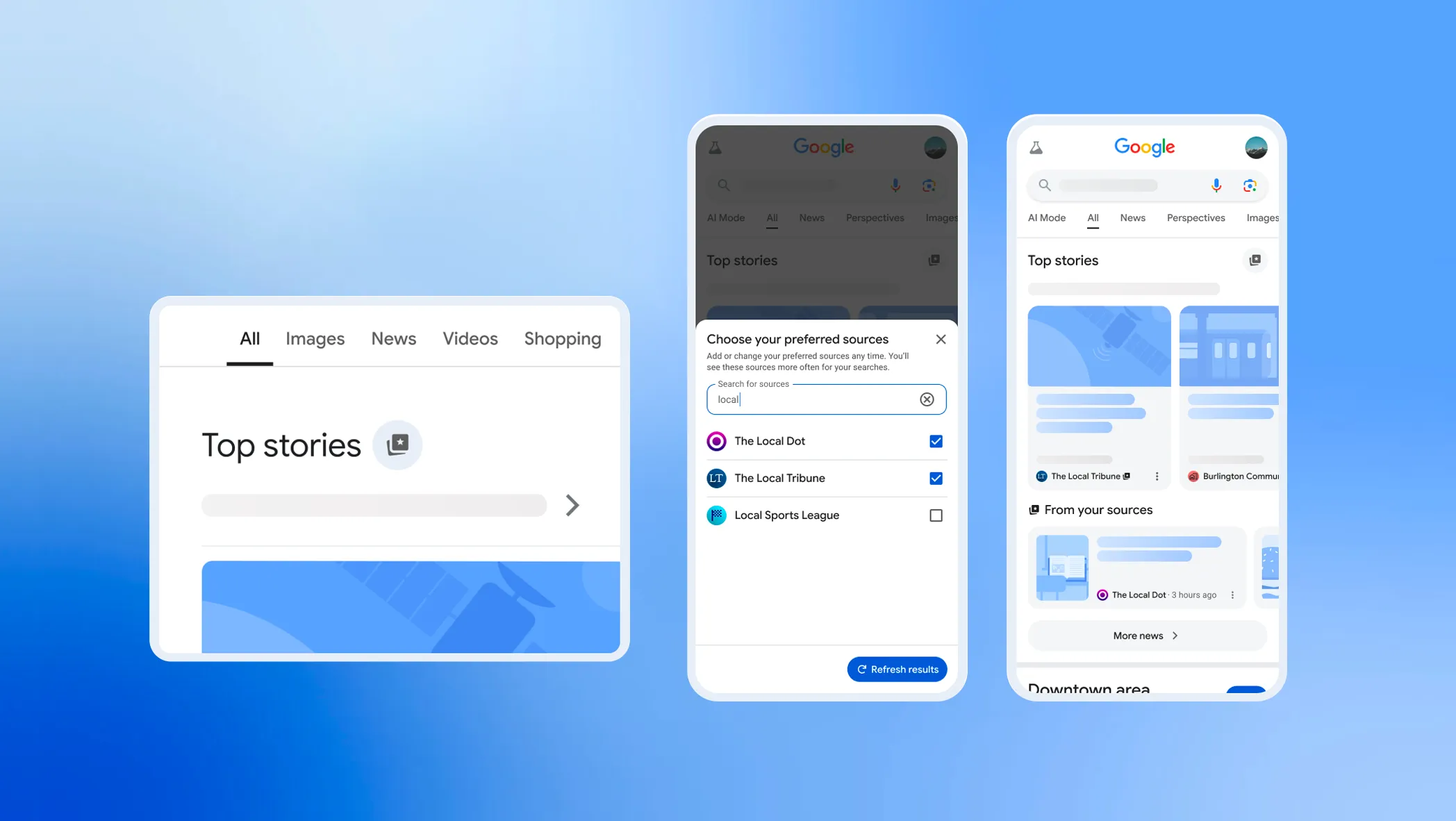
Google runs a feature named Preferred Sources, and on May 27, 2026 it brought that feature into AI Overviews and AI Mode Preferred Sources is a personalization tool. Your readers choose the websites they want to see more of, and your links then carry a visible Preferred label inside Google's AI answers. There is also a broader question hiding in the same phrase: does Google's AI lean toward certain kinds of sources when it writes an answer? The data says it does. Both points matter for answer engine optimization (AEO), and both reward genuine authority over shortcuts.
This guide covers what the feature is, what credible studies show about how AI answers pick sources, and the practical work that helps a business get cited. Where the evidence points one way but does not prove cause, we say so.
The short version
- Preferred Sources is controlled by users, so it hands no site a hidden ranking boost. Google reports that people are twice as likely to click a Preferred Source, and readers have already chosen more than 345,000 of them.
- Citation now matters more than the top blue link. Most AI Overview citations come from pages outside the top 10 organic results, so a focused smaller site can appear beside much larger ones.
- Earned authority beats tricks. In a study of 75,000 brands, how often other sites mention your brand lined up with AI Overview visibility far more closely than your backlink count. Buying those mentions backfires, because Google treats it like buying links.
- Being cited pays off. Brands cited inside an AI Overview saw about 35% more organic clicks and 91% more paid clicks than uncited brands on the same query.
What is Google Preferred Sources?
Preferred Sources is a Google Search setting that lets a person pick the websites they want to see more often. Google launched it in August 2025 for the Top Stories news box in the United States and India, opened it to all supported languages on April 30, 2026, and extended it into AI Overviews and AI Mode on May 27, 2026.
When someone adds your site, your links get a clear Preferred label inside their AI Overviews, AI Mode answers, Top Stories, and Google's new article carousels. The labels let readers, in Google's words, “easily spot links in AI responses from the sources you’ve already selected.”
Two numbers from Google are worth holding onto. People are twice as likely to click through to a Preferred Source, and readers have already selected more than 345,000 unique sites, from large news outlets to small niche blogs.
Google introduced a second label at the same time, called Highly Cited. It marks articles that many other publishers reference, which points readers toward original reporting and primary research. The two labels are earned in different ways.
One honest point. A Preferred Source still has to publish fresh, relevant content to appear in an answer. The opt-in does not override quality or relevance. It works as a tiebreaker that helps you when you already have something worth showing. The label rewards sites that keep earning the choice, not sites that game a setting. Sensible teams treat it as one more signal, not a traffic recovery button.
One technical rule that catches publishers off guard
Eligibility has a structural edge worth knowing. Google's documentation says only domain-level and subdomain-level sites can appear in the source preferences tool. So example.com and news.example.com qualify, but a subdirectory like example.com/blog does not.
If your main articles live in a subfolder rather than on their own domain or subdomain, readers will not find you in the selection tool, no matter how good your content is. That is worth checking before you build any campaign around the feature. Moving a blog off a subfolder needs careful planning so you do not lose existing search traffic, which is one reason teams bring in help for this kind of work.
How does Preferred Sources affect your AEO?
Most AEO work tries to convince a machine to cite you. Preferred Sources works the other way around. A reader chooses you on purpose, before any search happens. That makes this as much a conversion job as an optimization job.
Google gives publishers a one-click deep link that opens the settings with your domain already filled in. The format is google.com/preferences/source?q=yourdomain.com. You can put that link, or Google's downloadable button, anywhere you reach loyal readers.
Placement decides results. A button buried in a footer does little, because intent is low there. The ask works best right after someone has felt your value.
- The end of a strong article or guide, when a reader just got something useful.
- A thank-you page after a download, signup, or purchase.
- An author bio, where a specific writer has earned trust.
- A newsletter footer, or a post to an engaged social audience.
Keep the framing about the reader, not about you. A medical site might say: add us as a preferred source so our reviewed health guidance shows up when you ask Google's AI a health question. That positions the request as a better experience for them.
Two limits keep this honest. The label boosts you only for people who already chose you, so it does not lift your visibility with the wider audience on its own. And manufacturing the effect is off the table, which leads to the next point.
Why buying your way in does not work
As more businesses chase AI visibility, some have tried to manufacture it by paying for brand mentions across blogs, forums, and social posts. The idea was that if a model sees your name everywhere, it will treat you as the consensus answer.
Google has been blunt about this. At Search Central Live in May 2026, Gary Illyes compared buying or manipulating brand mentions to buying links, a tactic Google's systems detect, ignore, and discount. In Google's words, “our core ranking systems focus on high-quality content while other systems block spam.” Around the same time, Google updated its spam policies to state plainly that they apply to AI Overviews and AI Mode, not just blue links.
There is a useful nuance here. Google did not promise that authentic mentions directly raise your AI visibility, only that fake ones will eventually backfire. So the safe and durable path is the same one good AEO has always taken: earn real attention from real sources, and make your content easy to cite.
Does Google's AI actually prefer certain sources?
Set the feature aside for a moment. The deeper question is whether Google's AI gravitates toward some sites when it builds an answer. Large studies of real citations say it does, through signals rather than a secret list.
Surfer analyzed 36 million AI Overviews and 46 million citations between March and August 2025. Across most industries, three domains led: YouTube near 23%, Wikipedia near 18%, and Google's own properties near 16%.
Ahrefs found a similar pattern in AI Mode, where Wikipedia, YouTube, Reddit, Quora, and Google's own pages sit at the top, and user-generated content shows up heavily. In health topics, the picture changes toward medical authorities like Mayo Clinic, Cleveland Clinic, Healthline, and the NIH. That tracks with how Google describes quality for sensitive subjects, where experience, expertise, authoritativeness, and trust carry the most weight, and trust matters most of all.
So the honest answer to “does Google keep a list of favored sites” is no, there is no master whitelist. But the system is built to lean toward sources that look trustworthy, well known, and authoritative. You cannot add yourself to a list. You can build the signals the system reads.
Why citation now beats ranking number one
Here is the part that surprises many business owners. Ranking first no longer guarantees you appear in the AI answer above it. Google often breaks a question into several smaller questions, then pulls the best source for each one. This is sometimes called query fan-out.
Because of that, the cited sources are usually not the same as the top organic results. Moz ran 40,000 queries through Google's AI Mode and found 88% of citations came from pages outside the top 10. Ahrefs reports a similar pattern in its citation data.
This is good news for smaller and more focused businesses. A page that ranks eighth for a broad term can still be cited if it answers a specific sub-question better than anyone else. Specificity and depth on a narrow topic can put you next to far larger competitors.
What actually earns AI citations
If a list is not the lever, what is? The strongest public dataset on this comes from Ahrefs, which checked which signals line up with appearing in AI Overviews across 75,000 brands. The top factors were all off-site.
Two things stand out. Mentions of your brand across the web lined up with AI visibility about three times more strongly than backlinks. And the number of pages on your site barely mattered. Ahrefs is careful to note these are correlations, not proof of cause, so treat the direction as a guide, not a guarantee.
What does this mean for clicks and revenue?
Being the source Google cites is now the prize. Seer Interactive studied 3,119 informational queries across 42 organizations and found that brands cited inside an AI Overview earned about 35% more organic clicks and 91% more paid clicks than uncited brands on the same queries.
Seer is careful about cause and effect. As its study lead Tracy McDonald put it, “queries where you’re cited consistently outperform those where you’re not,” whatever the reason. Stronger brands may simply get cited more often. Either way, citation is the side of the line you want to be on.
There is a quality angle too. When people do click through from an AI tool, that traffic tends to act with high intent. Adobe Analytics, looking at more than a trillion visits to U.S. retail sites, found AI-referred traffic converted 42% better than non-AI traffic in March 2026, with higher engagement and 37% more revenue per visit. A year earlier that traffic had converted worse, so the trend moved fast.
One realistic caveat keeps expectations sensible. On pages where an AI Overview appears, being cited usually beats not being cited, but those queries still send fewer clicks than searches with no AI answer at all. The smart play is to win citations on AI-heavy queries and keep winning the questions that still drive clicks.
Can a small business become a preferred source?
Yes, and in some ways it is more reachable now than top rankings ever were. AI answers pull most of their citations from outside the top 10, reward specific and complete answers, and weigh brand mentions over raw domain size. A focused operator who is the best answer to a narrow question can be cited beside much larger names.
What you can influence:
- Depth on a narrow topic, first-hand experience, and original data.
- Consistent business details and entity signals across the web.
- Earned mentions in relevant publications, podcasts, and communities.
- A genuine presence on YouTube and in places like Reddit and Quora, where people share real experience.
- Honest reviews and answer-first content.
What you cannot fully control: Google's frequent model updates, which reshuffle citations, and a built-in preference for big aggregators and community sites. Those are reasons to spread your bets, not to sit out.
What to keep in mind
A few honest caveats will keep your plan grounded.
- Correlation is not cause. The headline studies show signals that move together with AI visibility, not proof that one creates the other. Act on the direction, and measure your own results.
- Methods vary widely. Different firms report different numbers for how often AI answers appear and which domains lead, depending on dates, regions, and how they measure. Treat any single figure as directional.
- It moves fast. Model updates can reshuffle citations within weeks, so specific percentages will change. The principles, earn authority and make content easy to cite, are far more stable.
The throughline is simple. The most reliable way to show up in Google's AI answers is to be genuinely worth citing, and to make that easy for both readers and machines. Preferred Sources adds a new, honest lever on top of that: turning the audience who already trusts you into a visible vote in your favor. Build the substance first, then claim the lever.