
The Generative Re-Architecture of Digital Authority
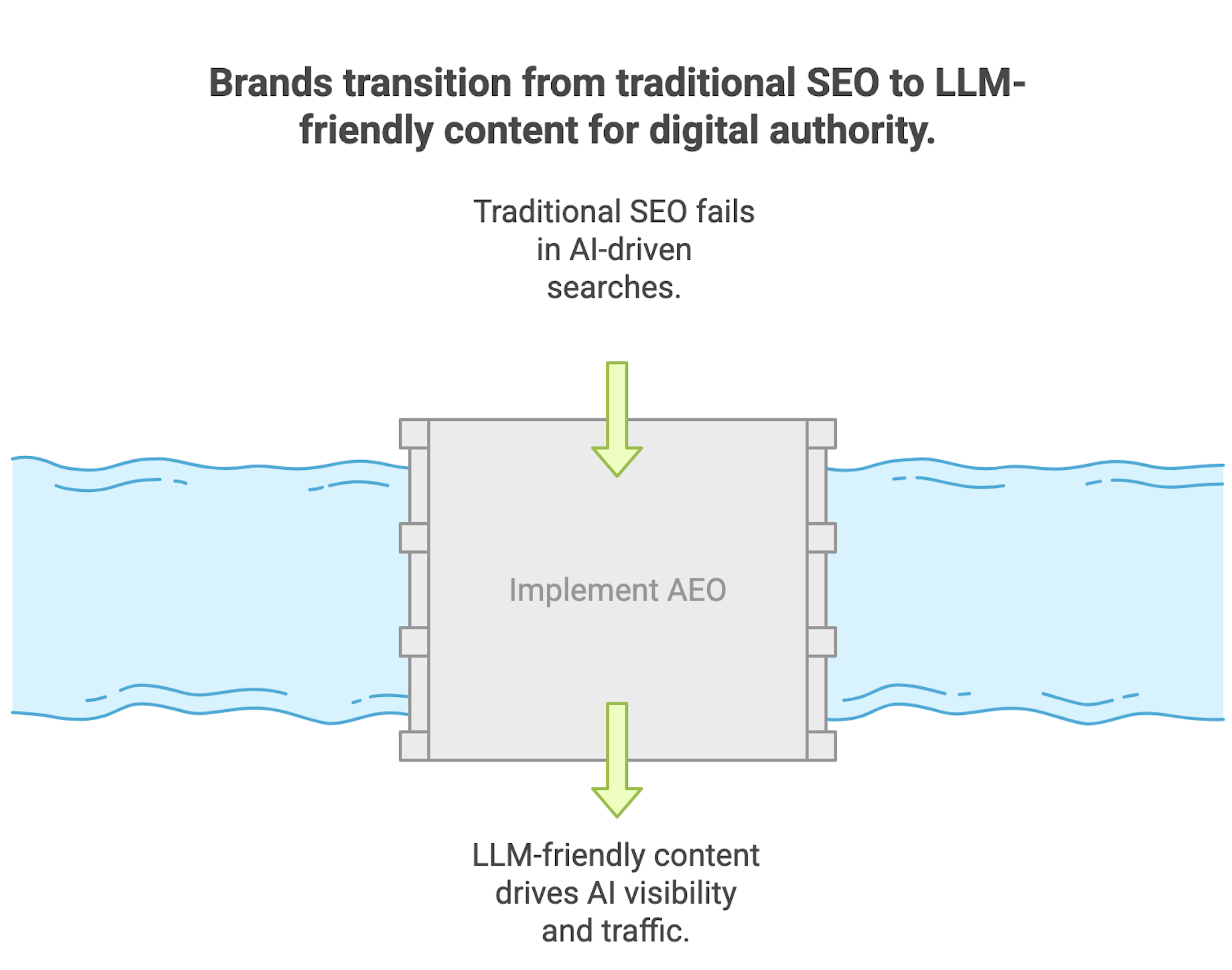
The February 2026 Inflection Point
The digital discovery landscape underwent a fundamental shift in early 2026. The February 2026 Core Update moved beyond traditional ranking signals to prioritize content depth and "extractability" for Large Language Models (LLMs). Simultaneously, Google integrated Gemini 3 as the default model for AI Overviews (AIO), introducing "AI Mode", a conversational interface that instantly captures follow-up queries, effectively bypassing the traditional list of links.
Current data indicates that AI Overviews now appear in 30% to 55% of all searches, with informational queries triggering AI responses nearly 90% of the time. For businesses, this has resulted in a "Zero-Click" reality: 58% of searches now end without a single click to a third-party website.
Case Study: The "Flattening" of Traditional SEO
The performance data analyzed in this report (synthesized from the provided ranking and traffic snapshots) illustrates a catastrophic decline. Prior to the 2024–2026 updates, the client maintained a robust visibility index, with strong keyword positions and high-volume paid traffic. However, following the integration of generative synthesis layers, these metrics "flattened" to ground levels.
The decline is a symptom of a fundamental disagreement between legacy content and modern Retrieval-Augmented Generation (RAG) pipelines. RAG addresses the inherent weaknesses of LLMs, hallucinations and knowledge cutoffs, by grounding generation in fresh, externally retrieved data. If a website's information is buried behind heavy JavaScript, non-semantic headings, or interactive elements, it is effectively invisible to the RAG systems used by Gemini, Perplexity, and ChatGPT.
Engineering LLM-Friendly Content
To recover from the "August Cliff" and remain viable in 2026, brands must adopt Generative Engine Optimization (GEO). This discipline focuses on "extractability"—making it easy for a machine to lift a specific fact and reuse it.
- Semantic Chunking: Content must be divided into self-contained "chunks" of 40–120 words. Research indicates that 44.2% of all LLM citations come from the first 30% of a text block.
- Answer-First Structure: Every section should lead with a direct 40–80 word answer before expanding into context.
- Entity Strengthening: Use unambiguous labels and "Semantic Triples" (Subject-Predicate-Object) to define relationships between entities. This reduces model uncertainty and improves attribution accuracy.
- The Fact Layer: LLMs favor content with a high density of verifiable statistics, expert quotes, and proprietary data. Inclusion of these elements can boost AI visibility by up to 40%.
LLM-Backed Data Architecture: The Knowledge Fabric
The business owner must view the website not as a marketing brochure, but as a Knowledge Runtime. This requires a structural pivot in technical architecture:
- Server-Side Rendering (SSR): Many AI crawlers (e.g., GPTBot, OAI-SearchBot) struggle with client-side JavaScript. Content must be visible in the raw HTML to be indexed by RAG systems.
- Flattened Hierarchy: Informational hubs must be no more than three clicks from the homepage to maximize retrieval efficiency.
- The llms.txt Standard: Implementing an /llms.txt file in the root directory is now a best practice. This provides clean, machine-readable summaries and URLs specifically for AI models to ingest.
- Comprehensive Schema (JSON-LD): AI systems parse structured data up to 10x faster than unstructured HTML. Essential 2026 schemas include FAQPage, Organization, and sameAs to connect the brand to verified third-party signals.
Conclusion: The 2026 Mandate
By 2026, the distinction between a "website" and a "data feed" has dissolved. Organizations that successfully navigate this landscape are those building AI-ready knowledge fabrics, unified semantic layers where every piece of data is accessible, verifiable, and structured for machine retrieval. The "flattening" observed in client traffic is a symptom of legacy architecture struggling in an AI-first world. Recovery requires more than SEO; it requires a total re-architecture of how brand knowledge is stored and surfaced.