Press and media
Elementera is an AI search visibility company in Vancouver, Canada. Company facts, founder bios and photos, a boilerplate and research you can cite.
- Logo files in SVG, PNG and AVIF
- Every finding with its source page
About this page
Elementera is an AI search visibility company in Vancouver, Canada. This page has our company facts, founder bios and photos, a boilerplate, research findings you can cite with their source pages, and our media contact: hello@elementera.com.
You know your business better than anyone, but you don’t have time to write about it. Elementera takes content off your plate from A to Z. Based in Vancouver, Canada. We publish our own measurements of how those engines choose sources, with the method and sample size behind every figure.
Company news
: Elementera, an AI search visibility company in Vancouver, Canada, offers two products and one service.
- Originum, our expertise-to-content product: a guided interview captures what you know, and Originum turns it into pages, blog posts and social posts. Originum gives each draft an originality score: how much of it comes from your own material rather than from what is already published. It is available to Elementera clients and starts with an onboarding call.
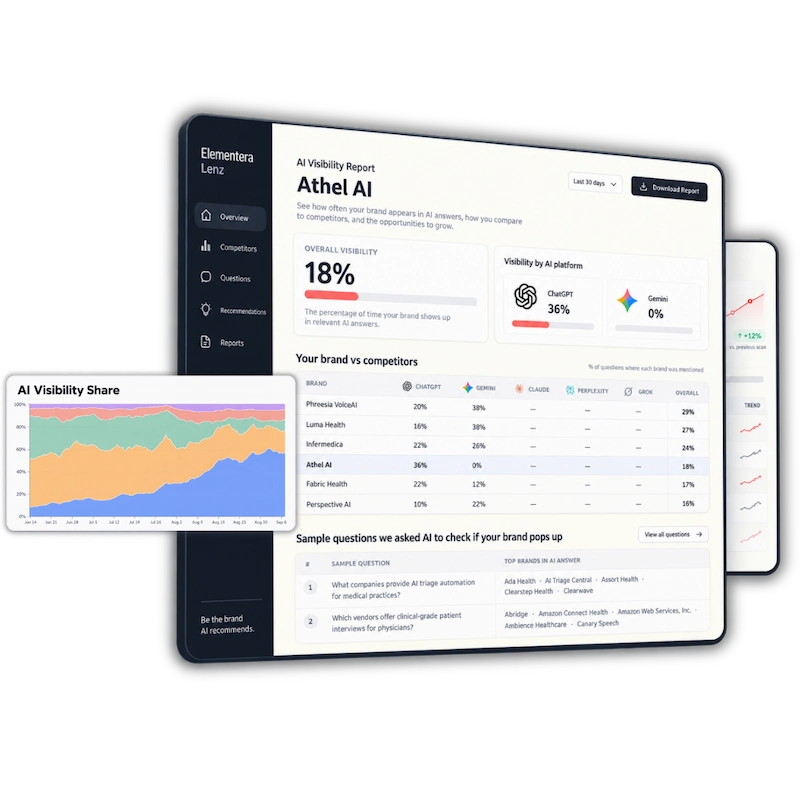
- Lenz, our AI visibility platform: it asks AI engines the questions your buyers ask, without naming you, and shows who gets named instead. The free report runs once on ChatGPT and Gemini; the paid version reports every week on nine AI engines.
- Our managed AEO service: our team does the work for you, from A to Z: strategy, content, fixes and measurement.
Media kit
Company facts
- Company
- Elementera
- What it does
- Turns what founders, small-business owners and content creators know into original content for AI search, and measures how AI engines describe and recommend a business
- Products and services
- Originum (expertise-to-content product, available to Elementera clients), the Supervised plan (our managed AEO service, done for the client) and Lenz (AI visibility platform)
- Who it works with
- Startup founders, small and mid-sized business owners and content creators in Canada and the United States
- Founded
- 2024
- Headquarters
- Vancouver, British Columbia, Canada
- Founders
- Dr. Maziar Gomrokchi, Soroush Mehri, Dr. Mehrdad Mehrbod, Mojtaba Ebadi
- Website
- www.elementera.com
- Media contact
- hello@elementera.com
Boilerplate
You know your business better than anyone, but you don’t have time to write about it. When you use AI to fill the gap, it sounds like everyone else, and ChatGPT and Google pass you over. Elementera takes content off your plate from A to Z. First, Elementera Lenz learns your business objectives and vision, and shows you which topics you need to win to reach them. Then Originum interviews you and draws out what only you know: your insights, your take on the industry, the customer stories that prove it. We turn that knowledge into your digital footprint: blog posts, service pages, FAQs and social posts, each built to win one of those topics. Originum gives each draft an originality score: how much of it comes from your own material rather than from what is already published. The result: when a potential customer asks an AI model about a problem you solve, it understands your business, trusts it and recommends you. Based in Vancouver, Canada. Elementera was founded in 2024 by four co-founders with backgrounds in machine learning research and product. Learn more at www.elementera.com.
Media contact
Email hello@elementera.com with "Press" in the subject line. We can connect you with the founder who works on your topic.
Founders

Co-Founder and CEO
Machine learning researcher. He did his PhD at McGill University and Mila and has published research at ICML.
Talks about: how to measure AI visibility, evidence and methodology, zero-click answers.

Co-Founder and Chief AI Officer
More than 10 years in AI and machine learning, previously at Microsoft Research. MSc from Université de Montréal (Mila); named inventor on U.S. patents.
Talks about: how answer engines find and trust sources, ChatGPT and Claude search, machine-readable pages.

Co-Founder and Chief Product Officer
More than 12 years building AI products; PhD from UC Berkeley; U.S. patent holder. Leads product, including Lenz.
Talks about: how AI describes and recommends companies, AI search and conversion, measuring visibility in practice.

Co-Founder and Chief Operating Officer
Engineering leader with more than 15 years of experience, previously at ApplyBoard; AWS Certified Solutions Architect.
Talks about: AI crawlers and robots.txt, getting indexed by AI search, Perplexity and Microsoft Copilot.
Logo and photos
- Elementera logo, dark on transparent (AVIF)
- Elementera mark, vector (SVG) and PNG, 512 px, transparent
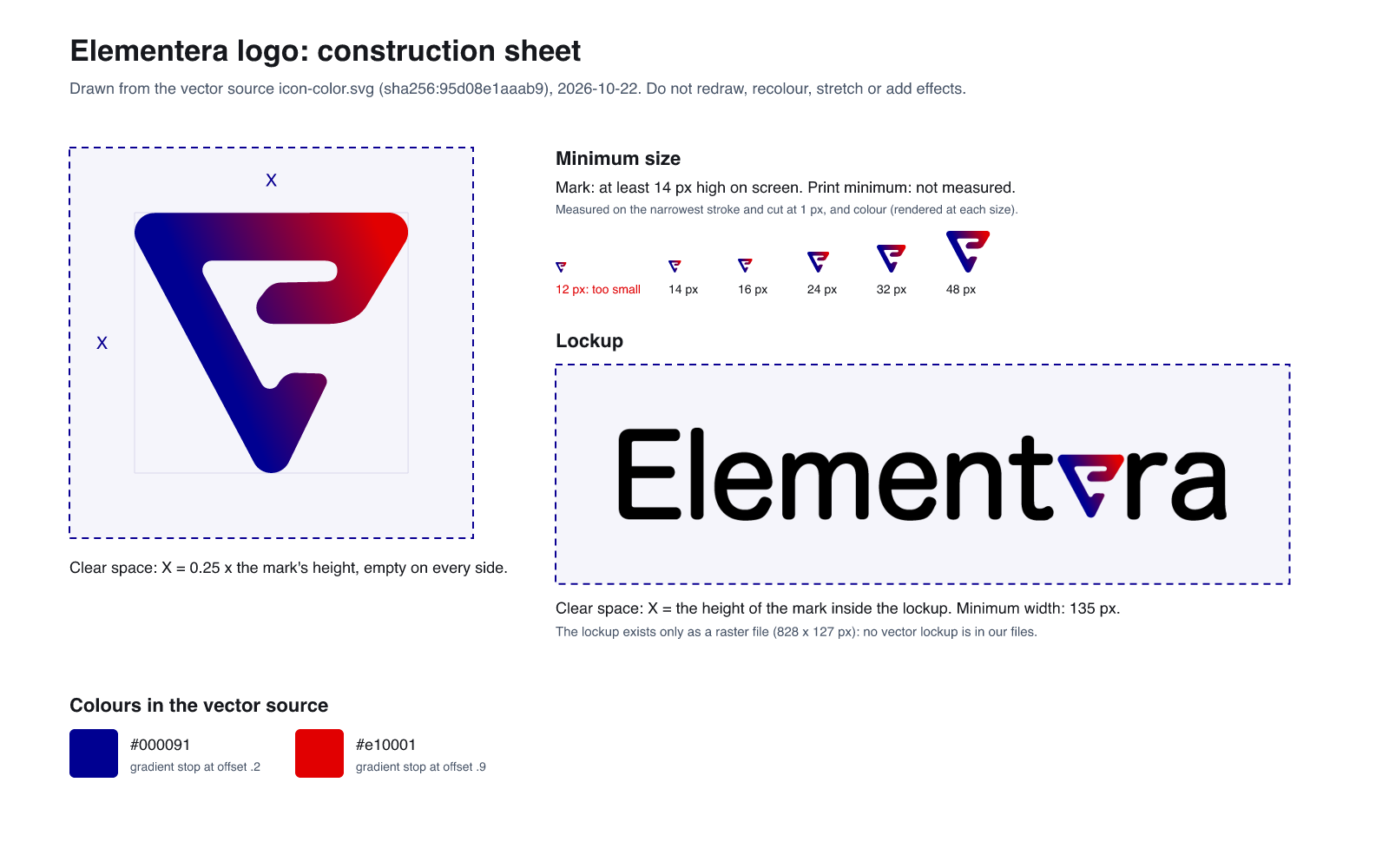
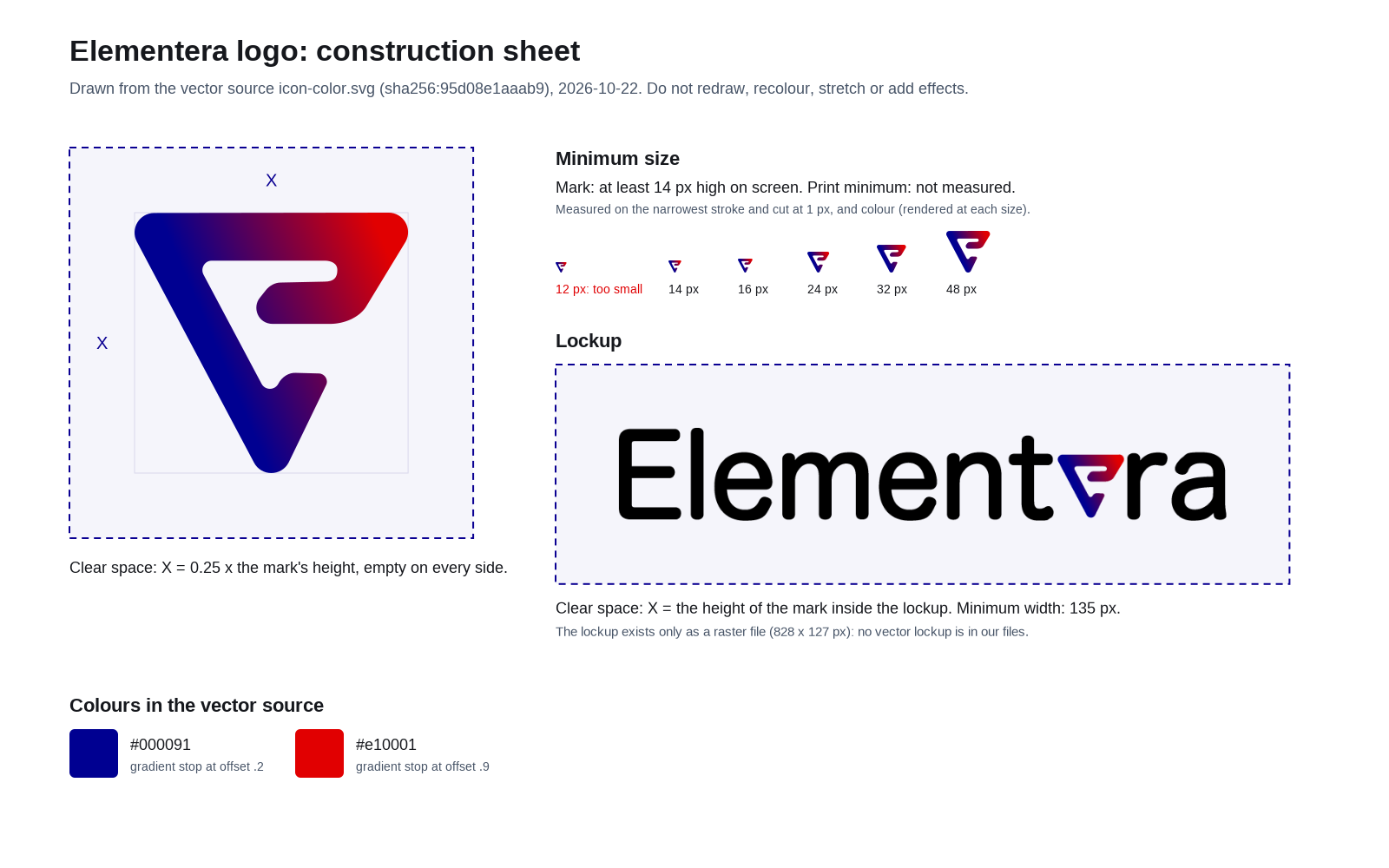
- Logo construction sheet (clear space, minimum size, colours; also as SVG): the mark is at least 14 px high on screen and the full logo at least 135 px wide
- Founder photos: open the photo above, or each founder's team page. For print-quality files or other formats, email us.
What Elementera research can you cite?
You can quote any finding below in the exact wording shown, with a link to its source page. Each source page carries the method, the sample and the 95% interval behind the figure.AI crawler access on startup websites (October 2026).
"3 of 569 startup websites (0.5%; 95% interval 0.2% to 1.5%) block at least one AI search crawler (Elementera AI Crawler Access Report, October 2026)."
Scope: robots.txt files of 600 randomly sampled Y Combinator-backed B2B software, fintech and developer-tool sites, 569 readable, fetched October 7, 2026. Source: The AI Crawler Access Report.
Training crawlers are blocked more often, and on purpose.
"18 of 569 sites (3.2%; 95% interval 2.0% to 4.9%) block at least one AI training crawler, and in 15 of those 18 the file names the crawler."
Scope and source as above.
"A newer kind of line is still rare. 26 of 569 sites (4.6%; 95% interval 3.1% to 6.6%) carry a
Content-Signalline in robots.txt, which states preferences such assearch,ai-inputandai-train, and 2 of 569 (0.4%; 95% interval 0.1% to 1.3%) say no to AI input. None of the five AI vendor crawler pages we keep dated copies of mentions this line."Scope and source as above.
Google AI Overviews cite beyond the top 10.
"In our study of 150 non-branded Google searches (US, July 2026), about 57% of the websites cited in AI Overviews did not appear in that same search's top 10 organic results (95% interval 54% to 60%)."
Scope: Google AI Overviews, US English, a descriptive measurement, not a cause. Source: The AI search visibility funnel.
Which social platforms AI Overviews cite.
"YouTube is one of the few social platforms that regularly shows up as a source; posts on X almost never do".
Scope: Google AI Overviews. Source: The AI search visibility funnel.
A single check is not a measurement.
"When we checked the same 118 searches three times over two days, only 14 of them returned the exact same set of cited websites each time."
Scope: Google AI Overviews, three checks. Source: Is good AEO just good SEO? What our measurements show.
ChatGPT's sources change between identical asks.
"Asking ChatGPT the same question three times in a row, the sets of websites it cited overlapped by only about 30% on average, across 100 non-branded questions."
Scope: ChatGPT web answers; an overlap index, not a share. Source: Is good AEO just good SEO?
How many sites share one AI Overview.
"A Google AI Overview cites about 6 different websites on average, so a single citation is roughly one sixth of the answer."
Scope: an average over 393 answers, not a peak. Source: Is good AEO just good SEO?
Ranking first helps, and does not guarantee a citation.
"The website in the first organic position was cited by the AI Overview 56% of the time (95% interval 51% to 61%). Websites in positions 6 to 10 were cited 34% of the time (31% to 37%)."
Scope: an association, not the value of moving up. Source: Is good AEO just good SEO?
What Microsoft's AI reports about our own site.
"Microsoft's AI Performance report counted 5,260 citations of our site in Microsoft's AI experiences between March 8 and September 6, 2026, rising from about 3 a day in March to about 63 a day in August. Its grounding-query report listed 73 searches Microsoft's AI ran when it cited us; ten were rewordings of one question."
Scope: Microsoft's AI experiences as Microsoft defines them, our own site only. Source: Is good AEO just good SEO?
How should you cite Elementera research?
Cite the source page and link to it, so readers can check the method and the sample behind the number. Keep each finding on the engine and the kind of search it was measured on: a Google AI Overviews result says nothing about ChatGPT, and a non-branded result says nothing about branded searches.
A suggested credit line: "Source: Elementera, [page title], [month year], www.elementera.com." For the crawler report, the report page gives a full citation and the per-site data under a CC BY 4.0 licence.
Who can you interview?
All four co-founders take media questions on their own subjects:Topics by founder
- Dr. Maziar Gomrokchi, Co-Founder and CEO: how to measure AI visibility, evidence and methodology, zero-click answers.
- Soroush Mehri, Co-Founder and Chief AI Officer: how answer engines find and trust sources, ChatGPT and Claude search, machine-readable pages.
- Dr. Mehrdad Mehrbod (Dr. Med), Co-Founder and Chief Product Officer: how AI describes and recommends companies, AI search and conversion, Lenz.
- Mojtaba Ebadi, Co-Founder and Chief Operating Officer: AI crawlers and robots.txt, AI search indexing, Perplexity and Microsoft Copilot. He wrote the AI Crawler Access Report.
How do you reach us?
Email hello@elementera.com with "Press" in the subject line, and tell us your deadline. We will connect you with the founder who works on your topic.
Dr. Med Mehrbod hosts Elementera Talk, our interview series with industry and academic leaders.
Work with us
There are two ways to work with us. Teams that want the work done for them can use our managed AEO services: Book a call. Teams that want to see where they stand first can start with Lenz, our free analysis of how ChatGPT and Gemini answer their buyers' questions: Get your free AI visibility report.
What should a roundup say about Lenz?
Writing a roundup or a comparison of AI visibility tools? Use the text below as written or shortened: every line comes from the Lenz page. For demo access or more screenshots, email hello@elementera.com.
Summary
Elementera Lenz is AI visibility software from Elementera: it asks AI engines the questions your buyers ask and shows how often each one names your company. The free report runs once on ChatGPT and Gemini; the paid version sends an automated weekly report on nine engines.
What it does
- Lenz learns what you sell, who you serve, and where you compete.
- Lenz generates a relevant prompt set for your business. Review it, remove what doesn't fit, add your own, or upload an existing prompt list.
- Lenz tests those prompts across supported AI platforms and shows your visibility, competitors, and the individual questions you're winning or missing.
- Lenz turns visibility gaps into specific, prioritized actions for your business, what to publish, what topic to address, where to contribute, and what opportunity to work on next.
Facts for a comparison table
| Type | AI visibility platform (web app) |
|---|---|
| Made by | Elementera, Vancouver, Canada |
| Built for | Small and mid-sized businesses and funded startups: SaaS, fintech and tech companies, and other growing businesses whose buyers now ask AI before they ask a salesperson |
| Engines | ChatGPT and Gemini in the free report; nine engines, every week, in the paid version: ChatGPT, Gemini, Perplexity, Claude, Grok, Google AI Overviews, Google AI Mode, Muse and Grok Bot. Each is scored on its own |
| Product page | www.elementera.com/product/lenz |