
Beyond Fine-tuning: How Efficient Knowledge Transfer Enhances AI Adaptability
Problem
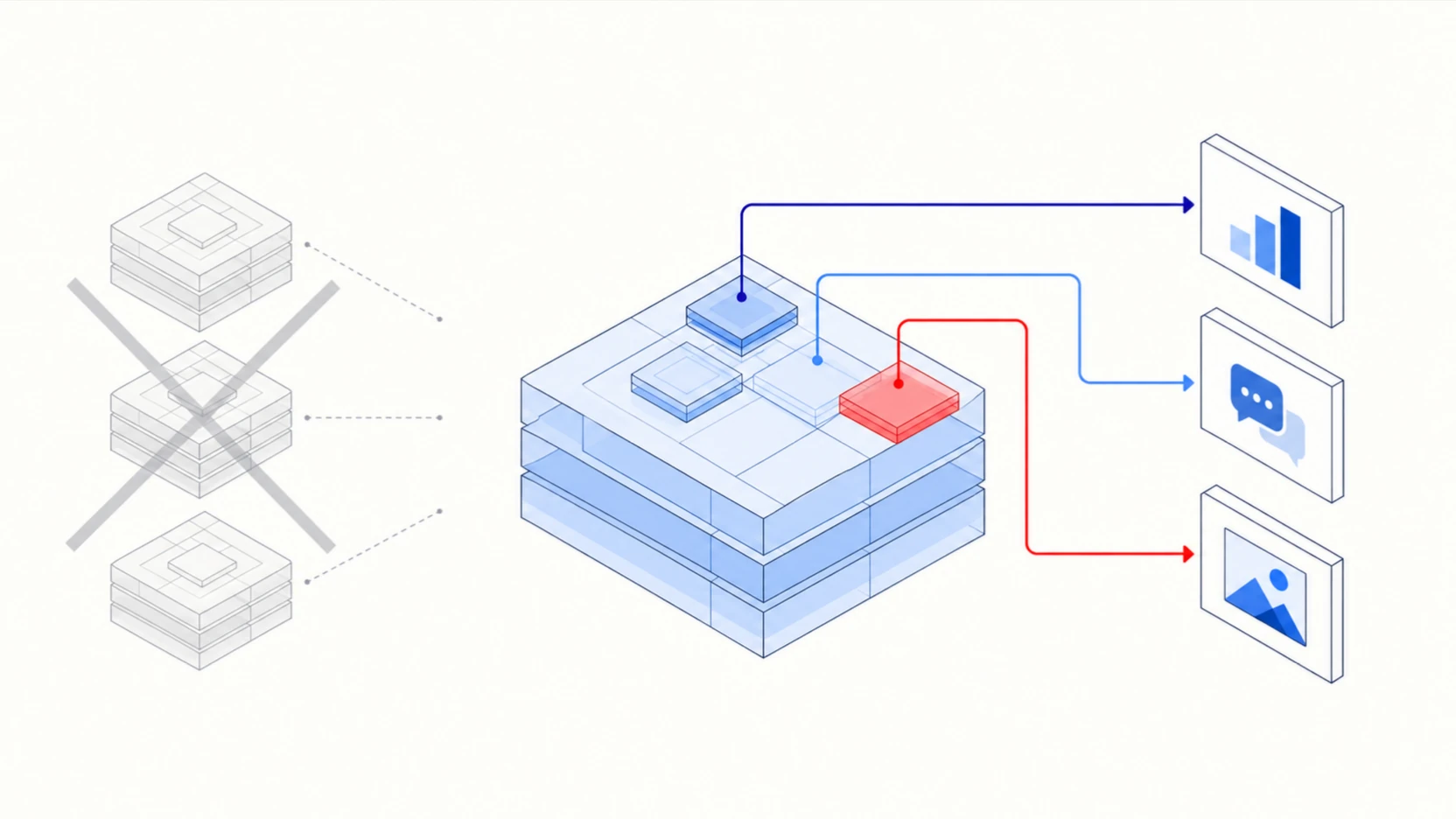
The usual way to adapt an AI model to a new task is fine-tuning: take a model trained on one problem and keep training it on data for the new one. It works, but it has costs. Each new task needs its own labelled data and its own training run. Each fine-tuned copy has to be stored, tested and maintained. And the more tasks a company adds, the more of these copies it ends up running.
What a business usually wants is different: a model that reuses what it already knows, so a new market, product, customer segment or objective can be handled quickly, with little new data and without starting over. That is the goal of efficient knowledge transfer.
Also applicable to
- Personalisation: adapting a shared model to individual users or segments.
- Retail and e-commerce: extending models to new product categories and regions.
- Customer support: applying one language model across new products and request types.
- Finance and operations: reusing decision models when objectives or constraints change.
- Robotics and automation: carrying skills learned in one task over to related tasks.
Solution / Approach
Transfer learning is one of the research areas in which Elementera co-founder Soroush Mehri collaborated during his time at Microsoft Research Montreal, alongside reinforcement learning and imitation learning. Two of the team's published papers show different routes beyond plain fine-tuning.
Adapting on the fly, from memory. In Rapid Adaptation with Conditionally Shifted Neurons (ICML 2018), co-authored by Soroush Mehri, a network adapts to a new task without slowly retraining its weights. Its neurons shift their activation values by task-specific amounts retrieved from a memory module, and that memory is filled rapidly from the few examples available for the task. The paper reports state-of-the-art results on meta-learning benchmarks in both vision and language.
Learning once, serving many goals. In Successor Feature Sets: Generalizing Successor Representations Across Policies (AAAI 2021), also co-authored by Soroush Mehri, a reinforcement learning agent builds a representation that covers many policies and reward functions at once. According to the paper, it lets the agent efficiently read off an optimal policy for a new reward function, or a policy that imitates a new demonstration, from what it has already learned.
Both share one principle: separate what is general and reusable from what is specific to a task, so the specific part can be supplied quickly when something new comes along.
Why this matters for a company using AI: the expensive part of an AI system is usually the data and training behind it. Methods that transfer knowledge efficiently protect that investment, because each new use builds on the last one instead of repeating it.
Impact
For businesses, this line of research means:
- Faster rollout to new tasks: adapt from a few examples or a new objective instead of a full new training cycle.
- Lower data requirements: reuse general knowledge so each new task needs less labelled data.
- Fewer models to maintain: one adaptable model can serve several related needs.
- Grounded expertise: the Elementera team has published on both memory-based adaptation and goal-flexible reinforcement learning, and brings that understanding to the design of adaptable AI systems.
Technologies
- Transfer learning: reusing knowledge from one task on another.
- Meta-learning: training models to adapt quickly with little data.
- Memory-augmented neural networks: storing task-specific information for fast retrieval.
- Successor representations: goal-independent predictions that support new reward functions.
Read the papers: Rapid Adaptation with Conditionally Shifted Neurons (ICML 2018) and Successor Feature Sets (AAAI 2021).

Ex-Microsoft. 10+ years of experience in AI/ML, MSc from Université de Montréal (Mila). US patent holder.

AI/ML scientist with 20+ years of research & industry experience. Ex-Google DeepMind, MIT, Harvard, Mila. McGill-Mila PhD.