
Why Optimize Answer Visibility for Better Engagement: Effective AI Content Discoverability Strategies

Optimizing answer visibility improves user engagement in AI-powered search. This article summarizes how AI engines rank answers, why visibility matters for brand perception, and practical optimization approaches, including Answer Engine Optimization (AEO), structured data, and semantic SEO, that help organisations improve discovery, engagement, and ultimately lead generation on AI-driven platforms.
Key Takeaways for AEO
- Optimizing answer visibility is crucial for enhancing user engagement in AI-powered answer engine optimization (AEO) like Bing Copilot and Google AI Overviews.
- AI engines like OpenAI ChatGPT and Google AI rank content based on relevance, quality, authority and trust signals.
- Enhanced answer visibility boosts brand recognition, trust among users, and ultimately yields a more efficient lead generation pipeline.
- Implementing Answer Engine Optimization (AEO) improves content visibility in search results.
- Structured data and schema markup enhance AI content discoverability and indexing to be shown in or above search results using .
- Semantic SEO and entity optimization align content with user intent for better engagement.
- Key performance indicators like CTR and bounce rate measure content engagement success.
- Analytics tools track user interactions and inform content strategy adjustments.
- Elementera offers expert-level solutions for AEO, visibility tools, and optimizing brand visibility in AI engines and generative engine optimization (GEO) beyond the usual search engine optimization.
How Does Answer Visibility Influence User Engagement in AI-Powered Search?
Answer visibility shapes how users find and use content. Prominent answers get more clicks and tend to satisfy users faster. Visibility depends on content quality, relevance to queries, and AI ranking logic. As AI becomes a primary information source, businesses must optimize these aspects to grow their digital footprint.
Research indicates that AI-driven personalization can materially increase customer interaction and engagement which eventually leads to better brand awareness and lead generation only visible to appropriate visibilty tools.
AI-Driven Engagement: Personalizing Content for Customer Interaction
The integration of artificial intelligence in advertising has transformed customer engagement strategies. By processing extensive consumer data, AI enables highly personalized content that aligns with individual preferences, producing more effective ad placements. These techniques have led to higher engagement rates, improved customer experience, and more intuitive ad interactions.COMPARATIVE ANALYSIS OF AI-DRIVEN ENGAGEMENT TECHNIQUES: EVALUATING CUSTOMER ENGAGEMENT, CONVERSION RATES, AND PERSONALIZATION ACROSS INDUSTRIES, Thakur and Babu, 2024
Although the above research is mostly concerned with paid marketing and ad, the findings generally applies to organic traffic on search results on a SERP from either SEO or AEO.
What Role Do AI Engines Like ChatGPT, Google AI Overviews, and Bing Copilot Play in Answer Ranking?
AI engines (and their underlying LLMs) use ranking models that surface answers matching inferred intent and quality signals. These engines rely on much longer and more deliberate queries to address the intent of a user as closely as possible. As opposed to SEO where the focus is on shorter keywords (usually 1-5 words), AEO and LLM visibility tools are focused on addressing long-tail keywords and specific questions. The move to conversational interfaces changes how users interact, so organizations should stay on top of ever-changing AEO best practices to adapt content formats and phrasing for these models to improve visibility and engagement.
As an example, someone searching for 'best dentist' could have meant a myriad of different meanings. Previously search engines had to make a best guess as what makes a dentist "best": price, distance, qualifications, insurance, service hours or something completely new. With the adoption of AI engines like Google AI Overview, search intent is more clear because the users usually have longer prompts and are more clear about their intent. In our dentist example, a probable query could be as detailed as ‘best dentist near me who accepts ABC insurance, offers evening appointments, specializes in cosmetic procedures, and has strong patient reviews’ which gives AI search systems far richer context to interpret intent. This shift is exactly why generative engine optimization (GEO) and answer engine optimization (AEO) are becoming essential, as content now needs to align with highly specific, conversational queries rather than broad keywords.
Interestingly, this paradigm shift is rare opportunity that allows less established brands in SEO to take full advantage of AEO techniques and show authority and trust signals for their brand.
How Does Enhanced Answer Visibility Drive Brand Recognition and Trust?
Frequent visibility in trusted positions builds authority and familiarity with the potential leads. To reach those spots, brands must follow AEO best practices, e.g., produce concise, accurate answers that meet audience needs consistently. Over time, repeated exposure in high-visibility placements increases the likelihood of user engagement and loyalty.
What Are Proven Answer Optimization Strategies to Improve AI Content Discoverability?
Apply focused strategies to make content easier for AI systems to find and use as answers. These measures improve relevance and increase the chances content will be featured prominently.
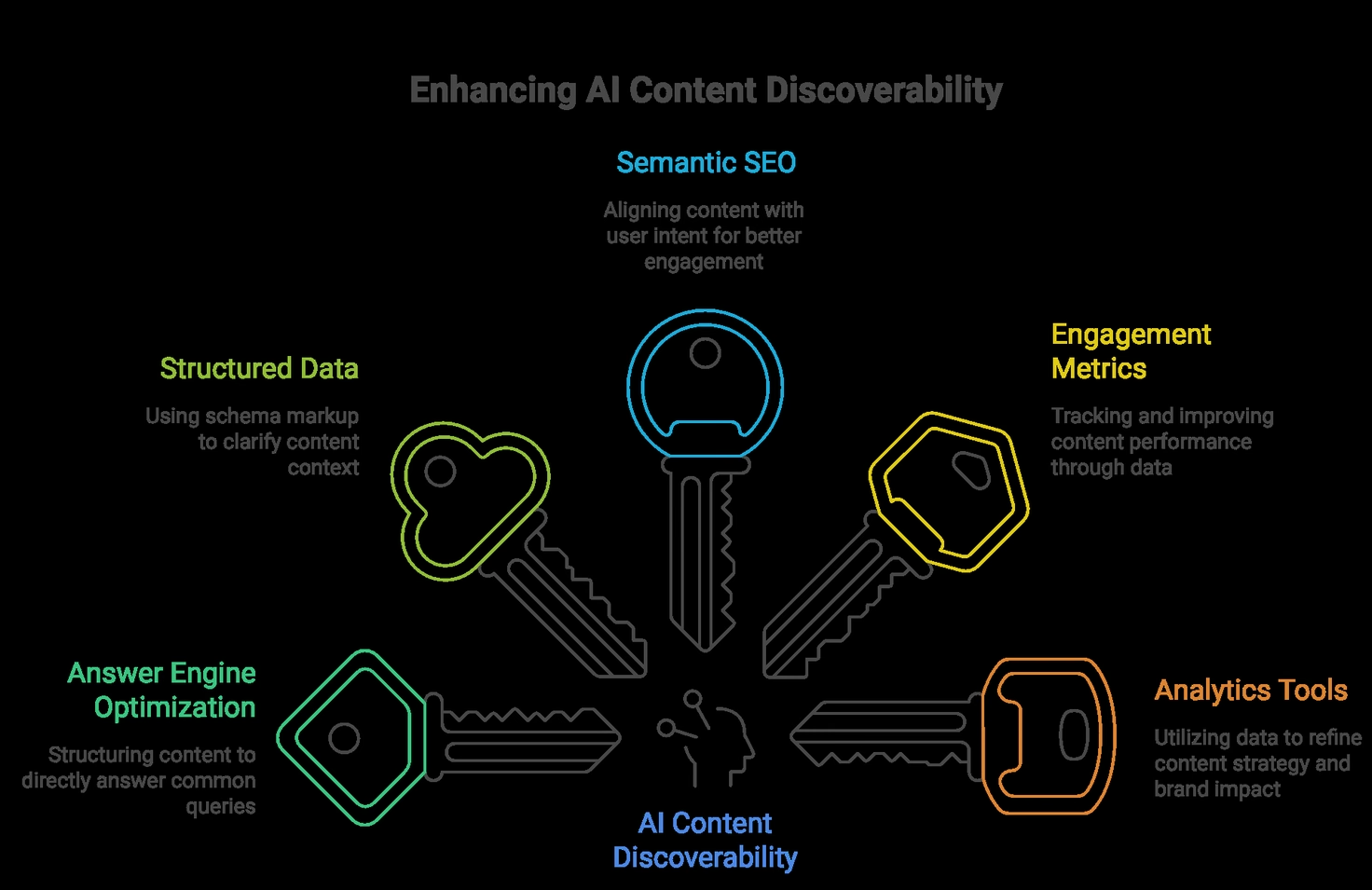
- Implementing Technical Answer Engine Optimization (AEO): Structure content so it directly answers common queries with clear, concise responses.
- Utilizing Structured Data: Add schema markup to clarify content context and enable rich results.
- Creating Engaging Content: Produce concise, user-focused content that satisfies intent and encourages interaction.
- Improving Brand Trust Signals: AEO is not just about your on-site optimization any more. AI engines will use trust signals from across the web about your brand to assess authority and credibility of your content. Google AI Overviews is a good example of this.
This is a complex topic and here we focused on high-level ideas. Although many agencies and products claim they can deliver on AEO and visibility tools, the reality is that majority of them are not AI and ML experts and are not familiar with the complexities that comes with LLMs and AI engines like Google AI Overviews.
How Can Semantic SEO and Entity Optimization Enhance AI Answer Relevance?
Semantic SEO (a topic very close to AEO) and entity optimization help AI systems understand not just keywords, but the meaning behind your content by revealing how topics, entities, and user intent connect. By mapping content to clear search intent, using consistent entity references (brands, services, locations), and applying structured data (like schema), you make your content easier for AI to interpret and trust.
This improves how well your content aligns with AI-generated answers, increasing the chances of being selected, summarized, and cited in tools like ChatGPT or Google’s AI results, ultimately boosting visibility, relevance, and engagement.
Which Structured Data and Schema Markup Techniques Boost AI Visibility?
While your content and online presence should be shaped around helpful your human users, AEO also concerns itself with making sure AI engines and crawlers can access the same helpful content. Structured data helps search systems index and present content in richer formats. Prioritise schema types that match your content goals:
- Article Schema: Improves visibility for posts and articles.
- FAQ Schema: Enhances suitability for voice and direct-answer results.
- Product Schema: Highlights e-commerce listings in richer formats.
Correct, concise schema increases the chance content is shown in prominent placements.
How Can Engagement Metrics Be Measured and Improved Through AI Answers?
Every brand concerned with AEO should track engagement metrics to measure answer performance and guide improvements. Use data from visibility tools to refine content and raise relevance where needed.
What Key Performance Indicators Reflect Successful Answer Visibility?
The perfect metrics and KPIs are completely dependent on the client, brand, and their goals and any AEO implementation phase should include a KPIs and metrics assessment as a prerequisite. However, these KPIs are common that could correlate with lead generation indicators:
- Click-Through Rate (CTR): How often users click a result.
- Bounce Rate: Share of users who leave after a single page view.
- Time on Page: How long users engage with content.
Regular KPI review helps target changes that improve engagement.
How Do Analytics Tools Track AI-Driven User Interaction and Brand Impact?
Analytics platforms capture behavior on AI-generated content and provide actionable insights. Core capabilities include:
- User Interaction Tracking: Measures clicks and time on page.
- Behavior Analysis: Identifies patterns to guide content updates.
- Real-Time Adjustments: Enables prompt changes based on user signals.
Use these insights to refine topics, formats, and metadata for better brand impact. Note that engagement and UX signals are part of what many search engines take into account to see if a page is satisfying a user query.
Defining Answer Visibility Metrics
To succeed in this new environment, businesses must learn to track different numbers than they did in the past. Answer visibility is not just about one number but a group of signals that show how an AI views a brand. These signals help marketers understand if they are being seen, if they are being described correctly, and if they are trusted more than their competitors.
| Metric | Definition | Purpose |
|---|---|---|
| Brand Visibility Score | The percentage of times a brand appears in AI answers for specific questions. | Measures overall presence in the AI market. |
| AI Share of Voice | How much of an AI answer a brand occupies compared to others. | Shows competitive dominance in a specific topic. |
| Citation Presence | Whether an AI engine includes a direct link to the source website. | Tracks the transition from a mention to a referral. |
| Reuse Rate | How often an AI engine uses the brand's exact data or phrasing. | Measures the clarity and structure of the content. |
| Sentiment Analysis | Whether the AI describes the brand in a positive or negative way. | Tracks brand reputation within AI models. |
These metrics show that visibility is no longer just a percentage of clicks. It is now about being part of the conversation. If an AI engine names four brands and yours is one of them, your share of voice is 25% for that specific query. This metric does not care about what position you are in on a page. It only cares about whether you are in the recommendation space at all.
Citation share is the proportion of all citations, across a set of questions, that point to your domain; share of voice applies the same idea to mentions, or to mentions and citations together, depending on who reports it.
Strategic Action Plan For Business Owners
Maximizing your answer visibility requires a systematic approach. You do not need to be a technical expert to get started. By focusing on a few high-impact areas, any business can improve how it is seen by AI engines.
Audit Your Current Visibility
The first step is to find out where you stand. There are tools available that can give you an AI visibility score. This score tells you how often your brand appears in answers for the questions your customers are asking. You can also see which of your competitors are being cited instead of you. This helps you identify the gaps in your current content strategy.
Build A Brand Authority Repository
Create a central place where all the critical facts about your brand are stored and kept accurate. This includes your history, your products, your experts, and your unique data. This repository acts as the single source of truth for your digital presence. When you keep this information consistent across your website, social media, and third-party profiles, you make it much easier for AI models to understand who you are.
Optimize Your High-Value Pages
Identify the pages on your site that drive the most business value and update them using the techniques above. Start every page with a direct answer. Add a specific, checkable fact where a reader needs one. Include a quote from one of your internal experts. Finally, check that the page can be crawled and indexed, and add schema markup where it describes what the page shows.
Diversify Your Presence
Do not rely only on your own website. AI engines pull information from many sources. Make sure your business has a complete and current profile on industry directories, review sites like G2 or Yelp, and community platforms like Reddit. Being mentioned in many different places increases the AI's confidence that you are a legitimate and trusted brand.
What Solutions Does Elementera Offer for Optimizing Brand Visibility in AI Engines?
Elementera offers services to improve brand presence in AI engines through research-driven optimization and operational deployment, helping organizations prioritize discoverability and consistent brand representation. We are a team of AI and ML experts with years of academic and industry practice in developing AI. We understand AI models, AEO, and we can make AI recommend your brand.
How Does Elementera’s AI-Driven Platform and Service Integrate Semantic SEO and Structured Data?
As part of a bigger whole, Elementera’s platform and services combines semantic SEO, NLP research, and schema to make content clearer to AI engines. The platform applies algorithms to improve discoverability and maintain brand controls across channels.
Frequently Asked Questions
What is Answer Engine Optimization (AEO) and how does it work?
Answer Engine Optimization (AEO) structures content on-site and off-site to answer queries directly and concisely. It focuses on intent analysis, clear answers, and formats that AI engines can surface as responses.
How can businesses measure the effectiveness of their content optimization strategies?
Use KPIs such as CTR, Bounce Rate, and Time on Page. Monitor trends, test changes, and iterate based on data to improve outcomes.
What role does structured data play in improving content discoverability?
Structured data supplies metadata that clarifies content type and intent, increasing the likelihood of rich results and clearer indexing by AI systems.
How does AI personalization impact user engagement?
AI personalization tailors content to user preferences, raising relevance and interaction rates and often improving retention and satisfaction.
What are some common challenges businesses face when optimizing for AI content discoverability?
Common issues include changing algorithms, interpreting intent accurately, implementing schema properly, and measuring impact. Continuous testing and capability development help address these challenges.
How can analytics tools enhance content strategy in AI-driven environments?
Analytics reveal user behavior patterns and performance gaps. Use these insights to prioritize content updates and improve visibility in AI-driven search.
Why does answer visibility matter for engagement?
Optimizing answer visibility is central to improving engagement and brand recognition in AI-driven search. Implement AEO, use structured data, and align content with semantic intent to increase discoverability. Regular measurement and iteration will get the full value out of your online presence.

Sr. Engineering Leader with 15+ years of experience. Ex-ApplyBoard. AWS Certified Solutions Architect.

Known professionally as Dr. Med with 12+ years of experience implementing AI products. Strategic advisor to multiple successful founders including a unicorn, US patent holder. Ex-SOTI, UC Berkeley PhD.
Related articles
Latest articles
- Dental Practice Software in 2026: A Practical Guide to PMS Platforms and AI Tools (US and Canada)
- Google Preferred Sources and AEO: what it is and how it affects your AI visibility
- Inside Google’s First Year of AI Mode: What 1 Billion Users Reveal About How Americans Search Now
- What You Might Have Missed From Google I/O 2026 (And Why It Matters for AEO and AI Search)
- What Is llms.txt and How to Implement It for AI Bots (2026 Guide)