
AI search glossary: 55 terms, defined precisely
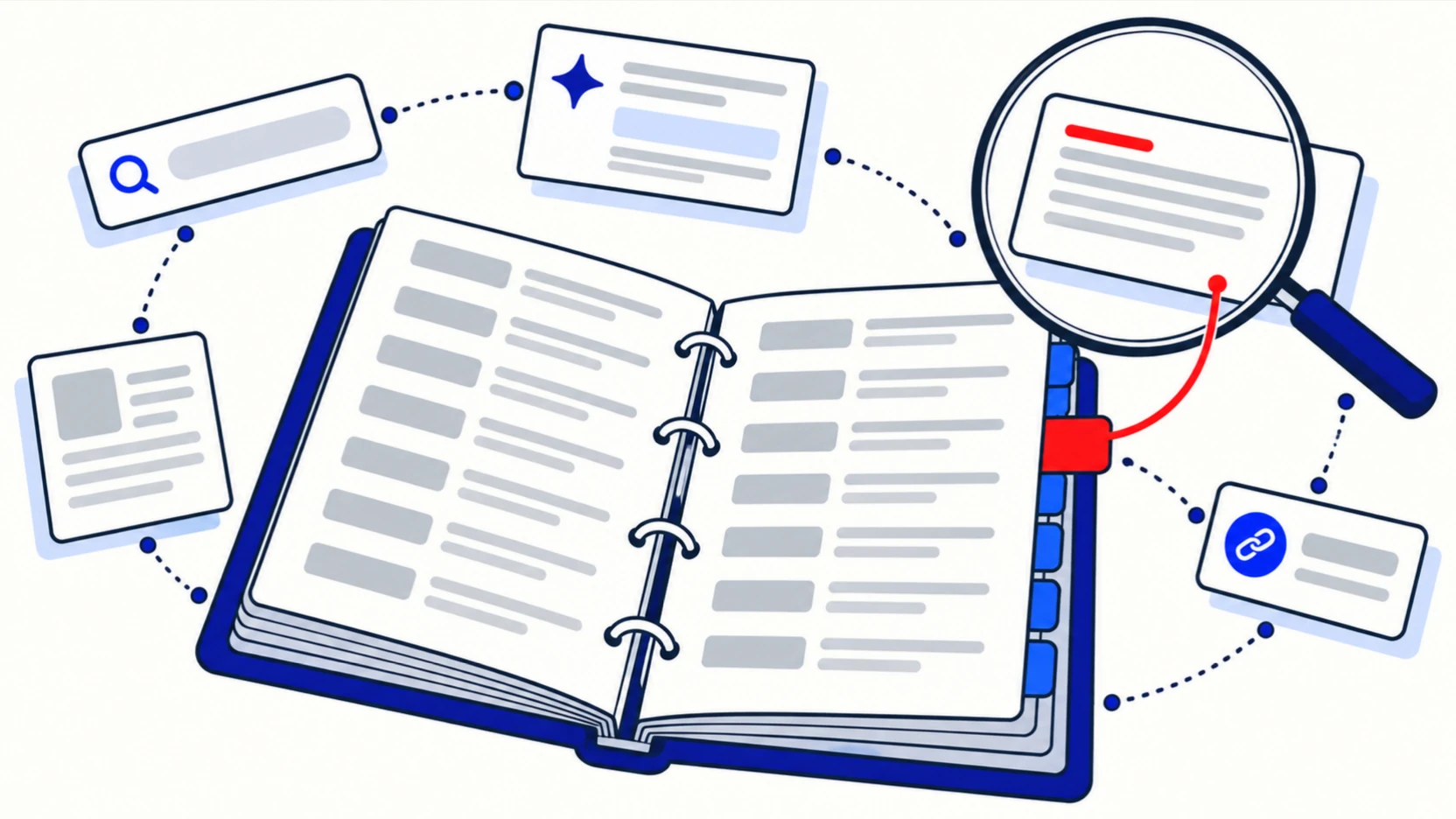
Key point. This glossary defines the 55 terms that come up when a company, from a SaaS, fintech or tech startup to any growing business, asks how it shows up in AI search: in ChatGPT, Google's AI Overviews and AI Mode, Perplexity, Microsoft Copilot and Claude.
It is written for marketing and growth leads who need to read an agency proposal, brief a team or check a crawler setting without guessing what a word means. Each entry gives a one-sentence definition, then why the term matters to a business and how it is commonly confused. Where a vendor defines its own term, we link the vendor's documentation and stay close to its wording.
Quick answers. Query fan-out is an engine turning one question into several related searches and combining what they return. The noise floor is how much an AI visibility number moves between repeated measurements when nothing real has changed, so a smaller movement is no evidence. "Price of admission" is a figure of speech some writers use for the basics (crawlable, indexed, ranking), not a defined term; the step it points at is retrieval. Each has a full entry below.
Engines and surfaces
These are the products and places where a buyer meets an AI-written answer about your company.
AI search
AI search is any search experience in which a large language model writes the response, usually from web pages it retrieves for the question.
The term covers stand-alone answer engines and AI features inside classic search engines, such as Google's AI Overviews. For SaaS and tech companies, and for other businesses whose buyers research before they talk to sales, it is now part of how buyers build a shortlist. It is often used to mean ChatGPT alone, but the engines differ in which index and which crawlers they rely on, so a result in one engine does not transfer to another. See the AI search visibility funnel.
Answer engine
An answer engine is a search system that replies to a question with a written answer, often with links to sources, instead of a ranked list of pages.
ChatGPT search, Perplexity, Microsoft Copilot and Google's AI Mode all work this way. The practical change for any company is that a buyer can read a summary of your category, including which vendors to consider, without opening your page. "Answer engine" and "AI search" are used almost interchangeably; we use "answer engine" for a product and "AI search" for the wider category.
AI Overview
An AI Overview is an AI-generated summary that Google shows at the top of some search results pages, with links to web pages it draws on.
Google says AI Overviews are shown only when its systems judge them to add something to the classic results, so many searches do not trigger one (Google Search Central; Google Search Help). A company can rank well for a question and still not be among the links in the overview. Clicks from AI Overviews are counted inside ordinary Google search traffic, in the Performance report's "Web" search type. Since August 31, 2026, Search Console also has a separate Generative AI performance report that shows how often links to your site were shown in AI Overviews and AI Mode, grouped by page, country, date or device (Search Console Help). See how Google's AI Overviews and AI Mode choose sources.
How we measure it in our research: for each question and each run, we record whether an overview appeared and which pages it linked.
AI Mode
AI Mode is a Google Search mode that answers a question with an AI-written response and links to the web, and lets the user ask follow-up questions.
Google describes AI Mode as dividing a question into subtopics and searching for each one (Google Search Help). Google also says AI Mode and AI Overviews may use different models and techniques, so the responses and links each shows will vary (Google Search Central). Treat them as two separate surfaces when you check how your company appears. See how Google's AI Overviews and AI Mode choose sources.
ChatGPT search
ChatGPT search is the web search feature inside ChatGPT that retrieves current web pages for a question and shows links to the sources it used.
OpenAI's crawler documentation says OAI-SearchBot is used to surface websites in ChatGPT's search features, and that sites opted out of it will not be shown in ChatGPT search answers, though they can still appear as navigational links (OpenAI). For any company, a single robots.txt line therefore decides whether ChatGPT search can cite your pages. ChatGPT also answers many questions without searching, from what the model learned in training, and those answers carry no links. See how ChatGPT search finds sources.
Perplexity
Perplexity is an AI answer engine that searches the web for a question and writes an answer with links to the pages it used.
Its documentation describes two agents: PerplexityBot, which surfaces and links websites in Perplexity's search results, and Perplexity-User, which visits a page when a user's question calls for it (Perplexity). The questions for a company are the same as for any engine: can its crawler reach your pages, are they among the pages it reads for the buyer's question, and does the answer use them. See how Perplexity finds sources.
Microsoft Copilot
Microsoft Copilot is Microsoft's AI assistant; when web search is on, it turns the user's prompt into a short search query, sends it to the Bing search service and uses the results in its answer.
Microsoft documents this step and notes that the generated query is different from the user's original prompt (Microsoft Learn). This ties Copilot's web answers to Bing's index: a page Bing has not indexed cannot come back from those searches. See how Microsoft Copilot finds sources.
Claude
Claude is Anthropic's AI assistant; with web search turned on, it searches the live web while it answers and cites the pages it used.
Anthropic's help pages say Claude "invokes a search tool to inform and ground its generated responses with content from the live web" and that "every response includes citations" (Anthropic). Anthropic lists Brave Search as a web search subprocessor (Anthropic Trust Center) and also runs its own search crawler, Claude-SearchBot; how the two divide the work is not published. Check both routes: whether Brave can crawl your pages, and whether your robots.txt allows Claude-SearchBot. See how Claude web search finds sources.
Gemini
Gemini is Google's AI assistant app, which answers questions in a chat and can draw on Google Search for current information.
Google's Gemini Apps Help says "Gemini can always use public information from Google Search, even if Keep Activity is off or you're signed out" (Gemini Apps Help). The Gemini app is a separate product from AI Overviews and AI Mode in Google Search, and Google names Google-Extended, not the Search setting, as the control for grounding in the Gemini app. Test it as its own surface when you check how your company appears.
Featured snippet
A featured snippet is a box at the top of some Google results pages that shows an extract from one page before the link to that page.
Google describes featured snippets as "special boxes where the format of a regular search result is reversed, showing the descriptive snippet first" (Google Search Central). Featured snippets predate AI Overviews and quote a single page, while an AI Overview is written by a model and links several. The two are often confused because both sit above the classic results; a page can appear in one and not the other.
How answers are built
These terms describe what happens between a buyer's question and the answer they read.
Large language model (LLM)
A large language model (LLM) is a neural network trained on very large amounts of text to predict the next piece of text, which lets it write fluent answers to questions.
The LLM is one component of an answer engine. The system around it decides whether to search, which pages to read and how to show sources. People often blame "the model" for an answer that came from a retrieved page, or credit a page for an answer the model produced from training alone.
Parametric knowledge
Parametric knowledge is what a language model knows from its training data, stored in the model's weights rather than looked up when the question is asked.
When an engine answers without searching, this is what it draws on, and it reflects the web as it was before the model's knowledge cutoff. A company that renamed itself or changed what it sells after that date can be described by its old positioning. Parametric knowledge and retrieved content can disagree within the same answer. See when AI describes your company wrongly.
Knowledge cutoff
A knowledge cutoff is the latest date covered by a model's training data; the model knows nothing after that date unless it retrieves it.
The cutoff differs from model to model and moves with each release. For a startup that launched a product, raised a round or changed its pricing recently, the model's own memory may not contain the change. Retrieval can fill the gap, but only on questions where the engine decides to search.
Freshness
Freshness is how recent the information is that an engine uses for an answer, whether that information came from training or from a page it retrieved.
For a SaaS or fintech company, stale information shows up as old pricing or fees, retired product names or a description from before a rebrand. An updated page helps only if the engine retrieves it; it does not change what the model learned in training. Freshness is often confused with a page's publication date: a page with a recent date and old facts is still stale.
Retrieval
Retrieval is the step in which an answer engine searches an index and pulls back the pages or passages it will read before it writes the answer.
A page has to be among the pages the engine retrieves for the question before the answer can quote or link it; a page that is not retrieved cannot be cited, however good it is. A company with strong pages can still miss this step if the engine's searches for the question return other pages. Retrieval is often assumed to follow classic search rankings, but it is a separate step and the two can diverge. Some writers call basic crawlability and indexing the "price of admission" for AI visibility; that is a figure of speech, not a defined term, and being crawlable does not by itself mean being retrieved. See why ranking is not retrieval.
What we see in our own measurements (Google AI Overviews, US, non-branded searches): "Across the non-branded searches we measured, more than half of the sites AI Overviews cited weren't in Google's top 10. Good rankings don't guarantee your page is the one being read."
How we measure it in our research: we count a page as retrieved when it appears anywhere in the sources an engine lists for a question.
Retrieval-augmented generation (RAG)
Retrieval-augmented generation (RAG) is a method in which a system retrieves documents relevant to a question and gives them to a language model as context for writing its answer.
The term comes from a 2020 research paper by Patrick Lewis and colleagues (Lewis et al., NeurIPS 2020). Answer engines that search the web follow this pattern; Google's own guide to its AI features describes RAG as "a technique (also known as grounding)" that relies on its core Search ranking systems to retrieve pages from its index (Google Search Central). It explains how the words on your page can end up in an answer: the model is reading them at the moment it writes.
Grounding
Grounding is supplying a model with content from an outside source, such as a search index, at the time of the question so that its answer rests on that content.
Google's documentation describes grounding as "providing content from the Google Search index to the model at prompt time to improve factuality and relevancy" (Google). A grounded answer can still be wrong if the source it rests on is wrong or out of date. The word is often used interchangeably with RAG.
Query fan-out
Query fan-out is the technique of turning one question into several related searches across subtopics and sources, then combining what they return into one answer.
Google defines it for its own AI features as "a set of concurrent, related queries generated by the model to request more information and fetch additional relevant search results", with the example of "how to fix a lawn that's full of weeds" producing searches such as "best herbicides for lawns" and "remove weeds without chemicals" (Google Search Central), and says both AI Overviews and AI Mode may use it (Google Search Central). Search Console does not list the fan-out searches Google ran for a question; its Generative AI performance report groups data by page, country, date and device. Microsoft documents a related step for Copilot, which generates its own short search query from the prompt instead of sending the prompt as typed (Microsoft Learn). For a software or fintech company this means a page can be retrieved for a sub-question the buyer never typed, such as an integration or a pricing detail, and missed for the question they did type. Google also warns that creating separate content for every fan-out variation "primarily to manipulate rankings or generative AI responses in Google Search violates Google's scaled content abuse spam policy"; cover the sub-questions your buyers have on the pages where they belong instead.
What we see on our own site (Microsoft's AI experiences, elementera.com only, March 8 to September 6, 2026): Bing Webmaster Tools' grounding-query report listed 73 searches Microsoft's AI ran when it cited us; ten were rewordings of one question. Microsoft says these grounding queries are a sample. Microsoft shows site owners these generated searches; Google's reports do not. Those rewordings are what fan-out looks like from the site owner's side: the engine searched for one idea in many phrasings, and our site was cited across them.
Passage (chunk)
A passage, or chunk, is a short section of a page, from a few sentences to a few paragraphs, that a retrieval system stores, scores and can quote on its own.
The way each engine splits pages is internal to that engine, but retrieval systems commonly work at this level rather than on whole pages. A section whose first sentence answers its own heading gives an engine something it can use without the rest of the page. "Chunk" is the engineering word and "passage" the search word for the same thing. Google says you do not need to break content into small pieces for its AI features: "There's no requirement to break your content into tiny pieces for AI to better understand it" (Google Search Central). Write sections that answer a question clearly for a reader; splitting a page to suit a retrieval system is not needed for Google. See writing pages for AI answer engines.
Embedding
An embedding is a list of numbers that represents a piece of text, computed so that texts with similar meanings get similar numbers.
Google's machine learning glossary describes an embedding as a relatively low-dimensional vector computed from higher-dimensional data, which places semantically similar inputs close together (Google). Many retrieval systems compare a question's embedding with the embeddings of stored passages, so a passage can be found for a question that uses different words, an approach known as dense retrieval (Karpukhin et al., EMNLP 2020). Answer engines do not publish which embeddings they use, so the practical step is to describe what you do in the words your buyers use.
Hallucination
A hallucination is a statement in an AI answer that is fluent and confident but false or unsupported by any source.
For a software company the common forms are an invented feature, wrong pricing or an integration you do not offer; for other businesses, a wrong service, location or price. Not every wrong answer is a hallucination: an engine that faithfully repeats an outdated page or a wrong review listing is reporting a bad source, and the fix is different. See when AI describes your company wrongly.
Being found
These terms cover the crawlers, files and signals that decide whether an engine can reach and understand your pages.
robots.txt
robots.txt is a plain-text file at the root of a website that tells automated crawlers which paths they may fetch, standardized in 2022 as the Robots Exclusion Protocol, RFC 9309 (RFC Editor).
It is a request that well-behaved crawlers honour, and it does not enforce access. Each AI vendor names its own crawlers, so one line can remove your site from one engine's search results while leaving another untouched. A rule copied from a template that blocks every AI agent can take a company's site out of ChatGPT search along with model training. See being indexable by AI search engines .
Search crawler vs training crawler
A search crawler fetches pages so an engine can show and cite them in answers, while a training crawler fetches pages that may be used to train future models.
Several vendors run the two separately and let you control them separately. OpenAI says each of its settings is independent, so a site can allow OAI-SearchBot to appear in search results while disallowing GPTBot (OpenAI); Anthropic and Perplexity document a similar split (Anthropic; Perplexity). At OpenAI, blocking GPTBot leaves you eligible for ChatGPT search, and blocking OAI-SearchBot does not. See being indexable by AI search engines .
User-triggered fetcher
A user-triggered fetcher is an agent that visits a page because a user's request requires it, rather than crawling the web on a schedule.
Google says that because the fetch was requested by a user, its user-triggered fetchers generally ignore robots.txt rules (Google). OpenAI says robots.txt rules may not apply to ChatGPT-User, and Perplexity says Perplexity-User generally ignores them; Anthropic, by contrast, describes blocking Claude-User as a way to stop Claude retrieving your pages for its users (OpenAI; Perplexity; Anthropic). In your server logs, these agents usually mean a user's question led an assistant to your page.
Googlebot
Googlebot is the crawler Google uses to fetch pages for Google Search and its features, including AI Overviews and AI Mode.
Google says robots.txt directives for Googlebot are "the control for site owners to manage access to how their sites are crawled for Search", and that to be shown as a supporting link in AI Overviews or AI Mode a page must be indexed and eligible to appear in Search with a snippet, with "no additional technical requirements" (Google Search Central). Google's newer guide adds one setting: a site must also be "included in Search generative AI features in Search Console", which is the default for every property unless its owner opts out (Google Search Central; Search Console Help). There is no separate Google crawler to allow for AI features. Blocking Googlebot to keep content out of AI Overviews also removes it from Search.
Google-Extended
Google-Extended is a robots.txt token, with no crawler of its own, that tells Google whether content it crawls from your site may be used to train future Gemini models and for grounding in Gemini Apps and Grounding with Google Search on Vertex AI.
Google says it does not affect a site's inclusion in Google Search and is not used as a ranking signal there (Google). It therefore does not control AI Overviews or AI Mode, which are part of Search. The crawling itself is done by Google's existing user agents, and the token is read only as a preference.
OAI-SearchBot
OAI-SearchBot is OpenAI's crawler for search, used to surface websites in ChatGPT's search features.
OpenAI says sites that opt out of it will not be shown in ChatGPT search answers, though they can still appear as navigational links, and that robots.txt changes can take about 24 hours to take effect (OpenAI). For any company this is the OpenAI robots.txt setting that decides whether ChatGPT search can cite you. Leave it allowed unless you have a specific reason not to.
GPTBot
GPTBot is OpenAI's crawler for content that may be used to train its generative AI foundation models.
OpenAI says disallowing GPTBot indicates a site's content should not be used in training, and that the setting is independent of OAI-SearchBot (OpenAI). Blocking GPTBot therefore does not remove a site from ChatGPT search. Whether to allow it is a decision about training: allowing it may let future models learn about your company from your own pages.
Claude-SearchBot
Claude-SearchBot is Anthropic's crawler for search, which navigates the web to improve the quality of search results for Claude's users.
Anthropic says disabling it prevents Anthropic from indexing your content for search, which may reduce your site's visibility and accuracy in user search results (Anthropic). Anthropic runs it separately from ClaudeBot, which collects content that may be used for training, and from Claude-User, which fetches pages for individual users. See how Claude web search finds sources.
PerplexityBot
PerplexityBot is Perplexity's crawler for surfacing and linking websites in Perplexity's search results, and Perplexity says it is not used to crawl content for AI foundation models.
Perplexity recommends allowing it in robots.txt and permitting requests from its published IP ranges if you want to appear in its results (Perplexity). Firewall and bot-protection rules on a company's marketing site can block it even when robots.txt allows it, so check both.
Bingbot
Bingbot is the crawler Microsoft uses to fetch pages for the Bing search index.
Bing's index matters beyond Bing: Microsoft documents that Copilot's web search sends queries to the Bing search service (Microsoft Learn). Microsoft lists its crawlers in Bing Webmaster Tools help. A page Bingbot cannot reach is unlikely to reach Copilot's web answers.
IndexNow
IndexNow is an open protocol that lets a website notify participating search engines that a URL has been added, updated or deleted, instead of waiting for a crawler to find the change.
The engines listed on the protocol's site include Bing, Naver, Seznam, Yandex and Yep, and a submission to one is shared with the others; Google is not on that list (IndexNow; IndexNow FAQ). Because Copilot's web answers draw on Bing, IndexNow is a direct way to tell Bing about a changed pricing or product page.
XML sitemap
An XML sitemap is a file that lists the URLs on a site, optionally with details such as when each page last changed, so search engines can discover them.
Google defines a sitemap as "a file where you provide information about the pages, videos, and other files on your site, and the relationships between them", and says a sitemap "helps search engines discover URLs on your site, but it doesn't guarantee that all the items in your sitemap will be crawled and indexed" (Google Search Central). Submit it in Google Search Console and Bing Webmaster Tools; Bing's index feeds Copilot's web answers. A sitemap helps an engine find a page, and it does not make the engine read that page for a question. See being indexable by AI search engines .
llms.txt
llms.txt is a proposed convention for a Markdown file at a site's root that gives language models a short summary of the site and links to its most useful pages (llmstxt.org).
It is a proposal and has not been adopted as a web standard. Google says plainly that Google Search does not use it: maintaining one "will neither harm nor help your site's visibility or rankings in Google Search, as Google Search ignores them", and it is "completely fine" to keep one for other services or systems that use such files (Google Search Central). The crawler documentation from OpenAI, Anthropic and Perplexity that we keep copies of does not say whether their search systems read it; OpenAI and Perplexity publish llms.txt files for their own developer documentation, which is a different use. Publishing one is cheap, but treat it as optional until an engine says it uses one.
Structured data (schema markup)
Structured data is code added to a page, usually in the schema.org vocabulary and JSON-LD format, that labels what the page describes, such as an organization, a product or a price.
Google calls it "a standardized format for providing information about a page and classifying the page content" (Google; schema.org). It lets machines read facts such as your company name, logo and product details without guessing. For Google's AI features, Google says "Structured data isn't required for generative AI search, and there's no special schema.org markup you need to add", while recommending you keep using it because it helps pages qualify for rich results (Google Search Central). Google also asks that structured data match the visible text on the page (Google Search Central). Other engines have not documented how they use it.
Entity
An entity is a single, uniquely identifiable thing, such as a company, product or person, that search systems track as one record regardless of the words used to name it.
For a startup the usual problems are a name shared with another business, a rebrand, or a product that engines treat as a separate company. One consistent name, description and set of profile links across your site and third-party listings makes it easier to tie facts to the right record. See when AI describes your company wrongly.
Knowledge graph
A knowledge graph is a database of entities and the relationships between them, such as which company makes which product and who founded it.
Google describes its Knowledge Graph as "our database of billions of facts about people, places, and things," and some information in its search results comes from it (Google). The capitalized name refers to Google's product; the lower-case term means any database of this kind.
Measuring visibility
These are the words that appear in AI visibility reports, and the ones most often used loosely.
Citation
A citation is a link or reference in an AI answer that attributes part of the answer to a specific web page.
A citation is the clearest sign that an engine read and used your page. Being cited differs from being recommended: an engine can cite your pricing page while recommending a competitor. Engines display citations in different ways (inline, in a list or in a side panel), so counts are comparable only within one engine. See being trusted as a source.
How we measure it in our research: we record every cited URL for each question on each run, and we report citations per engine rather than pooled across engines.
Mention
A mention is your company or product name appearing in the text of an AI answer, with or without a link.
Mentions matter because the answer text is what the buyer reads. A company can be mentioned without being cited, when the engine names it from training or from someone else's page, and cited without being mentioned. A mention can be negative or wrong, so a count alone says little. See when AI recommends competitors instead of you.
How we measure it in our research: we record whether and how the company is named in the answer text separately from whether its pages are cited.
Source
A source is the page behind a citation: the document an answer engine read and pointed to as support for its answer.
In reports, "sources" usually means the pages an engine listed and "citations" the links to them inside the answer, but reporting tools do not use the two words consistently. For most companies the sources that matter are often not on their own site: review listings, comparison articles and documentation hubs can be what an engine reads about you. See being trusted as a source.
Citation share (share of voice)
Citation share is the proportion of all citations, across a set of questions, that point to your domain; share of voice applies the same idea to mentions, or to mentions and citations together, depending on who reports it.
It is useful for tracking one company against named competitors on the same questions over time. Tools differ in what they count and over which questions, so citation-share figures from two different vendors are not comparable. Ask how many questions, how many runs and which engines sit behind any share you are shown. See why most AI visibility numbers mislead.
How we measure it in our research: we compute it per engine, on a fixed question set, from repeated runs, and report it with its sample size.
Prompt
In AI visibility measurement, a prompt is one question, phrased as a buyer would type it, that is sent to an answer engine so the answer can be recorded.
This is narrower than the sense used in prompt engineering, where a prompt is any instruction given to a model. Small changes in wording can change an answer, so once a prompt is chosen it is kept word for word. Prompts that name your company measure something different from prompts that do not.
Prompt set (prompt panel)
A prompt set, or prompt panel, is a fixed list of prompts asked of one or more engines on a schedule so that results can be compared over time.
The panel defines what a visibility number means: a share measured on a handful of branded questions and one measured on a broad set of category questions are different measurements. A useful panel looks like the questions your buyers ask, at the stage they ask them. See how we measure AI visibility.
How we measure it in our research: we write the panel before we look at any answers, and we keep non-branded and branded questions in separate groups.
Non-branded vs branded query
A branded query names your company or product, while a non-branded query asks about the problem or category without naming any vendor.
Non-branded questions, such as "best SOC 2 compliance software for startups", are where a buyer who has not heard of you can find you. Branded questions, such as "is YourCompany good for enterprise teams", are where the engine's description of you is tested. A result measured on one type does not carry over to the other, so every figure should say which type it covers.
How we measure it in our research: we report the two types separately and never state a non-branded result about branded questions.
Repeat sampling (run-to-run variation)
Repeat sampling is asking the same prompt of the same engine more than once, because the answer, its sources and its recommendations can change from one run to the next.
Run-to-run variation is that change. Engines generate text with some randomness and refresh what they retrieve, so a single run is one draw from many possible answers. A screenshot of one answer is a weak basis for a decision about your content. See why most AI visibility numbers mislead.
How we measure it in our research: we ask each question at least three times, and repeat on another day before we report a change.
Noise floor
The noise floor is the amount of change you would see between repeated measurements when nothing real has changed.
A movement smaller than the noise floor is no evidence that your work did anything. A report that does not state one cannot tell a normal week-to-week wobble from a real change. The term is used in this sense in a 2026 statistics preprint by Ronald Sielinski, which sampled Perplexity, OpenAI's search and Google Gemini repeatedly on three consumer product topics and found that "many apparent differences between domains fall within the noise floor of the measurement process" (Sielinski, arXiv 2603.08924, preprint). Its magnitudes come from consumer product questions, so they need not match B2B buyer questions. See why most AI visibility numbers mislead.
How we measure it in our research: we ask each question at least three times, and repeat on another day before we treat a change as real.
Confidence interval
A confidence interval is a range around a measured number that shows how far the true value could plausibly be from it, given how much data was collected.
A 95% interval is built so that, across many repeated studies, about 95% of such ranges would contain the true value. More questions and more runs make the range narrower. When two figures have overlapping intervals, the data may not show a real difference between them.
How we measure it in our research: we report a figure with its sample size and its interval, and we do not call a change real while the interval still includes no change.
Generative AI performance report
The Generative AI performance report is a Google Search Console report that shows how many times links to your site were shown in AI Overviews and AI Mode, rolled out to all sites on August 31, 2026 (Search Console Help).
It counts impressions and lets you group them by page, country, date or device; it does not list the questions people asked. It covers Google Search; Google Discover has a report of its own. Google's guide adds a warning about outside tools: "No third-party tool has access to our internal ranking or AI systems" (Google Search Central). Bing Webmaster Tools has its own AI Performance report for Microsoft's AI experiences, which we use for our own site. See how we measure AI visibility.
What we see on our own site (Bing Webmaster Tools, elementera.com only): "Microsoft's AI Performance report counted 5,260 citations of our site in Microsoft's AI experiences between March 8 and September 6, 2026, rising from about 3 a day in March to about 63 a day in August." Microsoft says the report covers Microsoft Copilot, AI-generated summaries in Bing and select partner integrations. Our site grew over that window, and the report covers one engine family.
AI referral traffic
AI referral traffic is visits to your site from people who clicked a link in an AI answer.
Visits from assistants such as ChatGPT, Perplexity and Copilot often arrive with the assistant's domain as the referrer, so analytics tools can group them into one channel. Clicks from Google's AI Overviews and AI Mode are counted inside ordinary Google search traffic, under the "Web" search type in Search Console (Google Search Central). Treat any AI referral figure as a lower bound, because some visits arrive without a referrer and are counted as direct. See converting visitors who arrive from AI answers.
Zero-click search
A zero-click search is a search that ends without the user clicking any result, because the results page or the AI answer already gave them what they needed.
For a SaaS or fintech company, or any business with a considered purchase, it means a buyer can learn your category, compare vendors and form a shortlist without visiting your site, so traffic is an incomplete record of your visibility. It is often read as pure loss, yet an answer that names you and describes you correctly still works for you without a click. See when the AI answer replaces the visit .
Lenz
Lenz is Elementera's AI visibility platform, which measures how ChatGPT and Gemini answer the questions buyers ask, per engine, and whether and how a company appears in those answers.
Users can edit and reuse the question list. Origio, Elementera's emerging original-content workflow, is developed and tested alongside it: it interviews the customer to capture real experience, examples and point of view, then shapes that into original material. See the Lenz page for what it reports.
Disciplines and terms of art
The industry has not settled on one name for this work: answer engine optimization (AEO), generative engine optimization (GEO) and AI SEO are used for largely the same practice, and we compare them in AEO vs GEO vs AI SEO.
Answer engine optimization (AEO)
Answer engine optimization (AEO) is the practice of making a company's pages and facts easy for answer engines to find, read, trust and cite, so that the engines describe the company correctly.
It shares most of its foundations with SEO, since several engines retrieve from classic search indexes, but it adds questions SEO does not ask, such as whether an engine's description of you is right. For any company the work covers its own site and the third-party pages engines read about you. See AEO versus SEO, measured.
Generative engine optimization (GEO)
Generative engine optimization (GEO) is the practice of changing content so that generative AI engines are more likely to include and cite it in their answers.
The term was introduced in a 2023 research paper by Pranjal Aggarwal and colleagues, later published at KDD 2024 (Aggarwal et al., KDD 2024). In marketing use it overlaps almost entirely with AEO. See AEO vs GEO vs AI SEO.
What we see on our own site (Microsoft's AI experiences, elementera.com only, March 8 to September 6, 2026): "When Microsoft's AI cited our pages, 4 of the 73 searches it ran used the GEO paper's own method names, such as 'quotations statistics'." That reflects what our site is cited for, which includes pages about GEO, rather than which term the market uses.
AI SEO
AI SEO is a broad label for search engine optimization aimed at AI search results, and is also used for doing SEO with AI tools.
The double meaning makes it the least precise of the three names. When a vendor or agency says AI SEO, ask which of the two they mean. See AEO vs GEO vs AI SEO.
E-E-A-T
E-E-A-T stands for Experience, Expertise, Authoritativeness and Trustworthiness, the concepts Google's search quality raters use to assess pages under Google's Search Quality Rater Guidelines.
Google says "E-E-A-T itself isn't a specific ranking factor," that raters have no control over how pages rank, and that rater data is not used directly in its ranking algorithms (Google Search Central). Google does say it uses a mix of factors that can identify content with good E-E-A-T, and gives such content more weight on topics that affect people's health, finances or safety. Read it as a description of what Google wants its systems to reward, rather than a score you can raise directly.
Five checks you can run this week
These five checks use the terms above and need no new tools.
- Open your robots.txt and confirm that OAI-SearchBot, Claude-SearchBot, PerplexityBot, Googlebot and Bingbot are not blocked. Decide separately, as a training question, about GPTBot, ClaudeBot and Google-Extended.
- Ask whoever runs your firewall or CDN whether bot-protection rules block those agents even where robots.txt allows them.
- Write ten non-branded questions a buyer would ask before they know your name, and ten branded ones. Keep the two lists apart.
- Ask each question in two engines at least three times, on two different days, and note citations and mentions separately.
- In your analytics, set up a channel for AI referral traffic so visits from assistants are not lost inside "referral" or "direct".
Work with us
If you want a team to measure and fix how AI search describes your company, our managed AEO services do that work with you: Book a call. If you would rather start by seeing where you stand, Lenz gives you a free analysis of how ChatGPT and Gemini answer your buyers' questions: Get your free AI visibility report.
Sources
These are the vendor documents and papers the definitions above rely on.
- Google Search Central, AI features and your website
- Google Search Help, AI Overviews in Google Search
- Google Search Help, AI Mode in Google Search
- Google, List of Google's common crawlers (Googlebot, Google-Extended)
- Google, List of Google user-triggered fetchers
- Google Search Central, Introduction to structured data markup
- Google Search Central, Creating helpful, reliable, people-first content
- Google Search Central, Optimizing your website for generative AI features on Google Search
- Search Console Help, Generative AI performance report (Search) and Search generative AI control
- Google Search Central, Featured snippets and your website
- Google Search Central, What is a sitemap
- Google, Machine learning glossary (embedding)
- Google, Gemini Apps Help, Use and manage connected apps in Gemini
- Anthropic, Enable and use web search; Anthropic Trust Center, subprocessors
- V. Karpukhin et al., Dense Passage Retrieval for Open-Domain Question Answering, EMNLP 2020
- Google, Search Quality Rater Guidelines
- Google Knowledge Panel Help, How Google's Knowledge Graph works
- OpenAI, Overview of OpenAI crawlers (OAI-SearchBot, GPTBot, ChatGPT-User)
- Anthropic, Does Anthropic crawl data from the web, and how can site owners block the crawler? (ClaudeBot, Claude-User, Claude-SearchBot)
- Perplexity, Perplexity crawlers (PerplexityBot, Perplexity-User)
- Microsoft Learn, Manage public web access in Microsoft Copilot
- Microsoft, Which crawlers does Bing use?
- IndexNow, About IndexNow and FAQ
- llmstxt.org, The /llms.txt file
- Schema.org, Schema.org
- M. Koster, G. Illyes, H. Zeller and L. Sassman, RFC 9309: Robots Exclusion Protocol, IETF, 2022
- P. Lewis et al., Retrieval-Augmented Generation for Knowledge-Intensive NLP Tasks, NeurIPS 2020
- R. Sielinski, Quantifying Uncertainty in AI Visibility: A Statistical Framework for Generative Search Measurement, arXiv preprint, 2026
- Bing Webmaster Tools, AI Performance and grounding-query exports for elementera.com, March 8 to September 6, 2026 (our own site)
- P. Aggarwal et al., GEO: Generative Engine Optimization, KDD 2024

Known professionally as Dr. Med with 12+ years of experience implementing AI products. Strategic advisor to multiple successful founders including a unicorn, co-inventor on a US patent. Ex-SOTI, UC Berkeley PhD.

Ex-Microsoft. 10+ years of experience in AI/ML, MSc from Université de Montréal (Mila). Named inventor on three US patents.
Related articles
- Inside Google’s First Year of AI Mode: What 1 Billion Users Reveal About How Americans Search Now
- How to Do Prompt Research for AEO and AI Search Optimization
- Why Choose Answer Engine Optimization (AEO) for AI Search Optimization Over Traditional SEO?
- How Answer Engine Optimization Strategies Enhance AI Search Engine Visibility and Brand Discoverability
- Is good AEO just good SEO? What our measurements show
Latest articles
- Elementera receives angel investment to grow Lenz and the team behind it
- Dental Practice Software in 2026: A Practical Guide to PMS Platforms and AI Tools (US and Canada)
- Google Preferred Sources and AEO: what it is and how it affects your AI visibility
- What an AI Visibility Audit Actually Covers for SMBs
- What You Might Have Missed From Google I/O 2026 (And Why It Matters for AEO and AI Search)