
Unlock AEO and SEO Optimization Strategies for Business Growth

The digital landscape is evolving quickly. Organizations must adapt to AI-driven search and modern SEO practices to stay visible and competitive. Today, search is no longer just about ranking pages. It is about being selected, summarized, and recommended by AI systems.
AI-driven SEO combines traditional optimization with machine learning, semantic understanding, and answer-focused content. This approach helps businesses improve visibility, increase engagement, and drive measurable growth across both search engines and AI platforms.
Key Takeaways
- AI-driven SEO uses algorithms to improve content relevance and conversions.
- Machine learning automates pattern analysis to improve semantic relevance.
- AI engines like ChatGPT affect brand visibility via personalized content.
- Keyword research and backlink analysis platforms support keyword and link work.
- Semantic search helps match intent, increasing chances for featured snippets.
- SEO automation scales work through audits, optimization, and semantic tactics.
- AI analytics track organic traffic, engagement, and conversion metrics.
- Core KPIs (traffic, engagement, conversions) reflect AI SEO effectiveness.
- Trends show increased AI adoption and a shift to answer-focused optimization.
How do you integrate AEO with traditional SEO?
Add AEO on top of your SEO rather than replacing it: AI-driven SEO combines traditional optimization with machine learning, semantic understanding, and answer-focused content. Keep the SEO foundations below, write content that answers customer questions, and measure visibility across both search engines and AI platforms. Start by auditing your current content, implementing structured improvements, and creating genuinely helpful, trustworthy content that AI systems can confidently surface.
Effective SEO Strategies for Businesses
Effective SEO strategies for businesses focus on optimizing visibility through a comprehensive Google Business Profile (specially for local businesses), high-quality content creation, and technical website improvements. Key tactics include targeting long-tail, location-based keywords, generating consistent customer reviews, and building reputable backlinks to increase domain authority and local search rankings.
Key SEO Strategies for Businesses:
- Optimize Google Business Profile (GBP): Ensure all information is complete, including address, phone number, and operating hours. Add high-quality photos, use the "Posts" feature for updates, and actively solicit customer reviews, as higher-rated businesses rank better in the Local Map Pack.
- Keyword Research and Mapping: Identify 20 to 50 keywords customers use to find your products or services, focusing on long-tail phrases (3-5 words) that have lower competition. Use Google Keyword Planner or another keyword research tool to validate search volume.
- Content Marketing Strategy: Regularly publish high-quality content, such as blog posts and infographics, that answers customer questions. Create topic clusters, linking detailed subtopic pages to a central "pillar" page to improve site authority.
- Local SEO Tactics: Create dedicated pages for each service or service area. Incorporate location-based keywords into meta descriptions, titles, and site content to improve local relevance.
- Technical On-Page SEO: Use descriptive URLs, optimize image alt text, and ensure the site is mobile-friendly. Structure content with proper headers and include internal links to relevant pages.
- Link Building and Reputation: Build backlinks from other reputable websites, which act as "votes of confidence" and improve search ranking.
- Analyze and Adjust: Use tools to track website performance, monitoring metrics like search visibility, bounce rate, and average session duration to refine the strategy.
How Does AI-Driven SEO Support Business Growth?
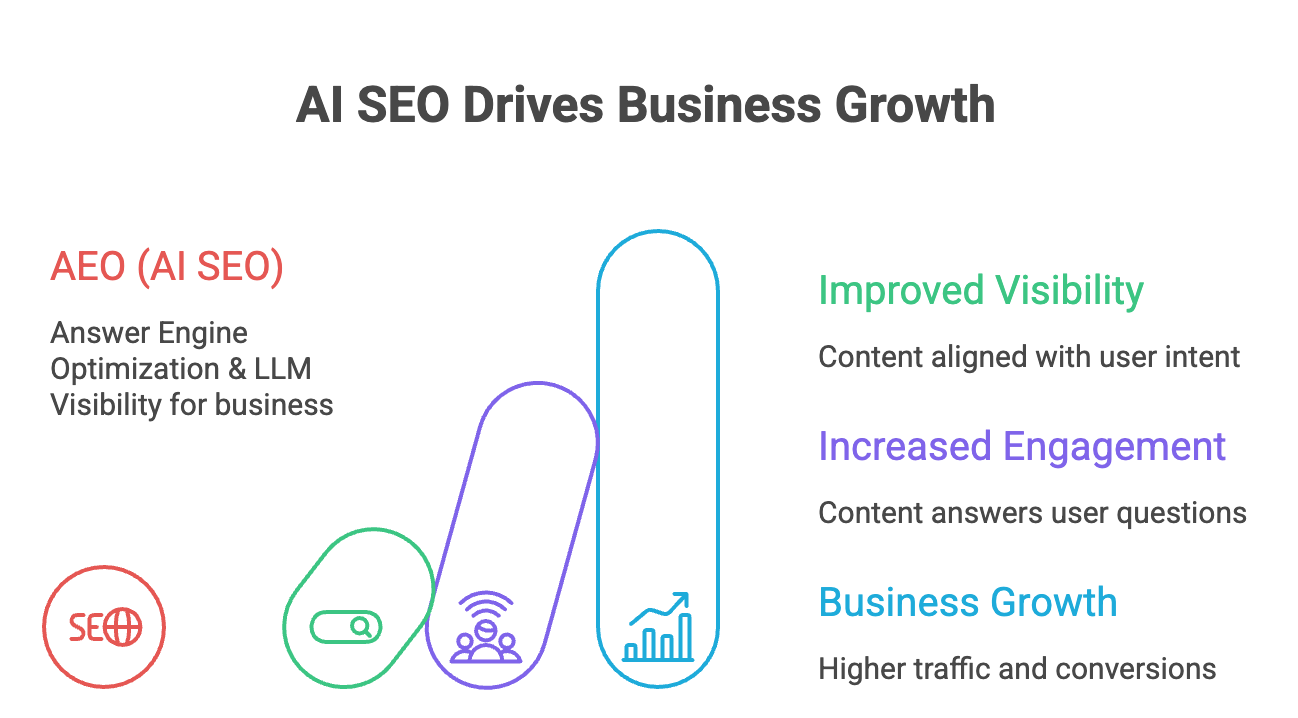
AI-driven SEO supports business growth by improving how content aligns with user intent and how efficiently optimization is executed. Instead of relying only on manual keyword targeting, AI systems analyze search behavior, click patterns and content performance, which helps businesses find high-impact opportunities faster and improve conversion rates through better relevance.
The integration of AI into SEO is transforming digital marketing by enabling capabilities that were previously unattainable. AI-driven SEO improves business growth by improving how content aligns with user intent and how efficiently optimization is executed. Instead of relying only on manual keyword targeting, AI systems analyze large datasets, including search behavior, click patterns, and content performance. This allows businesses to:
- Identify high-impact opportunities faster
- Optimize content based on real user intent
- Improve conversion rates through better relevance
AI also enables structured data implementation, internal linking improvements, and automated audits. These reduce manual workload while increasing precision.
AI SEO for Business Growth: Strategies & Ethical Innovation
Integrating artificial intelligence into search engine optimization marks a new phase in digital marketing, combining technical innovation with ethical considerations. Through advanced algorithms and machine learning, AI-powered SEO tools increase efficiency in keyword research, content optimization, and trend analysis. In addition, AI enables personalized content generation aligned with individual user preferences, which can drive higher traffic and conversion rates. Optimizing SEO with AI: Achieving Success Through Responsible Innovation
, S Paul, 2024
Elementera applies AI research and implementation experience that translates into practical strategies that help brands rank and also appear accurately across AI-generated answers and recommendations to support growth and competitiveness in crowded markets.
What Role Does Machine Learning and AI Play in SEO Automation?
Machine learning (a subset of AI) is the core engine behind modern SEO automation. Machine learning processes large datasets to detect patterns, improving semantic interpretation and ranking decisions. Applied correctly, it automates routine tasks, frees resources, and enables continuous optimization as user behavior and algorithms shift. It processes large volumes of data to identify patterns in:
- Search queries
- User behavior
- Content performance
- Ranking signals
This allows systems to continuously improve how content is evaluated and surfaced. In practice, machine learning enables:
- Automated keyword clustering
- Content gap detection
- Intent classification
- Continuous optimization based on performance data
The key benefit is scalability. Tasks that would take weeks manually can now be done continuously and at scale, allowing teams to focus on strategy rather than repetitive work.
How Do AI Engines Like ChatGPT and Gemini Influence Brand Visibility?
AI engines like ChatGPT and Gemini change how people discover brands: instead of a list of links, they write a direct answer and select only a few sources. Visibility then depends on trust, clarity and relevance, so content must answer questions clearly, be structured for extraction, and show credibility and consistency.
AI engines are changing how users discover brands. Instead of showing a list of links, they generate direct answers. This means:
- Only a few sources are selected
- Visibility is based on trust, clarity, and relevance
- Being "ranked" is no longer enough
To be visible in AI-driven search, content must:
- Clearly answer questions
- Be structured in a way AI can extract
- Demonstrate credibility and consistency
These systems rely heavily on semantic understanding and trusted sources. Brands that provide clear, well-structured, and authoritative content are more likely to be cited or referenced. Tracking performance across both traditional search and AI surfaces is now essential to understand true visibility.
Which AI SEO Automation Tools Drive Effective Brand Visibility?
Traditional SEO tools still help with AEO, with modified use cases: keyword research and competitive analysis, rank tracking and on-page guidance, and backlink analysis, content gaps and keyword tracking now adapted to AI citations. These tools work best combined with AI-driven content strategies rather than used in isolation.
AEO, AI SEO, GEO, and LLM Visibility are relatively new fields and there are many emerging tools. We, at Elementera, also use some of these tools in conjunction with our internal tools. This is a developing arena. However, it is important to note that many platforms and tools that are useful for traditional SEO is still useful in AEO era too but their use cases are slightly modified. Several tools support AI-driven SEO workflows by providing data, automation, and insights to reduce manual effort and improve outcomes.
- Keyword research platforms: Keyword research, competitive analysis, and content optimization insights adapted to AEO.
- Rank tracking tools: Rank tracking, on-page optimization guidance, and domain authority insights.
- Backlink analysis tools: Backlink analysis, content gap identification, and keyword/query tracking suitable for AI citations.
These tools help teams prioritize high-impact opportunities and make data-driven decisions. They are most effective when combined with AI-driven content strategies rather than used in isolation.
What Are the Benefits of Semantic Search in AI SEO Strategies?
Semantic search helps AI SEO because it focuses on meaning and intent rather than matching keywords. Content is interpreted more accurately even with varied phrasing, results match user intent better, and the content is more likely to be selected for featured snippets and AI-generated answers.
Semantic search focuses on understanding meaning and intent rather than just matching keywords. This is critical for both Google and AI engines. Key benefits include:
- Improved AI Understanding: Content is interpreted more accurately, even with varied phrasing.
- Improved Contextual Relevance: Results better match user intent, not just keywords.
- Higher Visibility in AI Outputs: Content is more likely to be selected for featured snippets and AI-generated answers.
To benefit from semantic search, content should:
- Use natural language
- Cover topics comprehensively
- Include related concepts and entities
- Be structured clearly
How Can Businesses Leverage SEO Automation for Scalable Growth?
SEO automation lets businesses scale optimization without more manual work. Effective strategies are AEO audits that find pages with low impressions, content optimized for clarity, extractability and intent alignment, and semantic techniques such as contextual language and structured data, with automation keeping the work consistent.
SEO automation allows businesses to scale optimization without increasing manual workload. Effective strategies include:
- Conducting AEO Audits: Identify pages with low impressions or weak performance.
- Optimizing Content for AI Systems: Structure content for clarity, extractability, and intent alignment.
- Leveraging Semantic Search Techniques: Use contextual language and structured data to improve understanding.
Automation ensures consistency and allows continuous improvement, which is essential in a rapidly changing search environment.
How to Measure SEO Success Using AI-Powered Analytics?
AI-powered analytics connect SEO work to business outcomes. Instead of tracking rankings alone, track organic traffic, engagement rate and conversion rate, plus AI visibility: how often ChatGPT, Gemini and Google AI answers name or cite your brand for your buyers' questions.
AI-powered analytics help connect SEO efforts to real business outcomes. Instead of focusing only on rankings, businesses should track:
| Metric | What it measures | Priority |
|---|---|---|
| Organic traffic | Number of visitors from search engines | High |
| Engagement rate | Percentage of users interacting with content | Medium |
| Conversion rate | Percentage of visitors completing desired actions | High |
| AI visibility | How often ChatGPT, Gemini and Google AI answers name or cite your brand for your buyers' questions | High |
AI tools can identify patterns, highlight opportunities, and prioritize actions that drive measurable impact.
AI SEO Models: Boosting Digital Marketing Performance
This study evaluates the effects of AI-driven SEO models on digital marketing performance and addresses the need for adaptive, data-driven optimisation in an algorithmic search environment. The results indicate that AI improves keyword ranking stability, organic traffic, user engagement, and conversion metrics. Statistical analysis shows direct effects of AI-driven SEO on marketing outcomes, with SEO performance serving as a significant mediating factor. AI-Driven SEO Models for Enhancing Digital Marketing Performance, Sarfandi, 2025
What Industry Trends Support AI Adoption in SEO Strategies?
Three industry trends support AI adoption in SEO: users increasingly rely on AI-generated answers instead of traditional results, content is being optimized to be selected and cited rather than only ranked, and analytics and AI insights increasingly guide strategy and investment.
Industry trends show faster AI adoption in search and a shift to answer-focused optimization. Key trends include:
- Shift to AI-Driven Search Experiences: Users increasingly rely on AI-generated answers instead of traditional search results.
- Growth of Answer Engine Optimization (AEO): Content is being optimized to be selected and cited, not just ranked.
- Data-Driven Decision Making: Analytics and AI insights guide strategy and investment.
These trends make integrating AI into SEO important for maintaining competitive positioning.
Frequently Asked Questions
1. What are the key differences between traditional SEO and AI SEO?
Traditional SEO focuses on manually optimizing websites for search engines through keyword targeting, on-page improvements, and ranking performance. It emphasizes placing the right keywords in content, metadata, and backlinks to improve visibility in search results.
AEO (or AI SEO), on the other hand, uses automation and advanced data analysis to understand user intent, context, and behavior at scale. Instead of just targeting keywords, it prioritizes delivering relevant, meaningful content that aligns with what users (and AI systems) are actually looking for in the form of long-tail queries. This approach helps teams shift their focus away from repetitive tasks and toward strategy, creativity, and high-impact decision-making.
2. How can small businesses benefit from AI SEO strategies?
AI SEO strategies enable small businesses to compete more effectively without large budgets or teams. By leveraging automation, AI tools handle tasks like keyword research, content optimization, and performance analysis, allowing small teams to work more efficiently.
This gives businesses access to advanced insights, better audience targeting, and improved search citation, helping them achieve results that were previously only possible for larger organizations.
3. What ethical considerations should businesses keep in mind when using AI for SEO?
Businesses should prioritize transparency, data privacy, and accuracy. Content should remain helpful and trustworthy, avoiding manipulation or misleading practices.
4. How does AI impact the future of content creation in SEO?
AI is transforming content creation in SEO by improving efficiency across research, idea generation, and personalization. It helps identify relevant topics, uncover opportunities, and streamline content production at scale.
However, human oversight remains essential for shaping strategy, maintaining quality, and preserving a consistent brand voice. AI improves the process, but it works best when paired with human creativity and judgment.
5. What role does user experience (UX) play in AI SEO strategies?
UX remains critical: sites that load fast, are easy to navigate, and deliver relevant content perform better. AI helps identify and prioritize UX improvements. User engagement for AEO is also an important related topic.
Why is AEO no longer optional?
AEO is no longer optional. It is becoming the foundation of how brand AI citation works online. By combining automation, semantic understanding, and performance measurement, businesses can improve both discoverability and real outcomes. Start by auditing your current content, implementing structured improvements, and focusing on what matters most: creating genuinely helpful, trustworthy content that AI systems can confidently surface.

Known professionally as Dr. Med with 12+ years of experience implementing AI products. Strategic advisor to multiple successful founders including a unicorn, US patent holder. Ex-SOTI, UC Berkeley PhD.

Sr. Engineering Leader with 15+ years of experience. Ex-ApplyBoard. AWS Certified Solutions Architect.
Related articles
- Generative Engine Optimization: What the GEO Paper Actually Shows for Your Business
- How Answer Engine Optimization Strategies Enhance AI Search Engine Visibility and Brand Discoverability
- How to Do Prompt Research for AEO and AI Search Optimization
- User Intent Optimization: What It Is and Why It Matters in AEO (AI SEO and AI Brand Visibility)
- Why Optimize Answer Visibility for Better Engagement: Effective AI Content Discoverability Strategies
Latest articles
- Dental Practice Software in 2026: A Practical Guide to PMS Platforms and AI Tools (US and Canada)
- Google Preferred Sources and AEO: what it is and how it affects your AI visibility
- What an AI Visibility Audit Actually Covers for SMBs
- Inside Google’s First Year of AI Mode: What 1 Billion Users Reveal About How Americans Search Now
- What You Might Have Missed From Google I/O 2026 (And Why It Matters for AEO and AI Search)