
Anthropic’s new usage policy and AI answer seeding: what it says
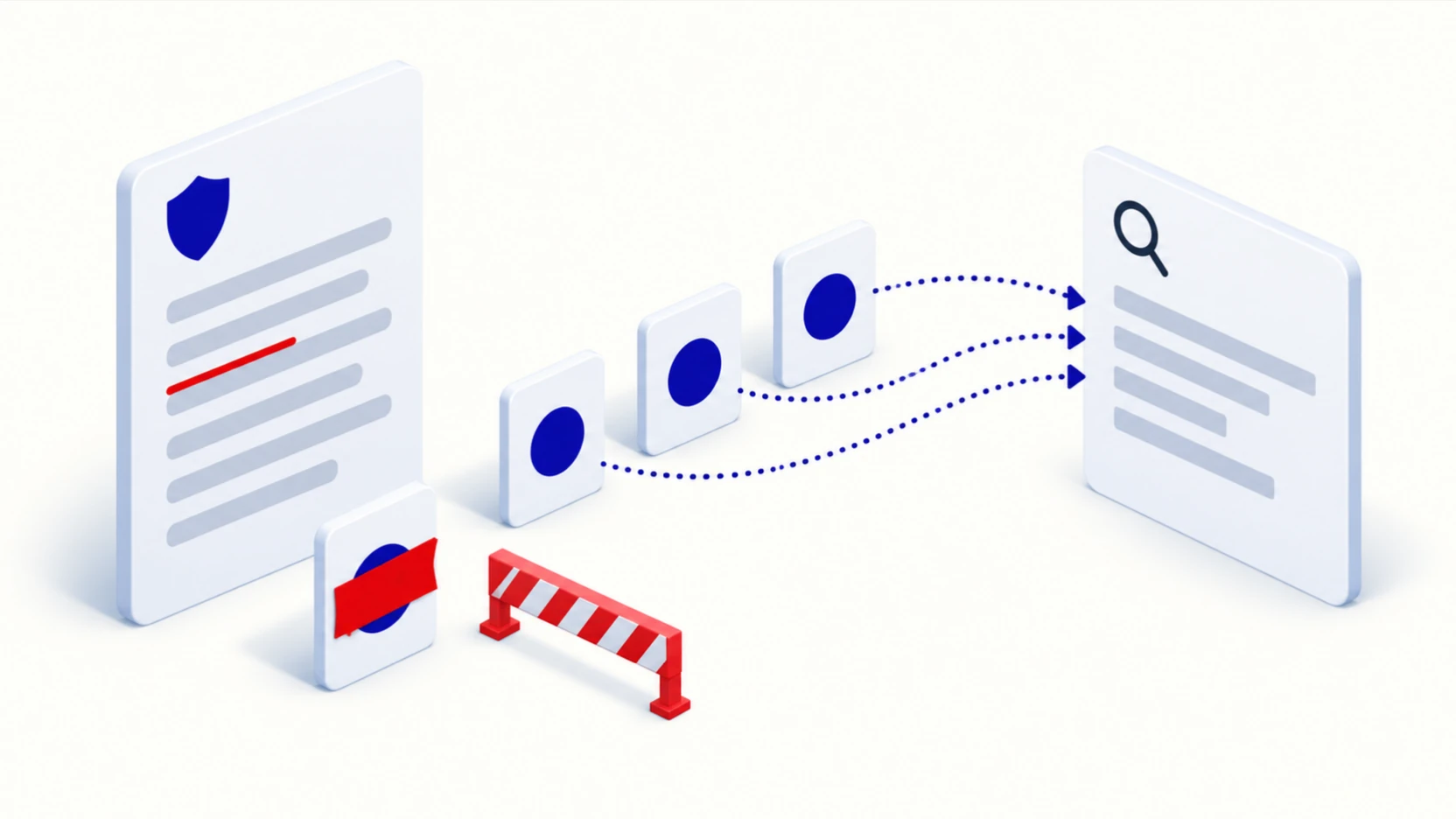
Key point. From November 12, 2026, Anthropic's Usage Policy prohibits using its products to seed the sources AI systems answer from "with content that misrepresents its origin, authorship, or independence". The target is deception. Pages under your own name, real customers' reviews and disclosed sponsorship are not what it describes.
Anthropic, the company that makes Claude, published a new version of its Usage Policy on October 8, 2026, and it takes effect on November 12, 2026. One line in it names AI answers directly. That puts it squarely in the work Elementera does for clients, answer engine optimization (AEO), so we read it closely. This page quotes the line and the section around it, and sets out what the text covers and what it does not.
What changed in Anthropic's Usage Policy?
Anthropic's announcement of the 2026 Usage Policy lists seven changes. There is a new section on deceptive activity, a narrower elections section, clearer weapons and surveillance rules, rewritten requirements for high-risk uses, a rule against abusive behavior toward its models, and a clarified Supported Regions Policy. For anyone working on AI visibility, the first change is the one to read.
In the announcement, Anthropic says its earlier policy already prohibited running networks of fake accounts and fabricated news sites, but that "the restrictions were scattered across our elections, fraud, privacy, and disinformation sections." The new version brings them together in one section, titled Do Not Engage in Deceptive Campaigns or Artificial Activity, "which applies to deceptive activity of any kind (whether political or commercial)."
That last phrase is the reason this matters for marketing. The section is not limited to elections or state actors. It covers commercial work too.
What does the new section say about AI answers?
The new section says AI answers can be a target of deception, in one of its six lines. It prohibits using Anthropic's products or services to do the following. Quoted exactly from the Usage Policy:
- Create or operate fake personas, accounts, media outlets, or organizations, or impersonate real people, organizations, or media outlets, in order to mislead people about their origin or attribution, how widely a view is held, or whether they are interacting with a human (e.g., sockpuppets, astroturfing, fake reviews, or bots that claim to be human)
- Misrepresent or intentionally conceal the sponsorship of content or messaging intended to influence public opinion, officials, or other decision-makers
- Distribute content through networks of fake or ostensibly independent outlets, websites, or accounts to hide that it comes from a common source
- Manipulate the sources from which search engines or AI systems draw answers by seeding them with content that misrepresents its origin, authorship, or independence (e.g., networks of sites posing as unaffiliated sources corroborating the same claims)
- Build, improve, maintain, or contribute to tools, systems, or infrastructure designed to facilitate or enable deceptive campaigns, including astroturfing, sockpuppet account creation, coordinated inauthentic behavior, or scaled impersonation
- Market, sell, or solicit funding for any of the above as a product or service
The fourth line is the one about AI answers. It has three parts:
- The target: "the sources from which search engines or AI systems draw answers". That is the set of pages, reviews, lists and profiles an AI assistant reads before it answers.
- The act: "seeding them with content". Placing content where an answer engine will find it.
- The condition: content "that misrepresents its origin, authorship, or independence". Who made it, who wrote it, or whether it is really independent of the company it praises.
The example in brackets shows the pattern Anthropic has in mind: "networks of sites posing as unaffiliated sources corroborating the same claims". The last two lines extend the section to building tools for such campaigns and to selling them as a service.
Who does the policy apply to?
The policy governs the use of Anthropic's own products. In its words, it "applies to anyone who submits inputs to Anthropic's products or services", which it says includes people using Anthropic's apps, developers and businesses using its API, customers reaching Claude through cloud providers and resellers, and the end users of products built on Claude.
So the line binds anyone who uses Claude to do the work: to write the content, to run the accounts, or to build the tooling. It is a condition of using Anthropic's products. It is not a ranking rule, and the section says nothing about how Claude's own answers choose sources.
What does the new section not cover?
The new section does not cover marketing as such: read as written, the line targets misrepresentation. The policy says so about industries in general: "Its prohibitions and requirements do not categorically prohibit use by any particular industry or line of business, provided the use of our products and services complies with this Usage Policy."
Each part of the seeding line turns on a misrepresentation of origin, authorship or independence. Work that misrepresents none of the three is outside it. In our reading of the text (not legal advice), that includes:
- Your own pages, under your own name. A product page, a guide or a facts page on your site says who made it.
- Profiles you claim and correct. A directory or review-site profile that the company manages as itself.
- Reviews from real customers, in their own words. The policy names fake reviews; a genuine review is not one.
- Sponsorship that is disclosed. The second line covers sponsorship that is misrepresented or intentionally concealed. A placement marked as sponsored is neither.
- A press release presented as a press release. It says who issued it. Offering the same release as independent coverage is where it would start to misrepresent independence.
The format of a page does not decide the question. A best-of list, a press release and a review can each be honest or not, depending on whether a reader is told who stands behind it.
Which AI visibility tactics does the wording describe?
The wording describes some AI visibility tactics closely. These are sold as ways to "get recommended by AI", and they match the policy's own examples:
- A set of sites that repeat one claim and look unrelated. This is the policy's example almost word for word.
- Reviews or forum posts written by the company or its agency under made-up names. These are the sockpuppets and fake reviews the first line names.
- A best-of list on the company's own site that ranks itself first, offered to engines as if a third party wrote it. The list misrepresents its independence.
- Articles paid for and presented as an outlet's own editorial choice, with the payment hidden. This is concealed sponsorship.
If a tactic only works when the reader or the answer engine does not know who is behind the content, it is the pattern this section describes.
What does an honest off-site plan look like?
An honest off-site plan makes the pages answer engines read describe a company correctly. It needs none of the tactics above. This is how we run it for clients:
- One fact sheet, in the company's own words. Name, one-line description, location, founders, what it sells. The same text on the company's site and every profile, so the sources agree with each other.
- Claim and correct existing profiles, as the company. Directories, review sites, software marketplaces. Never a profile in someone else's name.
- Ask real customers for reviews, one at a time. The customer writes the review. Nobody drafts it for them, and nobody trims it to its best half sentence.
- Pitch lists and journalists with evidence they can check. The author decides whether the company belongs on the list.
- Mark paid placements as sponsored. And never buy a placement without the client's decision and a disclosure.
- Count only independent mentions as coverage. A syndicated press release or a paid listing is logged as not independent and is never shown as press coverage.
- No networks of sites, and no reciprocal articles at scale. One useful article for a real publisher beats ten written for links.
This plan is slower than seeding. It also holds up when someone asks who wrote each source, which is exactly the question the new policy asks.
Frequently asked questions
When does Anthropic's new Usage Policy take effect?
On November 12, 2026. Anthropic published the new version on October 8, 2026, and its Usage Policy page lists the effective date as November 12, 2026.
Does the policy ban answer engine optimization?
No. The policy says its prohibitions "do not categorically prohibit use by any particular industry or line of business", provided the use complies with the policy. What it prohibits is deception, including seeding answer sources with content that misrepresents its origin, authorship or independence.
Can an agency use Claude to write content for a client?
The policy does not prohibit writing with AI. Its section on fraudulent practices does list "Plagiarize or submit AI-assisted work without proper permission or attribution". Work the client has approved, published under a name that tells readers who stands behind it, fits that wording; content presented as coming from someone who did not write or approve it does not.
Does the policy apply if we do not use Claude?
This policy governs the use of Anthropic's products. Other AI providers publish their own terms, so read the terms of each tool you use.
How this page was made
Soroush Mehri wrote this page with the help of an AI writing assistant (Claude, made by Anthropic). It works only from Anthropic's announcement and the Usage Policy itself, both read on October 24, 2026. Every quote is copied exactly from those two pages. Dr. Mehrdad Mehrbod reviewed the page, and Soroush Mehri approved it for publication.
Work with us
Book a call about Originum or the Supervised plan, our managed AEO service, in which Elementera does the work for you: Book a call. Or start with Lenz: its free report shows how ChatGPT and Gemini answer your buyers' questions about your company: Get your free AI visibility report.
Sources
- Anthropic, 2026 Usage Policy update, October 8, 2026, verified October 24, 2026
- Anthropic, Usage Policy, effective November 12, 2026, verified October 24, 2026

Ex-Microsoft. 10+ years of experience in AI/ML, MSc from Université de Montréal (Mila). US patent holder.

Known professionally as Dr. Med with 12+ years of experience implementing AI products. Strategic advisor to multiple successful founders including a unicorn, US patent holder. Ex-SOTI, UC Berkeley PhD.
Related articles
- Maximize Answer Visibility With Proven AEO Techniques
- Why Optimize Answer Visibility for Better Engagement: Effective AI Content Discoverability Strategies
- Why Choose Answer Engine Optimization (AEO) for AI Search Optimization Over Traditional SEO?
- How Answer Engine Optimization Strategies Enhance AI Search Engine Visibility and Brand Discoverability
- Can AI search engines fetch and index your pages? What you control
Latest articles
- How to advertise in AI assistants: what is live now
- How to choose an AEO agency: the questions to ask, the red flags, and what a managed AEO service should deliver
- AI search glossary: 55 terms, defined precisely
- Elementera receives angel investment to grow Lenz and the team behind it
- Is good AEO just good SEO? What our measurements show