
Converting visitors who arrive from AI answers
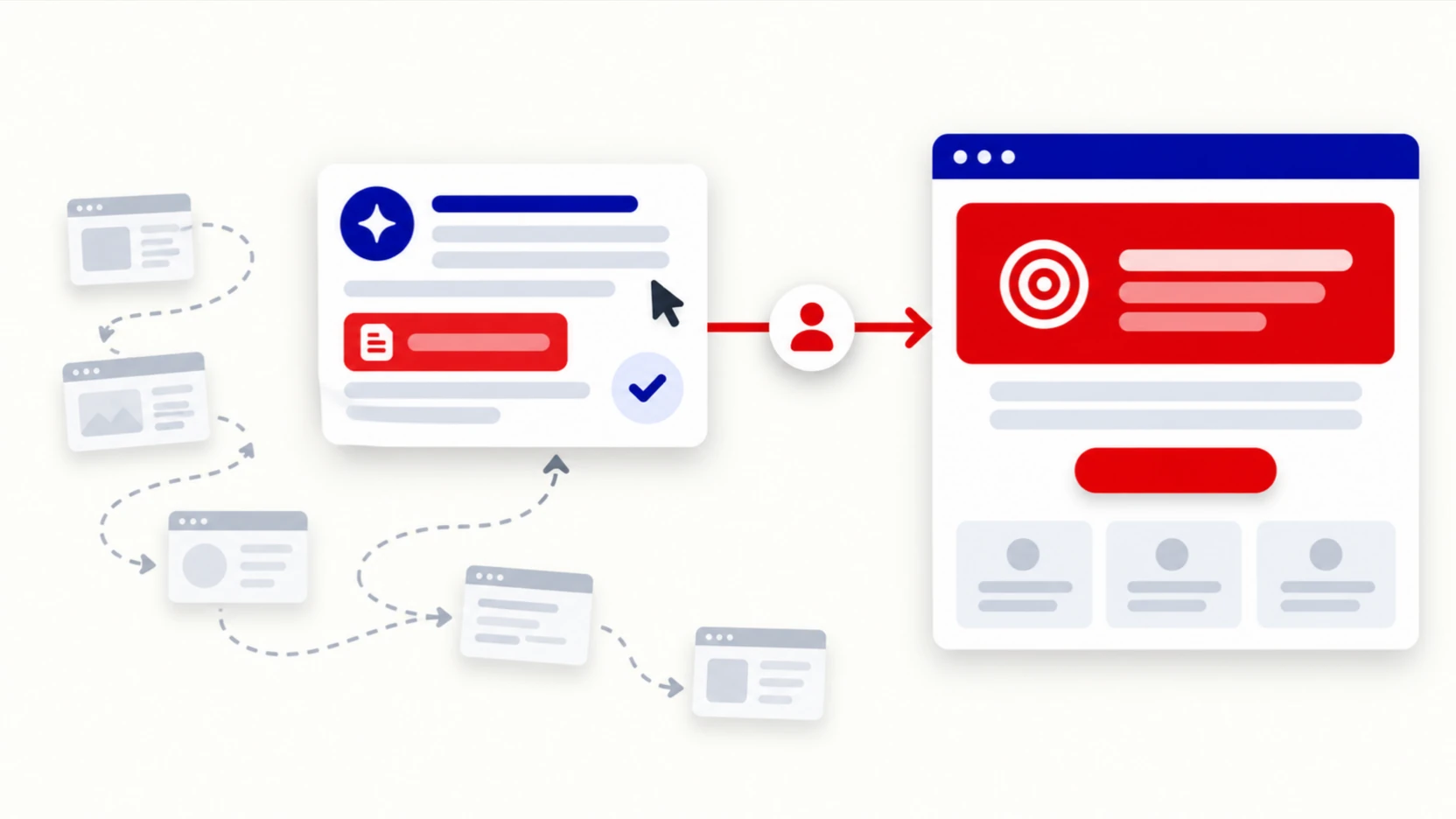
Key point. A visitor who clicks through from ChatGPT, Perplexity, Copilot or Gemini has usually just read a summary of your company, often next to two or three competitors, and clicks to check something specific: price, proof, fit, or whether the summary was right.
Give them a page that answers that question in its first lines, with pricing and evidence visible and one clear next step. Find them in Google Analytics 4 through the AI Assistant channel or a custom channel group built from a tested list of hosts, and measure them as a small, undercounted segment: report counts with their denominators, never a conversion rate on its own. The popular claims that AI traffic converts several times better come from one site, one page type, or selected samples; the larger studies disagree.
How are visitors from AI answers different from search visitors?
They arrive later in their decision and with a narrower question. A search visitor often lands on your page to find out what you do. An AI visitor has already been told what you do, by an engine that may have compared you with alternatives, and arrives to verify one thing. That changes what the landing page has to do.
There are also fewer of them than the attention suggests. In Pew Research Center's browsing panel of 900 US adults (March 2025), people clicked a link inside a Google AI Overview on 1% of visits to pages that showed one. Two multi-site studies of AI referrals put the volume in the same range:
- B2B lead generation. A web agency analysed GA4 data from about 100 B2B lead-generation websites (July 2025 to June 2026, about 29 million sessions). AI sources sent about 0.5% of all sessions. AI visitors were 3 times as likely as other visitors to become leads when all sessions were pooled, and 7 times at the per-site median; the pattern held on about two-thirds of the sites. ChatGPT turned about 2% of its visitors into leads, against about 0.5% for Google Search.
- E-commerce. Kaiser and Schulze, in a study published in 2026 (listed in Marketing Science), analysed twelve months of first-party data from 973 e-commerce sites. As reported by Digiday, ChatGPT referrals were under 0.2% of those sites' traffic and converted at a lower rate than organic search and affiliate links, though the rate improved over the study period. The authors measured last-click referrals only.
The two studies point in opposite directions, and each has a limit that matters for a SaaS, fintech or other B2B company. The B2B study included only sites that already had at least 100 AI-referred sessions, reported no intervals or tests, and classified each site's conversion events by hand, which its authors call the most judgment-dependent step. The e-commerce study is about stores, where the visitor buys on the spot. Read every figure below as evidence about its own sample.
Does traffic from AI answers really convert several times better?
Not on the evidence we could check. The multipliers that circulate are real numbers with narrow scopes, and none of the ones we could read at the source reports how uncertain it is. Here is every one we could read at the source, with its scope.
| Figure as relayed | What the source actually measured | What limits it |
|---|---|---|
| "3x" and "7x" more likely to become a lead | About 100 B2B lead-generation sites; 3x with all sessions pooled, 7x as the median of per-site ratios; ChatGPT about 2% against Google Search about 0.5% | Only sites with at least 100 AI sessions; conversion events tiered by hand; no intervals; an agency's own study |
| "4.4x" more valuable | One SEO software vendor's 2025 study: the average AI search visitor "is 4.4 times as valuable as the average visit from traditional organic search, based on conversion rate" | No sample, period or method is given for this figure in the study |
| ChatGPT converts below organic search | 973 e-commerce sites, 12 months, last-click (Kaiser and Schulze) | E-commerce, under 0.2% of traffic; as reported by Digiday |
Other figures you will see quoted, such as "23x", "31% better", "16% against 1.8%", "14.2% against 2.8%", "11.4% against 5.3%" and a 54-site comparison relayed as "not statistically significant", come without a source we could check. Treat each as unchecked until you can see its sample.
Our reading of the ones we could check:
- The baseline decides the multiplier. "3x pooled" and "7x per-site median" are the same data summarised two ways. A median of per-site ratios can be pulled up by small sites, where a handful of AI leads makes a large ratio.
- Brand intent is a candidate explanation the data cannot rule out. The B2B study's own authors list it: some AI visitors already know the company and ask the assistant to route them to its website, which also explains why so much AI traffic lands on homepages. A visitor who already chose you converts well from any channel.
- Selection inflates the average. A study restricted to sites that AI already sends traffic to describes those sites, not the average B2B website.
How do I find AI referral traffic in Google Analytics 4?
Start with the AI Assistant channel in GA4's default channel group, then build a custom channel group from a tested list of hosts if you need more control. Google added the AI Assistant channel on May 13, 2026. GA4 sets the medium to "ai-assistant" and the campaign to "(ai-assistant)" when the referrer matches Google's list of AI assistants, which the documentation describes as sources like ChatGPT, Gemini, Deepseek, Copilot or Grok; the release note also names Claude.
Four things to know about it:
- Google's own AI features are not in it. Clicks from AI Overviews and AI Mode are excluded from the AI Assistant channel and counted inside Organic Search, and Search Console reports them within the "Web" search type. See zero-click AI answers for how to estimate them.
- The channel is assigned from the referrer. Google's documentation sets the "ai-assistant" medium when the referrer matches. A ChatGPT visit that arrives with its tracking tag but without a referrer may therefore show source "chatgpt.com" in a different channel, such as Unassigned. Check the session source across all channels, not only inside the AI Assistant channel.
- The list is Google's. If a source you care about is missing, build a custom channel group, ordered above "Referral" so those visits are not counted as ordinary referrals.
- Do not tag your own links as ChatGPT. Some guides suggest adding
utm_source=chatgptto links you share. That books your own shares as ChatGPT visits, splits ChatGPT across two source values, and, unless the medium is exactly "ai-assistant", keeps them out of the AI Assistant channel, whose rule is "the medium exactly matches 'ai-assistant'".
Which regular expression should the custom channel use?
Use an explicit list of hosts, and avoid the broad pattern in Google's own help example. GA4 treats a "matches regex" condition as a full match by default and is case sensitive. Google's example for an "AI assistants" channel begins ^.*ai|...|.*gemini.*|.*gpt.*|.*copilot.*. We tested it against a list of sample source values, with full matching as GA4 applies it:
- It catches unrelated sites: any source ending in "ai" (many SaaS companies use a .ai domain, so a partner's link would count as an AI assistant), the crypto exchange gemini.com, copilot.github.com, and any source containing "gpt" or "chatgpt".
- It misses chat.deepseek.com and grok.com, two of the assistants GA4's own channel names.
- If a tool or a later edit applies it as a partial match, it also catches "email", "gmail" and mail.google.com.
This list matched every assistant host in our test and none of the unrelated sources:
chatgpt\.com|chat\.openai\.com|openai|perplexity\.ai|www\.perplexity\.ai|claude\.ai|gemini\.google\.com|copilot\.microsoft\.com|chat\.deepseek\.com|grok\.comIt is an example to test, not a standard. Before you save it, open the Traffic acquisition report, set the dimension to session source, and confirm what each rule matched on your own data. Add hosts you see that are not on it, and review the list every quarter, because domains change.
ChatGPT also tags its links. OpenAI's publisher FAQ says ChatGPT automatically includes utm_source=chatgpt.com in referral URLs from ChatGPT search, so those visits keep a source even when the referrer is lost. Links returned by OpenAI's developer API are different: in our own runs of OpenAI's API with web search, the links in answers carried utm_source=openai (34 of 36 answers). A product built on that API can therefore send you visits tagged "openai" rather than "chatgpt.com", which is why the list above includes "openai". OpenAI's web search guide for developers, as we read it, does not mention the tag, so check your own session sources for "openai".
Why is the AI referral number an undercount?
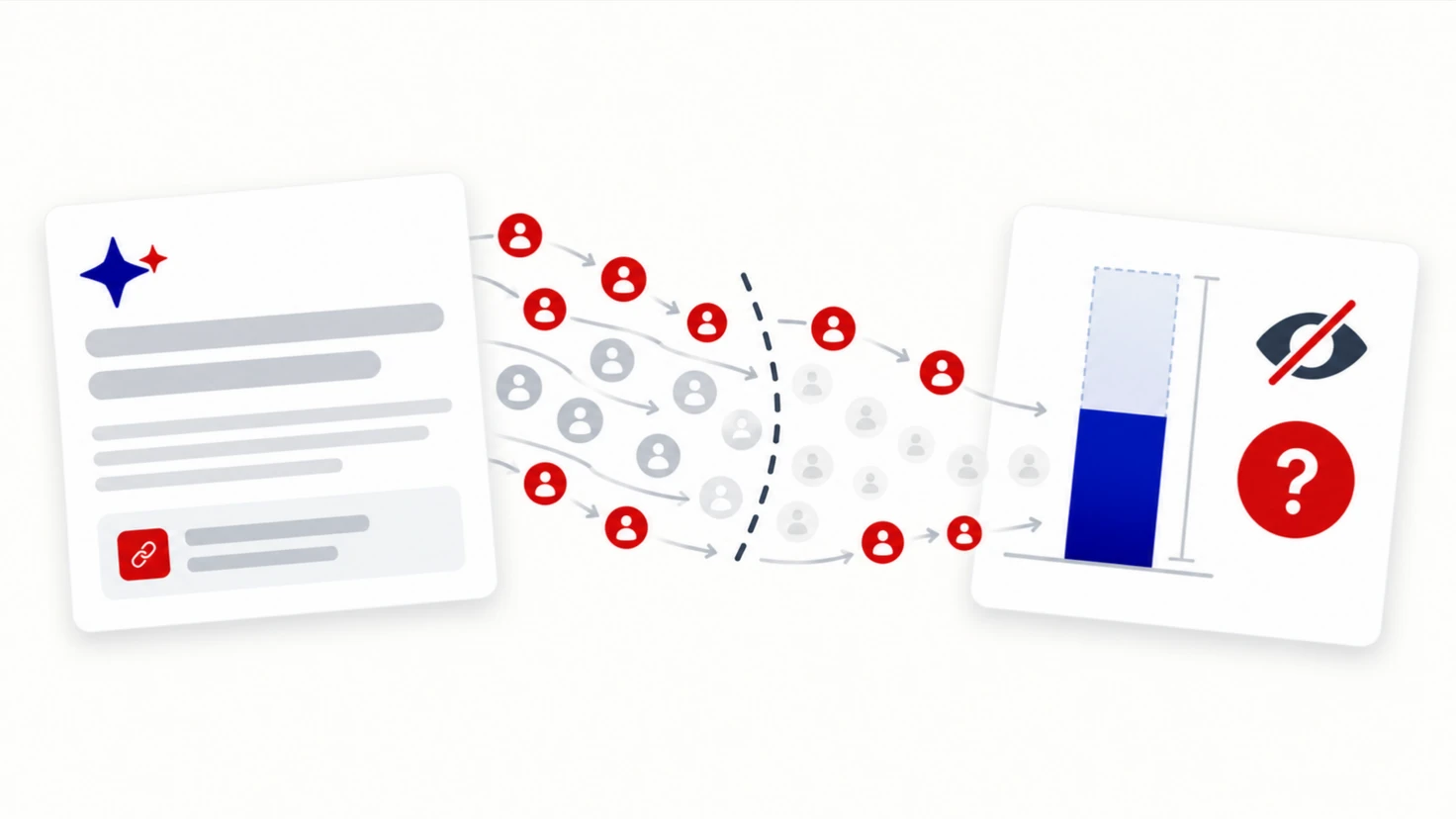
Because a large share of the influence of an AI answer never arrives as a referral. Treat the figure as a lower bound, for four reasons:
- Lost referrers. Desktop and mobile apps, and some in-app browsers, can open a link without passing a referrer. GA4 then reports the visit as direct. A tracking tag helps here; not every engine adds one.
- Origin only. Browsers by default send only the origin of a cross-site referrer (MDN documents
strict-origin-when-cross-originas the default policy). You see "chatgpt.com", never the question or conversation that led to the click. - The answer without the click. A buyer reads your name in an answer, then types your URL or searches your name on Google a day later. That visit is direct or branded search, and the AI answer gets no credit.
- Google's AI features. Clicks from AI Overviews and AI Mode are inside organic search, as above.
The honest reading of a small AI Assistant channel is "at least this many", and the useful questions are which pages these visitors land on and what they do next, not how big the channel is.
What landing page does a visitor from an AI answer need?
A page that confirms in its first lines what the AI said about you, answers the question that made them click, and shows the proof and price without a search. You do not choose which of your pages an engine links, so start with the pages that already receive AI visits: in GA4, filter the Landing page report to the AI Assistant channel or your custom channel. The authors of the B2B study above report high levels of homepage traffic from AI, so expect your homepage and pricing page near the top of that list.
For each of those pages:
- Open with one sentence that says what you do and for whom. If the AI described you correctly, this confirms it. If it described you wrongly, this is the first correction the buyer sees. See when AI describes your company wrongly .
- Answer the specific question the page was cited for. Look at which question the page answers; that is usually why the engine linked it. Put the answer at the top, under a heading that asks the question. Pages written for machines versus for people covers how.
- Make pricing visible. A price, a starting price, or a plain statement of how pricing works. A buyer who was comparing you with competitors in the answer will compare prices next.
- Show proof a stranger can check. Named customer case studies, links to independent reviews, security and compliance documents, and how your method works.
- Put a name and a date on pages buyers compare. A named author or owner and a "last checked" date on pricing and comparison pages tell a buyer whether the facts the AI repeated are current.
- Offer one next step, sized to their stage. A demo booking for buyers who are ready, and a short, ungated resource (a sample report, a product tour) for those who are still checking.
- Keep comparison pages honest. Visitors from "X vs Y" answers often land on your comparison page. If it contradicts what the engine just told them, it costs you the visit. See being recommended over competitors.
Can I A/B test a landing page on AI visitors only?
Rarely, because the segment is too small to give a readable result. An example with round figures: to tell a 2% conversion rate from a 3% one with the usual test settings (95% confidence, 80% power) takes about 3,800 sessions in each version. If AI sends about 0.5% of your traffic, as in the B2B study, that is about 7,700 AI sessions, or about 1.5 million total sessions during the test. Test the page on all its traffic instead, then read the AI segment's paths and counts for direction.
What we see in our own measurements
When we asked AI engines whether a buyer should hire us, the answers told us what was missing from our pages. We asked twelve buyer questions about Elementera, three times each, on OpenAI's API with web search and Perplexity's Sonar API. The things the answers most often said were missing before a buyer could decide were independent reviews, case studies, pricing and methodology.
Those are the same four things a buyer who clicks through will look for. So we use them as a checklist for any page that receives AI traffic, and it works for a SaaS, fintech or services landing page as well as for ours:
- Independent reviews: a link to your review platform profile, or quotes with names and companies that a buyer can verify, not anonymous testimonials.
- Case studies: at least one named customer, with the problem, what changed and over what period.
- Pricing: visible on the page or one click away, with what each plan includes.
- Methodology: how your product or service works, in enough detail that a skeptical buyer could check a claim.
These come from the vendors' developer APIs, measured on October 5 and 6, 2026. The method and the full results are in the AI due-diligence check.
How do you measure AI referral conversion honestly?
Report counts with their denominators, compare like with like, and add a self-reported source to your forms. A conversion rate on a small segment is mostly noise.
An example with invented figures: 2 demo requests from 40 AI referral sessions is a 5% conversion rate, and the 95% interval around it runs from about 1.4% to 16.5%. Almost any comparison with your search traffic is inside that range. Write "2 demos from 40 sessions" and wait for more data before you write "AI traffic converts at 5%".
- Count, do not rate. Sessions, engaged sessions, demo requests and trials from the AI segment, each as a count, by month.
- Separate high-intent from low-intent conversions. Demo, contact and pricing requests in one group; newsletter, download and webinar sign-ups in another. In the B2B study the gap for low-intent actions (about twice as likely) was smaller than for leads (about 3 times).
- Compare like with like. When you do compare rates, use the same landing page, the same conversion event, and new against returning visitors, and compare with branded and non-branded organic search separately. AI visitors who land on your homepage should be compared with search visitors who land on your homepage, not with your whole blog audience.
- Measure downstream. Follow AI-referred leads to qualified pipeline and closed deals. A lower form-fill rate with better pipeline is a better channel.
- Compare paths. Which pages AI visitors land on, which pages they view next, and where they leave. Paths tell you what to fix long before rates are reliable.
- Ask the buyer. Add "How did you hear about us?" to the demo form, with "AI assistant (ChatGPT, Perplexity, Copilot, Gemini or similar)" as an option and a free-text field. It catches the visits that arrived as direct or branded search.
- Watch branded search alongside it. A rise in searches for your name, with no other cause, is consistent with buyers meeting you in AI answers first. It is a signal to investigate, not proof.
- Keep the AI segment separate from Google organic. GA4 does not separate clicks from AI Overviews and AI Mode from Google organic, so do not add them to the AI Assistant channel by guesswork. Google says clicks from results pages with AI Overviews are "higher quality (meaning, users are more likely to spend more time on the site)"; you cannot check that in GA4, because those clicks sit inside Organic Search.
A checklist for this week
Seven steps, in order, that take an afternoon and give you a baseline before you change any page.
- Open GA4 and check that the AI Assistant channel appears in your Traffic acquisition report.
- Set the dimension to session source and search for chatgpt.com, perplexity.ai, claude.ai, copilot.microsoft.com, gemini.google.com and openai across all channels, so you see AI visits that landed outside the AI Assistant channel.
- If you need more control, add a custom channel group for AI assistants above Referral, using the host list above, and check what it matched.
- List the top five landing pages for that channel over the last 90 days.
- On each, check the first sentence, the visible price, the proof, the date and the next step against the list above.
- Add an "AI assistant" option to the "How did you hear about us?" field on your demo form.
- Write down this month's counts, with denominators and split by high- and low-intent conversions, as the baseline before you change anything.
Frequently asked questions
Does traffic from AI answers convert better than search traffic?
It depends on the sample. A B2B lead-generation study of about 100 sites found AI visitors about 3 times as likely to become leads, on sites selected for having AI traffic and with no intervals; a 973-site e-commerce study found ChatGPT referrals converting below organic search. Measure your own, and report it with the number of sessions behind it.
How do I measure leads from AI search traffic?
Count them, by source, before you calculate any rate. In GA4, use the AI Assistant channel (or a custom channel group) and record demo, contact and trial requests from that segment as monthly counts. Add "How did you hear about us?" with an AI assistant option to your forms; it catches the visits that arrive as direct or branded search. Then track those leads through to qualified pipeline.
Can I see which question a visitor asked ChatGPT before clicking?
No. The referrer carries the engine's domain, not the conversation. You can infer the likely question from the landing page and the passage on it that answers a question.
Why do I see AI visits in GA4 that I cannot find in my server logs as referrals?
GA4 can record the source from a tracking tag in the landing URL even when no referrer header was sent. Server logs that only read the referrer will miss those visits.
Are clicks from Google AI Overviews counted as AI traffic?
Not in GA4's AI Assistant channel. Google counts them as organic search, and Search Console reports the clicks within the "Web" search type; its generative AI performance report shows impressions by page, not clicks. Our AI search glossary defines AI referral traffic and zero-click search, and the AI search visibility funnel shows where this stage sits.
Work with us
There are two ways to work with us. Teams that want the measurement and the page work done for them can use our managed AEO services: Book a call. Teams that want to see first what AI engines tell their buyers before they click can start with Lenz, our free analysis of how ChatGPT and Gemini answer their buyers' questions: Get your free AI visibility report.
How this page was made
Written by Dr. Mehrdad Mehrbod. Reviewed by Mojtaba Ebadi.
Sources
- Google Analytics Help, "Default channel group" (the AI Assistant channel definition and rule): support.google.com
- Google Analytics Help, "Custom channel groups" (Google's AI assistants example): support.google.com
- Google Analytics Help, "About regular expressions" (full match by default, case sensitive): support.google.com
- Google Analytics Help, "What's new in Google Analytics" (AI Assistant traffic measurement, May 13, 2026): support.google.com
- Google Search Central, "AI features and your website": developers.google.com
- OpenAI Help Center, "Publishers and Developers - FAQ": help.openai.com
- MDN Web Docs, "Referrer-Policy header": developer.mozilla.org
- Chapekis, Lieb, Shah and Smith (Pew Research Center), "Investigating Click Behaviors On Google Search Result Pages That Produce an AI Overview", IC2S2 2026: arXiv 2608.04831
- Kaiser and Schulze, "Frontiers: ChatGPT Referrals to E-Commerce Websites: How Do LLMs Compare Against Traditional Channels?", 2026 (Marketing Science): doi.org/10.1287/mksc.2025.0489
- Smith, "E-commerce sites see low sales from ChatGPT traffic, new study finds", Digiday, October 23, 2025: digiday.com
- The 4.4x figure is from one SEO software vendor's 2025 study of AI search and SEO traffic; we describe it without naming or linking it, under our policy on vendor sources.
- Elementera, AI verdict baseline on Elementera, OpenAI API with web search and Perplexity Sonar API, October 5 and 6, 2026 (described in the AI due-diligence check).

Known professionally as Dr. Med with 12+ years of experience implementing AI products. Strategic advisor to multiple successful founders including a unicorn, US patent holder. Ex-SOTI, UC Berkeley PhD.

Sr. Engineering Leader with 15+ years of experience. Ex-ApplyBoard. AWS Certified Solutions Architect.
Related articles
- Constitutional AI and the Strategic Architecture Behind AI Answers
- The AI due-diligence check: what AI tells a buyer who asks whether to hire you
- GEO services vs AEO services: is there a difference, and what should you ask a provider?
- Managed AEO services or AEO software: which does your company need?
- Being recommended over competitors: why AI knows your company and still recommends someone else
Latest articles
- AEO From Zero for a B2B SaaS: The Order We Would Follow
- Zero-click: when the AI answer replaces the visit
- Why ranking well on Google does not mean AI Overviews read your page
- How Microsoft Copilot finds and cites sources, and what a site owner controls
- How ChatGPT search finds and cites sources, and what a site owner controls