
Zero-click: when the AI answer replaces the visit
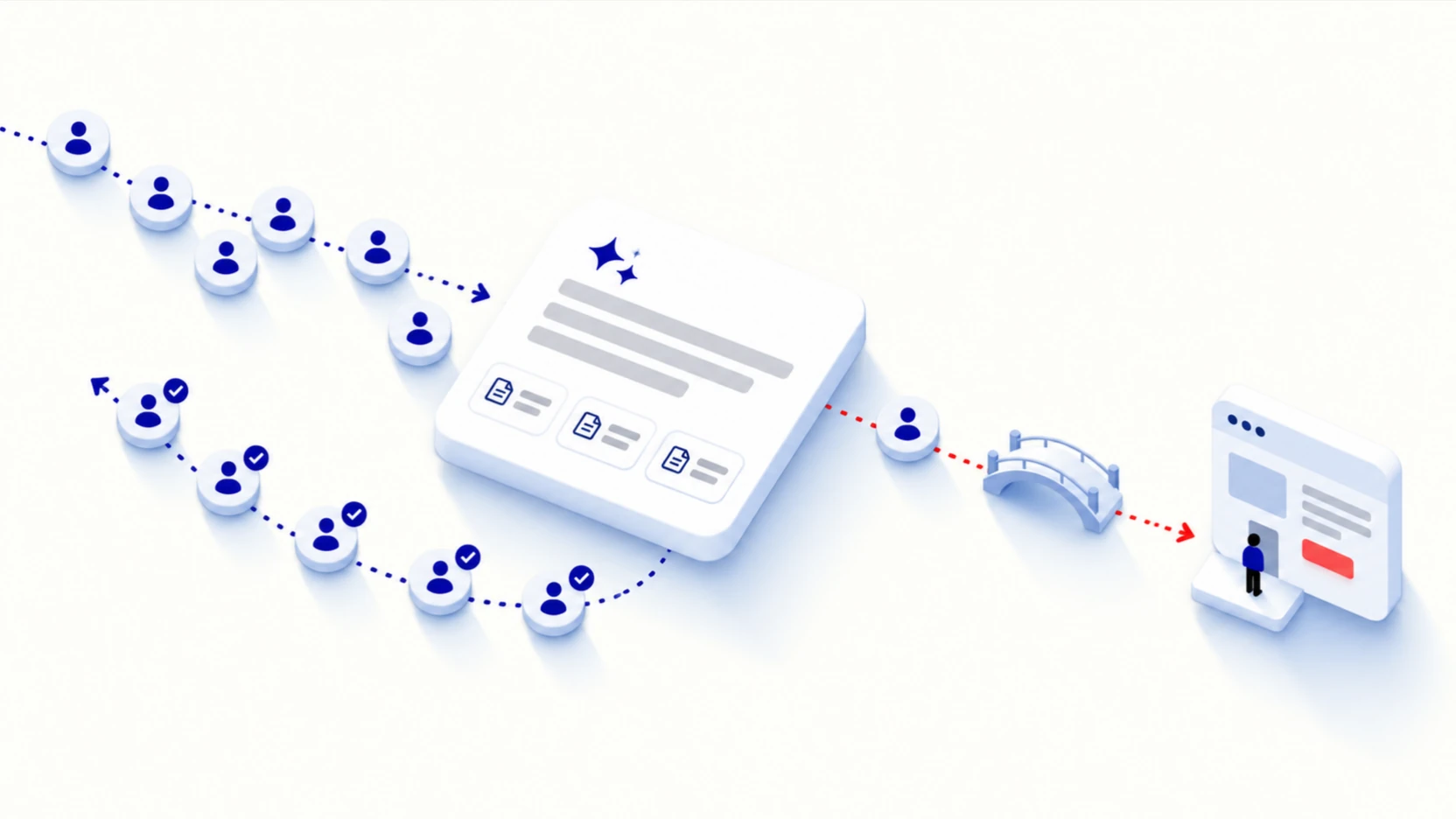
Key point. When an AI answer satisfies the buyer, a citation is worth what the answer says about you, because most people who read an AI summary never click through to anyone. So measure the answer itself, over repeated questions: whether you are named, how you are described, whether you are recommended and which sources the engine used.
On Google, a browsing panel and a randomized field experiment both find fewer clicks to websites when AI Overviews are on the page, and the links inside the overview are rarely clicked; Google says total organic clicks have stayed relatively stable. Check your own Search Console against a control set of queries before you blame AI Overviews for a drop. And write your pages so that the sentence an engine lifts carries your name and your claim, because that sentence may be the only part of your site the buyer ever reads.
This page is stage 5, Clicked, of our AI search visibility funnel. The glossary defines zero-click search, citation, mention and AI referral traffic.
How much less do people click when an AI answer appears?
On Google, people click a regular result about half as often when an AI Overview is on the page, according to Pew Research Center's independent browsing study. Researchers at Pew Research Center followed the browsing of 900 US adults through March 2025, covering 68,879 distinct Google searches. About 18% of the searches showed an AI Overview. On visits to a results page with one, people clicked a traditional search result 8% of the time, against 15% on pages without one, and they ended their browsing session more often (26% against 16%). They clicked a link inside the overview itself on 1% of visits to pages that showed one.
Pew's study is observational, and its authors say they cannot make causal claims from it. They did test whether the gap was only a difference between kinds of searches: in a mixed-effects model that controlled for query length, question words and each person's own habits, the differences in clicking and in ending the session remained significant.
A preregistered field experiment comes closer to cause and effect. Wang, Gleason, Bart, Wilson and Metaxa (a 2026 preprint) recruited about 1,100 US adults who use Chrome and Google, installed a browser extension, and after three normal days randomly assigned each person for seven days to ordinary Google Search, to Google with AI Overviews and AI Mode hidden, or to Google with every search sent to AI Mode. In their sample, 36% of searches showed an AI Overview.
- Hiding AI Overviews raised the click-through rate to other websites by 8.8 percentage points (95% interval 2.3 to 15.3; Wang and colleagues, 2026). A change Google made to the AI Overview page code partway through broke the hiding, so only about half of the overviews were actually removed; the authors scale the effect to the share of overviews actually hidden.
- Sending every search to AI Mode cut the click-through rate by 18.8 percentage points (95% interval 15.3 to 22.2), lowered people's trust in what they found on Google, and pushed more of them to try another search engine.
- Removing AI Overviews made no detectable difference to trust or to how useful and satisfying people found search.
The sample skewed younger, more educated and more left-leaning than the US population, and seven days is too short to see people adapt. The direction is the useful part: on Google, in ordinary browsing, AI features take clicks away from websites.
The overviews also appear most often on the kind of search a buyer runs before a demo call. Xu, Iqbal and Montgomery (ACM Internet Measurement Conference 2026) ran 55,393 trending Google searches between March 13 and April 21, 2026. An AI Overview appeared on 13.7% of them overall, on 64.7% of searches phrased as a question, and on 9.5% of the rest. About half of their sample was sports, and Technology searches were under 1% of it, so the rates will differ for software buying questions. "What is the best SOC 2 tool for a 40-person startup?" is a question, and questions are where answers replace results.
Our own Google measurements look at business searches rather than trending ones, and there the overviews were the rule rather than the exception. "Google showed an AI Overview on 573 of 650 non-branded business searches we tracked" (US English desktop, July 2026, five verticals). On software buying searches specifically: "On 148 commercial SaaS searches such as 'best CRM for small business', Google showed an AI Overview on 143 of them, and each one cited a median of 9 different websites." That measurement covers SaaS head terms on July 19, 2026.
All of these studies measure Google.
What does Google say about clicks from AI Overviews?
Google says total organic click volume from Search to websites "has been relatively stable year-over-year", and that it is sending "slightly more quality clicks", which it defines as clicks where the user does not quickly come back. Liz Reid, Google's head of Search, wrote this on Google's blog in August 2025 and called third-party reports of dramatic declines "often based on flawed methodologies". Google's developer documentation adds that clicks from results pages with AI Overviews are "higher quality (meaning, users are more likely to spend more time on the site)".
Google made similar claims under oath. In the US search antitrust case, the court's remedies opinion of September 2, 2025 records Reid's testimony that Google searches in the United States went up after AI Overviews launched, and a Google document saying a page shown as a corroborating link in an AI Overview gets more clicks than it would as a blue link (remedies opinion, pp. 20 to 21). The same 2025 finding records a Google witness agreeing that there is a sentiment inside Google that its own search features reduce clicks on other sites' results. These are Google's statements, not measurements by the court.
Three things to keep in mind when you weigh this against the studies above:
- It is an aggregate across the whole web, and Google has not published the data behind it. The same post says traffic is shifting between sites, "resulting in decreased traffic to some sites and increased traffic to others", and names forums, videos and first-hand perspectives as the winners. Stable totals and a falling line for your site can both be true.
- It answers a different question. Pew and the field experiment compare the same people with and without AI features at the same time. A year-over-year total mixes AI Overviews with growth in searches, new result types and everything else that changed in that year.
- "Quality click" is Google's own definition. Neither Pew nor the field experiment measured whether the clicks that remained were longer or more valuable. Treat it as Google's description of its product, and measure it yourself on visitors who arrive from AI answers.
Why do the click studies disagree?
They disagree because they measure different things, and most of the numbers you will see quoted are about a different unit from the one you care about. Here is how the studies fit together.
| Study | Design | What it measures | What it can and cannot tell you |
|---|---|---|---|
| Pew Research Center (March 2025) | Browsing panel, observational | Clicks per visit to a results page, with and without an AI Overview, same month | A large gap, which held after controls for query type; not proof of cause |
| Wang and colleagues (March 2026, preprint) | Randomized field experiment | Click-through rate when AI features are hidden or forced | Cause and effect, for one week, in a younger and more educated sample |
| One SEO vendor's keyword study (2025) | Same keywords, before and after an AI Overview appeared | Share of searches ending with no click at all | Found the zero-click rate fell, from 33.75% to 31.53%; no comparison group |
| Khosravi and Yoganarasimhan (Wikipedia, preprint) | Difference-in-differences, English against German and French | Search referrals to Wikipedia | A drop for one informational publisher; the estimate changed between versions |
| Google (Reid, 2025) | Company statement | Total organic clicks to all websites | Stable in aggregate; no data released |
Our reading of the disagreements:
- The vendor study and the experiments are not in conflict as much as they look. The vendor compared the same keywords in May and in October 2025, with no group of keywords that never gained an AI Overview to show what would have happened anyway, so anything else that changed between those months is inside its result. Its unit is also different: a keyword's zero-click rate, which does not say which results received the clicks. The vendor's clickstream panel comes from a company it owns, which it says in the study.
- A widely relayed Wikipedia figure is out of date. The first versions of the Wikipedia paper (February and April 2026) estimated that AI Overviews cut daily traffic to English articles by about 15%. The current version (September 2026) uses a different design, monthly search referrals, and estimates 5.45% and 4.82% against German and French. Both the field experiment and the Internet Measurement Conference paper above still cite the 15%. Always quote the version and date of a preprint.
- How often AI Overviews appear depends on whose searches you count. Pew found 18% of real searches by a representative panel in March 2025; the field experiment found 36% of its participants' searches in March 2026; Xu and colleagues found 13.7% of trending searches. None of these is "the" rate for your buyers.
- Pew's 8% against 15% is a comparison within one month. It is sometimes repeated as a fall from 15% to 8% over a year. It is not.
- The effect depends on the interface. In a preprint, Zhang, Cui and Zhang found that Reddit communities Google could cite in AI Overviews gained comments relative to communities it could not cite, mostly in experience-based discussion, and that the gain largely disappeared after AI Mode launched. In the field experiment, sending every search to AI Mode cut click-through by more than hiding AI Overviews raised it. Google can change the cost of zero-click with a design change.
A caution on any figure that compares click-through on keywords with an AI Overview against different keywords without one. That comparison is a correlation. Google shows AI Overviews more often on longer searches and on searches phrased as questions (Pew and Xu both found this), and those searches had different click habits before AI Overviews existed. Even the vendor above says the higher zero-click rate of its AI Overview keywords "may reflect that those terms often have informational intent rather than indicating causation". So a lower click-through rate on AI Overview keywords mixes the overview's effect with the kind of question being asked. Compare how each group changes over the same period, as in the method below, and treat the result as a strong hint, never as a measured effect on your site.
Is a citation worth anything if nobody clicks?
Yes, because a citation is an impression made at the moment a buyer is forming a view, and what it is worth depends on what the answer says next to it. Picture the buyer a week before your demo call. They ask an assistant which expense tools suit a 50-person startup that needs NetSuite sync. The answer names three vendors, gives each one sentence, and says which one fits a team of that size. They may never visit any of the three sites. If the sentence about you is accurate and favourable, the citation did its work. If it describes the product you sold two years ago, or repeats a weakness a reviewer wrote in 2023, it did harm, and your analytics will show nothing either way.
Three things decide the value of an appearance in an AI answer:
- Whether you are named in the text. A link in a source panel and a sentence that names you are different events. Buyers read the sentence.
- What the answer says about you. Your category, who you are for, whether you are recommended, and what caveats come with you.
- Which sources it used to say it. Your own pages, review listings, a competitor's comparison page or a forum thread. The source tells you where to make a correction.
A citation is also shared. "A Google AI Overview cites about 6 different websites on average, so a single citation is roughly one sixth of the answer." That is an average over 393 answers to 140 searches in our own Google measurements, not a peak, and it is one more reason to read what the answer says about you rather than count the link.
Is zero-click search killing small business websites?
Zero-click search is not killing small business websites, but it is changing what they are for. Searches that end without a click are now the majority on Google: SparkToro's clickstream studies counted about 585 of every 1,000 US Google searches ending with no click in 2024, and 680 of every 1,000 in the first four months of 2026, on two different panels, so read the trend rather than the exact rise.
A business that sells a product or a service does not need every reader to visit. It needs the answer the buyer reads to name it correctly and to give a reason to call, book or try, and that answer is written from pages, including yours. So keep the website, write it so its sentences survive being quoted, and judge it on the visits that come with intent (calls, bookings, demo requests) and on what answers say about you, not on total sessions.
What should we measure instead of clicks?
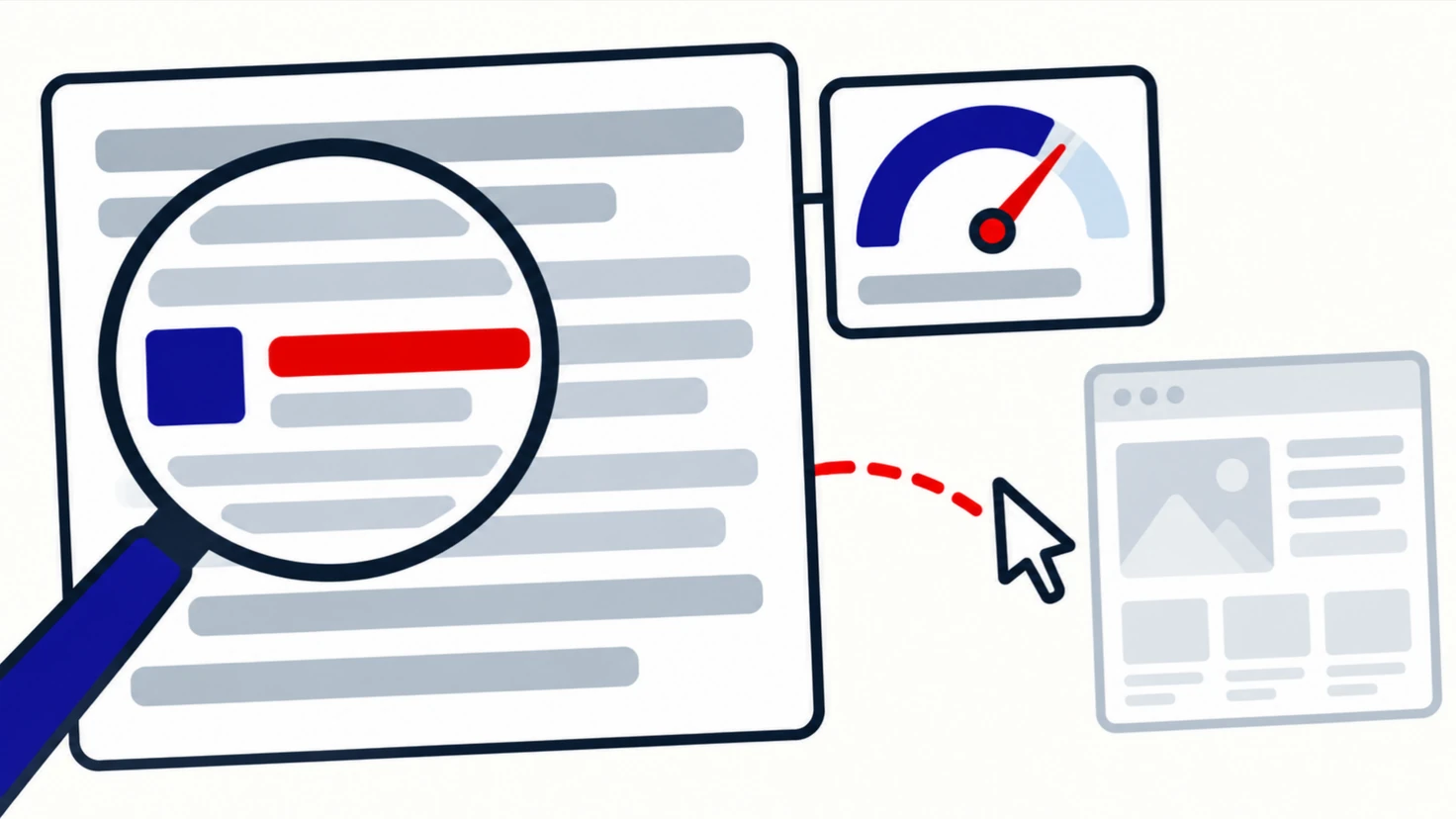
Measure the answer first and the traffic second. Traffic records only the buyers who clicked; the answer reaches all of them.
| What to measure | How | What it tells you |
|---|---|---|
| Named and described correctly | Ask 15 to 30 buyer questions on each engine, each at least three times, and record whether you are named and how you are described | Whether the answer works for you when no one clicks |
| Verdict and sources | For every answer that discusses you, record its conclusion about you and the domains it cites | Which stage of the funnel to fix |
| Branded search | Monthly impressions for searches that contain your company name, in Google Search Console | Interest created somewhere you cannot see |
| AI referral and direct visits | Referrers such as chatgpt.com and perplexity.ai in your analytics, plus direct traffic | A lower bound on the visits answers send |
| Self-reported attribution | An "AI assistant" option in "How did you hear about us?" | The only direct view of influence that left no click |
| Question-to-demo path | Landing pages of AI referral visits, and the questions buyers bring to the first call | Whether answer readers who do visit become pipeline |
Ask more than once because the sources move. In our Google measurements, "AI Overview source lists turn over fast: across 8 captures in one week, the typical website stayed in an answer's source list for one capture interval." A single check tells you about one moment, not about what buyers are being told.
Three cautions on the traffic rows:
- Google files AI Overview and AI Mode clicks under ordinary search. In Search Console they sit inside the "Web" search type of the Performance report. Search Console's separate generative AI performance report shows impressions in AI Overviews and AI Mode by page, country, device and date, but no clicks and no queries.
- Google Analytics 4 does the same. Its AI Assistant channel covers visitors from "sources like ChatGPT, Gemini, Deepseek, Copilot, or Grok" and "excludes Google's AI Overviews and AI Mode", which land in Organic Search. Our conversion guide shows how to check that every assistant you care about lands in the channel you expect.
- Many visits from AI assistants arrive with no referrer and are counted as direct, so every AI referral figure is a floor.
Why did my organic traffic drop after AI Overviews launched?
AI Overviews are one possible cause, because people click a regular result less often when an overview is on the page, but rankings, seasonality and demand move clicks too. To tell them apart in Search Console, compare the queries that now show an AI Overview with a control set of similar queries that do not, over the same two periods, and look at how each group's click-through rate changed. A fall in the first group alone is the pattern to look for; a fall in both points somewhere else. The method takes an afternoon.
- Export your queries. In the Search Console Performance report (search type "Web"), export queries with clicks, impressions, click-through rate and average position for the last 28 days and for the same 28 days a year earlier. Same dates a year apart remove most seasonality.
- Mark which queries show an AI Overview today. Search Console does not tell you this per query, so check your top 50 to 100 non-branded queries by hand in a private browser window, or with a search results tool, and note the date. Use the same country as your buyers.
- Build the two groups. Group A shows an AI Overview; group B does not. Keep them comparable: separate branded from non-branded searches, and match on position band (for example, average position 1 to 3 in both groups). Branded searches belong in neither group if you want to measure category questions.
- Read the four columns together. Impressions and position stable with click-through falling in group A but not in group B is consistent with the AI Overview taking clicks. Falling impressions point to demand or rankings. Falling click-through in both groups points to something else on the page, such as more ads, or to a tracking break.
- Watch the position column with care. Google assigns every link in an AI Overview the overview's single position. If your page is cited in an overview at the top, its average position can improve while its click-through rate falls, which looks like a ranking gain with lost traffic.
- Rule out tracking breaks. Compare Search Console clicks with analytics sessions from Google organic for the same pages. If one moved and the other did not, fix tracking before drawing conclusions.
- Add the generative AI report. For the pages in group A, set their AI Overview and AI Mode impressions (generative AI performance report) next to their Web clicks, month by month.
What this gives you is a strong hint, not a measured effect. Google shows AI Overviews where its systems judge them helpful, so the queries in group A were chosen by Google for reasons that may also change clicks. A difference that holds across several months and both position bands is worth acting on; one month is not.
How do you track buyers who never clicked?
Ask them: self-reported attribution is the one measure that sees influence without a visit, and it costs a form field.
- Add AI options to "How did you hear about us?" on the demo and trial forms: ChatGPT, Google AI Overview or AI Mode, Perplexity, Claude, Microsoft Copilot, and "another AI assistant". Keep your existing options so the trend stays comparable.
- Add an optional free-text field: "What did you ask?" The questions buyers type are the best input you will get for your measurement question list.
- Ask again on the first call. Sales asks where the buyer first heard of you and what they already believed about you. A buyer who arrives with a wrong belief is a direct report of what an answer said.
- Store the answer as a CRM field, so you can compare deal outcomes for buyers who cite an AI assistant with the rest.
Self-reports are imperfect. Buyers forget, and many cannot tell an AI Overview from the rest of Google. Read the share as a trend over months, next to branded search and your answer measurements, and never as a precise count.
What we see in our own measurements
We judge AI visibility by reading what the answer says about a company, and we started with ourselves. A prospective buyer once showed us a single ChatGPT answer about whether to hire Elementera. It gave its verdict on our team's expertise and on our track record. None of that would ever have reached our analytics. The buyer read it, and nothing was clicked.
One answer proves nothing, so we measure this as a method. We ask twelve questions a buyer asks before hiring us ("Is Elementera trustworthy?", "What does Elementera do?" and others), three times each, on two engines' developer APIs: OpenAI's API with web search and Perplexity's Sonar API. For every answer we record whether it discusses us, how it describes us, its verdict on each quality it chose to judge (expertise, track record, independent verification and so on), and every source it cited. A model labels the verdicts and we spot-check its labels by hand.
The method changed how we read our own visibility. A click count asks whether anyone came; a verdict asks what they were told, and on what evidence. The second question points at a fix, because a weak verdict usually traces to a gap in what independent sites say about you, which is a source reputation problem. We describe the measurement, with every answer and source, in the AI due-diligence check.
We record the version and date of every preprint we cite, and recheck it before each update of a page.
How do you write a page for a buyer who may never visit it?
Write so that the sentence an engine lifts works on its own, and give the reader a reason to click that a summary cannot replace.
- Put your name and category in the answering sentence. "YourCompany is expense management software for startups with 20 to 200 staff" survives being quoted. "Our platform helps growing teams" loses who "our" is the moment it is lifted.
- State the facts a buyer compares. Price range, named integrations, certifications, the team size you serve, and the date you last checked them. An answer can only repeat the facts it can find.
- Say who you are not for. Answers summarise fit, and a buyer who learns from the answer that you do not suit them was never going to close.
- Keep comparison and alternatives pages honest and current. Buyers ask "X versus Y", and the engine reads whichever page answers it.
- Offer what an answer cannot. A pricing calculator, an interactive demo, a sample report or a free trial is a reason to visit after reading a summary. Google's own post says people keep clicking for in-depth reviews, original posts and first-person analysis.
You will see advice to cut pages into 40-word answers or add special markup for AI. For Google Search, Google says you do not need to: its guide lists "chunking" content and special AI files and markup among things to ignore. Passage structure that helps readers (question headings, the answer in the first sentence, one topic per section) is covered in pages written for machines versus for people. If the answer describes you wrongly, start with when AI describes your company wrong.
What to do this week
- Add AI assistant options and an optional "What did you ask?" field to your demo request form.
- Run the Search Console comparison above on your top 50 non-branded queries: an AI Overview group, a control group, same 28 days this year and last.
- Write down 15 to 20 questions buyers ask before a demo. Ask each one on ChatGPT, Google and Perplexity at least three times, and record whether you are named, how you are described, whether you are recommended and which sources are cited.
- Create an AI referral segment in your analytics, and note in your reporting that Google's AI Overview clicks sit inside ordinary organic search traffic.
- Start a monthly log of branded search impressions and direct traffic, next to a log of what you launched and changed, so a rise has a candidate cause.
- Rewrite the first sentence of your home, pricing and main product pages so it names your company and your category in standard words.
- Ask sales to record, on every first call, where the buyer first heard of you and what they already believed.
Frequently asked questions
Is zero-click bad for a software or services company?
It is bad for a business that sells page views. A SaaS, fintech or services company sells a product or a service, and a buyer who reads an accurate, favourable answer about you and then books a demo directly is a good outcome with no AI click in it. Zero-click is bad for you when the answer describes you wrongly or leaves you out, because then you lose the buyer and the chance to correct them.
Should we block AI crawlers or opt out of AI Overviews so that buyers have to visit?
No. Blocking an engine's search crawler removes your pages from what it reads; the buyer still gets an answer, written from other people's pages about you. Google also lets a site exclude itself from generative AI features in Search Console; Google's guide says a site must be included there to be eligible for display in them. Excluding removes your citation, while the answer is still written from other sources. Our indexability guide explains which crawlers control search and which control training.
Is it true that 60% of searches are zero-click?
Roughly, for Google as a whole, and the latest figure is higher. SparkToro's 2024 study (a clickstream panel) found 58.5% of US Google searches ended without a click; its June 2026 follow-up, on a different panel, put January to April 2026 at 68%. The unit is a search: refining the query or leaving both count. It is not your page's click-through rate, which your Search Console shows.
Will ChatGPT replace Google for my business?
Nobody can say yet, and you do not need to bet on one. A buyer may ask an assistant for a shortlist and still search your name on Google before booking. Measure both: ask your buyer questions on ChatGPT and on Google, record whether you are named and how, and keep reading branded search in Search Console.
Does a link inside an AI Overview send traffic?
Rarely. In Pew Research Center's panel, people clicked a link inside the AI Overview on 1% of visits to pages that showed one. Count the citation as an impression and the click as a bonus.
Google says clicks are stable. Why did ours fall?
Google's figure is a total across all websites, and Google itself says traffic is moving between sites. Your fall may come from AI Overviews, from lost rankings, from lower demand or from a tracking change. The Search Console comparison above separates the first from the others.
How quickly does branded search respond to better AI answers?
There is no fixed timeline. Branded search moves with campaigns, launches, funding news and seasonality. Log those next to it, and look for a change that persists over several months.
Work with us
There are two ways to work with us. Teams that want the answer measurement and the follow-up work done for them can use our managed AEO services: Book a call. Teams that want to see first what AI engines tell buyers who never visit can start with Lenz, our free analysis of how ChatGPT and Gemini answer their buyers' questions: Get your free AI visibility report.
Sources
- Chapekis, Lieb, Shah and Smith (Pew Research Center). "Investigating Click Behaviors On Google Search Result Pages That Produce an AI Overview." Extended abstract, IC2S2 2026. arXiv 2608.04831. First reported by Pew Research Center on July 22, 2025: Pew Research Center
- Wang, Gleason, Bart, Wilson and Metaxa. "AI in Search Reduces Publisher Referrals Without Improving User Experience: Experimental Evidence." Preprint, version 1, August 2026. arXiv 2608.18352
- Xu, Iqbal and Montgomery. "Measuring Google AI Overviews: Activation, Source Quality, Claim Fidelity, and Publisher Impact." Proceedings of the ACM Internet Measurement Conference (IMC) 2026. DOI 10.1145/3777912.3839818. arXiv 2605.14021
- Khosravi and Yoganarasimhan. "Impact of AI Search Summaries on Website Traffic: Evidence from Google AI Overviews and Wikipedia." Preprint, version 6, September 2, 2026 (versions 1 and 3 reported about 15%). arXiv 2602.18455
- Zhang, Cui and Zhang. "The Impact of AI Search on the Online Content Ecosystem: Evidence from Google and Reddit." Preprint, version 3, 2026. arXiv 2605.16428
- Fishkin (SparkToro). "2024 Zero-Click Search Study: For every 1,000 EU Google Searches, only 374 clicks go to the Open Web. In the US, it's 360." July 1, 2024 (clickstream panel; 58.5% of US and 59.7% of EU Google searches ended with zero clicks). sparktoro.com
- SparkToro. "In 2026, Less than One Third of Google Searches Still Send a Click." June 8, 2026 (a different clickstream panel; 68.01% of Google searches, January to April 2026). sparktoro.com
- Reid. "AI in Search is driving more queries and higher quality clicks." Google, The Keyword, August 6, 2025. blog.google
- Google Search Central. "AI features and your website." developers.google.com
- Google Search Central. "Optimizing your website for generative AI features on Google Search." developers.google.com
- Search Console Help. "Performance report (Search results)", methodology for AI Overviews and AI Mode. support.google.com
- Search Console Help. "Generative AI performance report (Search)." support.google.com
- Analytics Help. "Default channel group." support.google.com
- Elementera, Google AI Overview measurements, US English desktop, July 2026, non-branded business searches in five verticals.
- The keyword study is one SEO software vendor's "AI Overviews Study" (2025, updated December 2025), described without naming or linking it.

AI/ML scientist with 20+ years of research & industry experience. Ex-Google DeepMind, MIT, Harvard, Mila. McGill-Mila PhD.

Known professionally as Dr. Med with 12+ years of experience implementing AI products. Strategic advisor to multiple successful founders including a unicorn, US patent holder. Ex-SOTI, UC Berkeley PhD.
Related articles
- Maximize Answer Visibility With Proven AEO Techniques
- Why Optimize Answer Visibility for Better Engagement: Effective AI Content Discoverability Strategies
- Why Choose Answer Engine Optimization (AEO) for AI Search Optimization Over Traditional SEO?
- How Answer Engine Optimization Strategies Enhance AI Search Engine Visibility and Brand Discoverability
- Why ranking well on Google does not mean AI Overviews read your page
Latest articles
- How Microsoft Copilot finds and cites sources, and what a site owner controls
- How ChatGPT search finds and cites sources, and what a site owner controls
- How Google AI Overviews and AI Mode choose sources, and what a site owner controls
- Can AI search engines fetch and index your pages? What you control
- How to advertise in AI assistants: what is live now