
The AI due-diligence check: what AI tells a buyer who asks whether to hire you
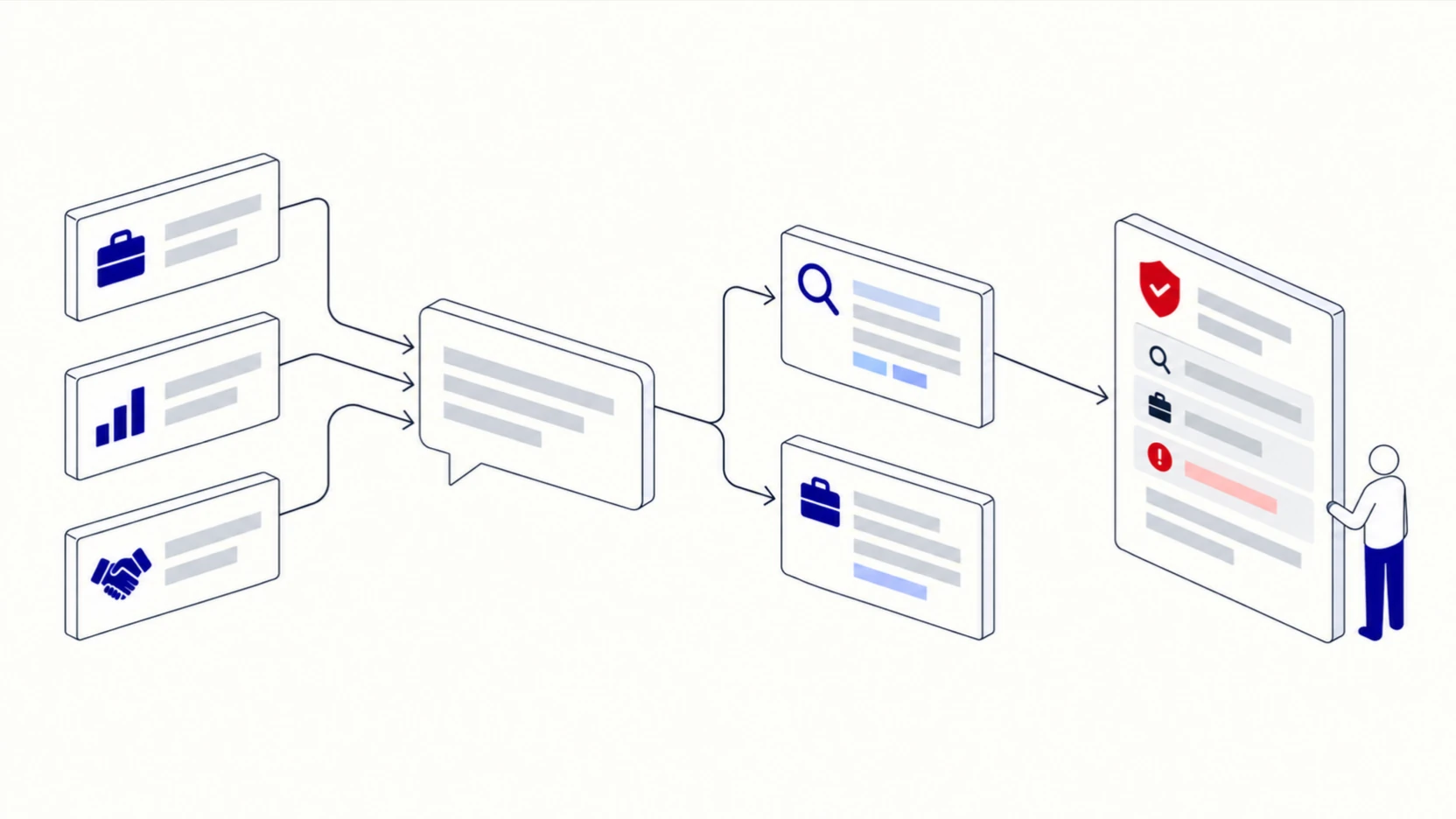
Key point. An AI due-diligence check measures what AI assistants tell a buyer, investor or partner who asks whether your company can be trusted, what it does, how it compares, what its downsides are and whether its people are credible.
You ask the questions a careful buyer asks, on more than one engine, several times each, and record the verdict each answer gives, the reasons it gives, and the sources it relies on. The result tells you which claims about you the engines can verify, which they cannot, and where they look. We ran it on ourselves before publishing this program; the results are below, including the parts that do not flatter us.
Do B2B buyers really ask ChatGPT about vendors before a sales call?
Most say they use AI in buying, much of it in early research before a vendor is involved, but the best public numbers are self-reported surveys, not observed behaviour. Forrester reported in January 2026 that 94% of business buyers in its Buyers' Journey Survey, 2025 used AI in their buying process, up from 89% a year earlier, and that twice as many named generative AI or conversational search as a more meaningful source of information than any other source, "far outpacing vendor websites, product experts, and sales".
A survey published in July 2026 by an SEO software vendor asked 622 US B2B professionals in March and April 2026; its findings are based on the 519 who said they use AI tools for work. Of those, 66% said they regularly use AI to research vendors and solutions, 72% said they use it during early research, scoping the category or defining what they need, 92% said AI has shaped their vendor shortlist, and 71% said they visit a vendor's website after an AI tool mentions it. The base matters: these are shares of people who already use AI at work, asked by a company that sells AI visibility tracking, so read them as the direction of the habit rather than its exact size.
What neither survey can tell you is what an assistant said about your company. That is what this check measures.
Why does it matter what ChatGPT says when someone asks about my company?
Because the summary a buyer gets is assembled from whatever the engine can find and is willing to trust, and you are not in the room to correct it. It does not see your sales deck. It sees your website, your LinkedIn page, review listings, press, directories, and the research and profiles of your people. If those sources are thin or old, the verdict reflects that.
We learned this directly. A prospective buyer asked ChatGPT whether to hire us and showed us the answer. It rated our team's AI expertise and research credentials as strong, our conceptual understanding of the problem as "promising", and our long-term independent track record as "not yet well established", and it explained that it discounted testimonials that appear only on our own site. That answer is the reason this check exists.
The scope of that lesson matters. Asked for a list of firms to hire, an assistant can repeat facts a company states about itself, such as years in business or accreditations. Asked whether one company can be trusted, the answer we saw weighed who else says so. Those are different questions, and a check should ask both kinds.
What does the check measure?
It measures five things, each across repeated answers rather than one.
- The verdict on each dimension the engine chooses to use. Engines do not use a fixed scorecard. One answer rates "expertise" and "track record"; another rates "transparency" and "product quality". We record each dimension in the engine's own words and map it to a short label, so the same dimension can be counted across answers.
- The recommendation. Whether the answer recommends you, says to proceed with diligence, urges caution, or declines to recommend.
- Whether the engine describes your current business, and the right company. After a rebrand or a change in what you sell, answers can describe what you used to do, and a company with a similar name can be merged with yours.
- The gaps the engine names. Answers often say what they could not find: independent reviews, case studies, pricing, methodology. These are the most useful lines in the whole exercise.
- The sources each answer cites. Which sites the engine relied on tells you where to act.
How do you run it?
You ask a fixed set of buyer questions on each engine at least three times, and keep every answer.
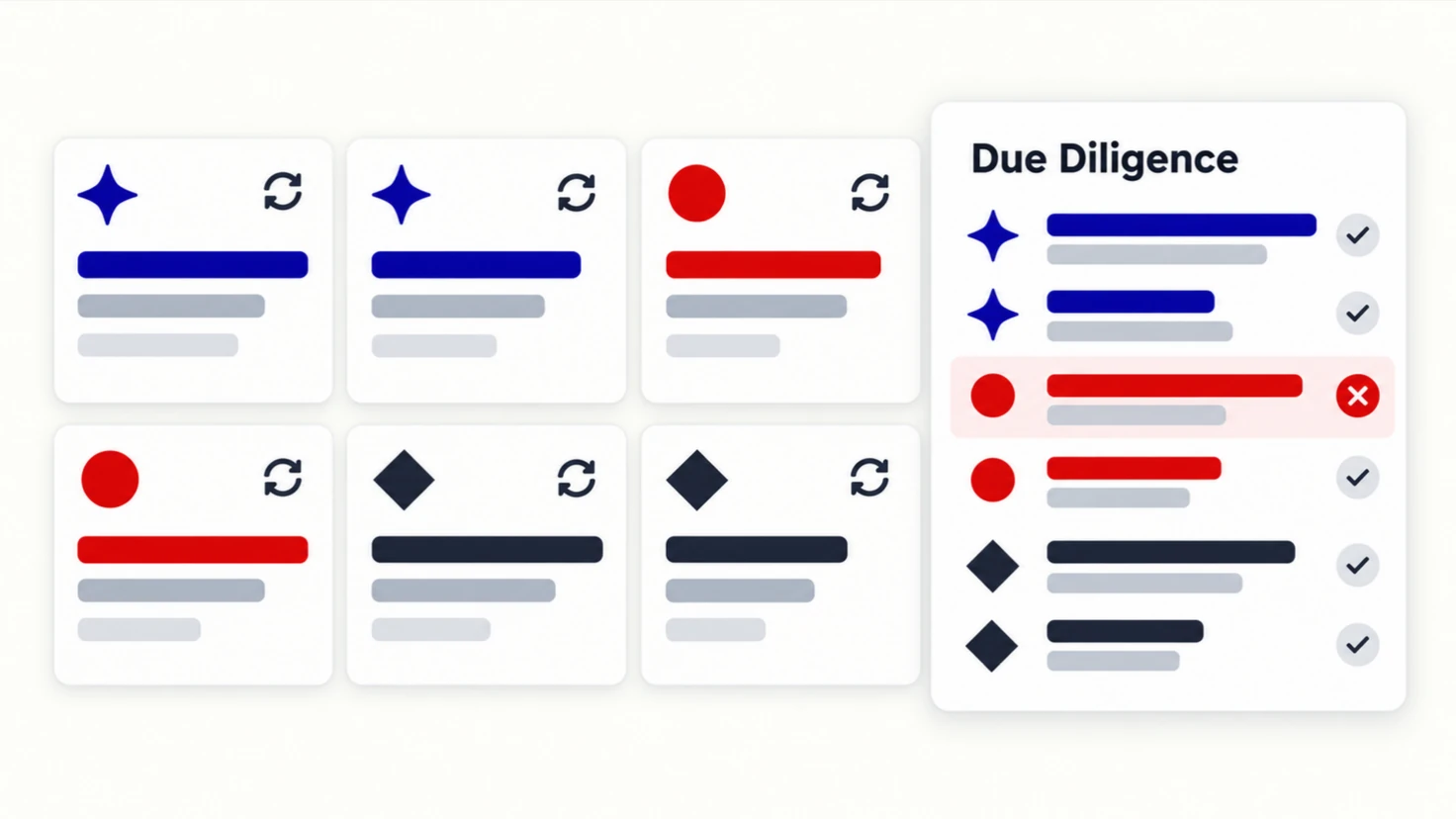
The questions. Use the questions a careful buyer asks, in their words. Ours were:
- "Is
[company]trustworthy?" - "Should I hire
[company]for[what you sell]?" - "
[company]reviews" - "What does
[company]do?" - "Is
[product]any good?" - "Who are the best
[category]providers for a[buyer type]?" (a question that does not name you) - "How does
[company]compare with other[category]providers?" (described by category, not by competitor name) - "Is
[founder name]credible on[your field]?", once per founder - One long diligence question: "I am a
[buyer type]considering[company]([domain]) for[what you sell]. Rate their expertise, credentials, understanding of the problem, and long-term track record."
For the next run we are adding two downside questions and two investor questions, described in the sections below. Our first run did not include them.
The engines. Measure each engine separately and never average them: they search, rank and cite differently. Label honestly what you measured. We used the OpenAI API with its web search tool and the Perplexity Sonar API because both can be asked the same question repeatedly and keep a full record. They are developer APIs, not the consumer apps a buyer uses, and they are not the only assistants buyers use: in the vendor survey above, ChatGPT (71%) and Gemini (61%) led for product research, ahead of Copilot (45%), Perplexity (18%) and Claude (14%). Gemini and Copilot are not in our run, and a full check should add them.
The repeats. At least three answers per question per engine. Answers vary between identical asks, so a single answer is an anecdote.
The record. Keep the full text of every answer, its cited sources, the date, and the model the engine reports it used. Without the full text you cannot check your own reading later. If you run the check by hand in a consumer app, use a logged-out session or a temporary chat so the assistant's memory of you does not shape the answer.
Should you ask AI about your company's downsides?
You should, because "What are the downsides of [company]?" and "What do customers complain about with [company]?" are the questions a careful buyer asks last, and they show which negative claims the engines can find and where they found them. A trust question tells you whether an engine is willing to recommend you; a downside question tells you what it will say against you.
When you read the answers, look for four things:
- Complaints with a source. A complaint that cites a review site, a forum thread or an article is something you can answer where it lives. A complaint with no source is the engine's guess, and repeated asks will show whether it is stable.
- Gaps presented as downsides. "Limited public reviews" and "pricing not published" are absences, not complaints, and they are fixed by publishing, not by rebuttal.
- Someone else's problems. A downside that belongs to a company with a similar name, or to your old product, is a stage 3 positioning error. See when AI describes your company wrongly .
- Old incidents. An outage, a lawsuit or a layoff from years ago can stay in answers long after it stopped being true. Note the date of the source the engine cites.
Our first run did not ask a downside question, so we have no numbers of our own here yet; it is in the next run. If an answer states something false, use the engine's feedback control to report it, and fix the source it cited.
What should a startup check before investors ask AI about it?
The same method works, with investor questions in place of buyer questions. Before a round, ask "What are the risks of investing in [company]?" and "Summarise [company]'s leadership, funding history and traction", then read the answers for the facts an investor will check: the founding team, the stage and date of your last round, your category, and your named customers. Out-of-date funding stages, wrong headcounts and a merged same-name company are the errors that matter most here, because an investor will notice them before you do.
Investors also read company databases directly, and some of those products have their own AI features. We have not measured those features, so the advice is narrow: make sure your profiles on the databases investors use describe your current company, round and team. We have not yet asked investor questions about ourselves; they are in the next run, and until then this section is a method, not a finding.
Does the check cover the documents you send investors?
An AI due-diligence check should include your deck and data room, because some investors give those documents to an AI assistant. What your own documents say to that assistant counts as much as what the web says. One published example is a "Due Diligence Audit Tool" in Feel the Boot's Fundraising Toolkit. Its page says the tool is "Built on Claude AI - Cowork" and offers "the same red flag analysis I run when evaluating startups for North Bay Angels" (read October 26, 2026). We have not run the tool and describe it only as its page does.
Before you share a data room, read it the way an investor's assistant would. Give an assistant the documents you plan to send. Ask "What are the red flags in this company?" and "Where do these documents disagree with each other or with the company's website?" Then look for four things:
- Figures that differ between documents. Revenue, customer counts or headcount that read one way in the deck and another in the model or on your website. An assistant puts them side by side; a busy reader may not.
- Claims with nothing behind them. A named customer, partnership or result with no contract, case study or public source in the folder.
- Old files. Last year's deck, a superseded model or a stale cap table left in the room.
- Gaps between the documents and the web. Your deck may describe a company the engines cannot find, or describe differently. An investor who asks the investor questions above will see that gap too.
We have not measured how investors' assistants read data rooms. Like the section above, this one is a method, not a finding.
What did the check find when we ran it on ourselves?
We ran it on October 5 and 6, 2026: twelve questions, three times each, on two engines, the OpenAI API with its web search tool and the Perplexity Sonar API, for 72 answers. The verdicts were read from each answer by a separate model and spot-checked by hand. Counts read this way can move by one or two between readings, so treat them as approximate.
What the engines credited. Expertise and research credentials were rated well. On the long diligence question, the OpenAI API's own scores out of 10 had a median of 8.0 for expertise and 7.5 for research credentials; the Perplexity API's were 7.5 and 7.0 (three answers per engine on that question).
What they could not verify. On both engines, most of the answers that rated "independent verification" said there was too little to go on. Track record scored lowest on the diligence question, a median of 4.5 on the OpenAI API and 5.5 on the Perplexity API (three answers per engine on that question). The gaps the answers named most often were independent reviews, case studies, pricing and methodology.
Where they looked. Our own site was cited in 59 of the 72 answers.
How they rated trust. Where an answer rated trustworthiness, the usual verdict was "mixed": 10 of the 13 OpenAI API answers that rated it, and 7 of the 11 Perplexity API answers.
Where we are missing. Asked the category question from this October 5 to 6 baseline, which asked for the best AEO firms for a SaaS company and did not name us, neither engine named us in any answer. A re-run with new wording for that question is in progress.
Which company they found. Asked for "Elementera reviews", the OpenAI API identified the right company in only 1 of 3 answers.
What did we change because of it?
We changed the order of our plan. The measured problem was not how the engines described what we do: the engines believed our expertise and could not check our track record or our method. So we are publishing our methods and their limits, a findings index that includes our null results, a record of forecasts locked before we measure, an open-source tool anyone can inspect, and our research as a preprint, in places an engine can check without taking our word for it.
The check maps directly onto the AI search visibility funnel. Credentials that engines trusted sit at stage 2, trusted as a source, because they live on independent sites. Our absence from the "best providers" question is stage 4, recommended. The description of our business is stage 3, positioned correctly, and that one was mostly fine.
How do you read your own results?
Read the gaps first, then the sources, then the scores.
- If the engines name the same gap repeatedly, that gap is your work list. "No independent reviews" means reviews on independent sites, not more testimonials on yours.
- If your own site dominates the sources, the engines are describing you mostly from your own claims, and a careful one will discount them.
- If the description is out of date or belongs to another company, the problem is stage 3, and the sources behind the wrong description tell you what to correct. See when AI describes your company wrongly .
- If you are known by name but absent from category questions, the problem is stage 4. See being recommended over competitors.
- If the scores differ between engines, believe both. They search and weigh sources differently.
A change you make shows up only if it reaches the sources the engines read, and only after they read them again. Compare a later run with your first one, question by question and engine by engine, and treat a move of one or two answers out of three as normal variation, not progress.
What can this check not tell you?
It cannot tell you what a specific buyer saw. Answers vary by account, location, wording and day, and the consumer apps add memory and personalisation that a developer API does not. Many buyers use assistants no outside check can reach: Forrester reports that 61% of business buyers use private AI tools provided by their organization, and that more than half of business users of ChatGPT and Microsoft Copilot use private versions behind their firewall. A buying committee may also have seen different answers from different people: in the vendor survey above, only 39% said most stakeholders in their company actively use AI during vendor research.
It cannot tell you why an engine weighed one source over another; it shows you which sources it cited, not its reasoning. And three answers per question cannot detect a small change. The check finds the large, repeated patterns: the gaps every answer names, the sources every answer relies on. Those are the ones worth acting on.
Frequently asked questions
Can I run this myself?
Yes. The questions, repeats and record-keeping above are the whole method. The work is in asking consistently and keeping every answer. We use our own tooling for it, and the same method in our research, described in how we measure AI visibility .
How do I find out what buyers actually saw?
Ask them. On discovery calls, ask "When you started looking, what did ChatGPT or another assistant tell you about us?" Our own reason for building this check was one buyer who showed us that answer unprompted. A check tells you the pattern; a buyer tells you the one answer that reached the deal.
How often should we re-run it?
Monthly is enough for most companies, and after any change you expect to matter, such as a funding announcement, a launch or a batch of new reviews. While we publish this program we plan to re-run ours weekly on one engine and monthly on both, because we are measuring the effect of the publishing itself.
Should we ask the engines about our founders?
Yes, especially before a funding round or an enterprise deal. In our check the engines rated the founders' research credentials well, with a median score of 7.5 out of 10 on the OpenAI API and 7.0 on the Perplexity API on the diligence question. Founders without independent records give the engines nothing to check.
Does a good result mean buyers will trust us?
No. It means the engines will not undercut you. Buyers still decide on what they see, hear and verify. The check removes one source of doubt you cannot otherwise see.
Work with us
There are two ways to work with us. Teams that want the check run and the gaps worked on for them can use our managed AEO services: Book a call. Teams that want a first look on their own can start with Lenz, our free analysis of how ChatGPT and Gemini answer their buyers' questions: Get your free AI visibility report.
How this page was made
Written by Dr. Mehrdad Mehrbod. Reviewed by Dr. Maziar Gomrokchi.
Sources
- Forrester, John Buten, "B2B Buyers Make Zero-Click Buying Number One", 22 January 2026: forrester.com
- A survey of 622 US B2B professionals (findings based on the 519 who use AI for work), March to April 2026, published July 2026 by an SEO software vendor. Not linked: the publisher is on our no-link list.
- Elementera, AI verdict measurement of Elementera, October 5 to 6, 2026: OpenAI API with web search (served model
gpt-5.5-2026-04-23) and Perplexity Sonar API, 12 questions, 3 repeats each, 72 answers. Method and limits in how we measure AI visibility.

Known professionally as Dr. Med with 12+ years of experience implementing AI products. Strategic advisor to multiple successful founders including a unicorn, US patent holder. Ex-SOTI, UC Berkeley PhD.

AI/ML scientist with 20+ years of research & industry experience. Ex-Google DeepMind, MIT, Harvard, Mila. McGill-Mila PhD.
Related articles
- GEO services vs AEO services: is there a difference, and what should you ask a provider?
- Managed AEO services or AEO software: which does your company need?
- Being recommended over competitors: why AI knows your company and still recommends someone else
- AEO From Zero for a B2B SaaS: The Order We Would Follow
- Zero-click: when the AI answer replaces the visit
Latest articles
- Why ranking well on Google does not mean AI Overviews read your page
- How Microsoft Copilot finds and cites sources, and what a site owner controls
- How ChatGPT search finds and cites sources, and what a site owner controls
- How Google AI Overviews and AI Mode choose sources, and what a site owner controls
- Can AI search engines fetch and index your pages? What you control