
How Google AI Overviews and AI Mode choose sources, and what a site owner controls
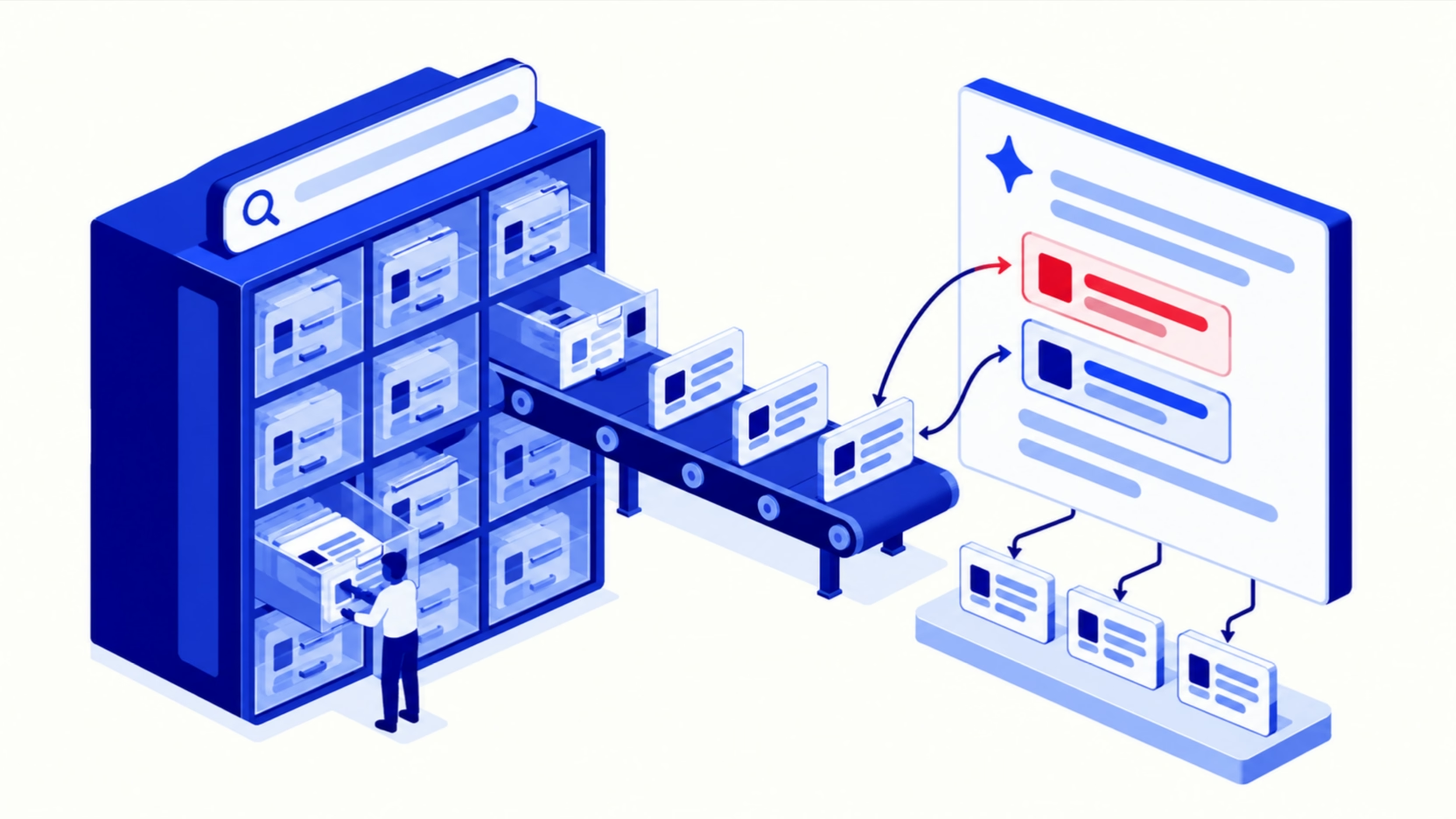
Key point. Google AI Overviews and AI Mode take their sources from Google's own Search index, fetched by the normal Googlebot crawler. There is no separate AI crawler to allow and nothing extra to submit.
Google names two conditions: the page must be indexed and eligible to show a snippet, and the site must be included in "Search generative AI features" in Search Console, which is the default. Eligibility is not selection. In our study of 150 non-branded Google searches (US, July 2026), about 57% of the websites cited in AI Overviews did not appear in that same search's top 10 organic results (95% interval 54% to 60%). You control eligibility (Googlebot access, noindex, snippet controls and that Search Console setting); Google decides which eligible page it cites.
This is one of our engine guides under the AI search visibility funnel. The same questions are answered for Perplexity , Microsoft Copilot and ChatGPT search , and terms such as AI Overview, citation and query fan-out are defined in our AI search glossary.
Which index do AI Overviews and AI Mode retrieve from?
They retrieve from the Google Search index, the same one behind the ordinary results. Google's guide for site owners, AI features and your website, treats both features as part of Search and applies the normal Search requirements to them. Its newer guide, Optimizing your website for generative AI features on Google Search, says the features "are rooted in our core Search ranking and quality systems" and names the two techniques they use.
Retrieval-augmented generation, which Google says is "also known as grounding". Google describes it as "relying on our core Search ranking systems to retrieve relevant, up-to-date web pages from our Search index". The systems then "review the specific information from those retrieved pages" and show "prominent, clickable links" to the pages that support the answer.
Query fan-out. Google defines it as "a set of concurrent, related queries generated by the model to request more information and fetch additional relevant search results". Its example: for "how to fix a lawn that's full of weeds", fan-out queries might include "best herbicides for lawns" and "how to prevent weeds in lawn". Your page may be judged against searches the buyer never typed.
Google attaches a warning to fan-out that most advice on this topic leaves out. Creating separate pages "for every possible variation of how people might search (for example, by focusing on other queries that people have asked, or fan-out queries)" in order "primarily to manipulate rankings or generative AI responses in Google Search violates Google's scaled content abuse spam policy." Write the pages your buyers need; do not mint one page per sub-question.
One more detail from the site-owner guide: "AI Mode and AI Overviews may use different models and techniques, so the set of responses and links they show will vary." Treat them as two surfaces and check both.
Which crawler fetches for it, and which is for training?
Googlebot fetches pages for AI Overviews and AI Mode; Google-Extended is the training control, and it is not a crawler. Google's crawler documentation says preferences addressed to Googlebot "affect Google Search (including Discover and all Google Search features)". Block Googlebot and you leave AI Overviews and AI Mode along with the rest of Search.
Google-Extended works differently: "Google-Extended doesn't have a separate HTTP request user agent string. Crawling is done with existing Google user agent strings; the robots.txt user-agent token is used in a control capacity." It governs whether content may train future Gemini models and ground answers in Gemini Apps and Vertex AI, and "Google-Extended does not impact a site's inclusion in Google Search nor is it used as a ranking signal in Google Search."
The site-owner guide puts it in one line: "To limit AI training and grounding in some of Google's other systems, read more about Google-Extended." Google's help page for the Search Console control adds the part that touches AI Overviews: the control "doesn't affect AI training; to limit training of the models used to generate responses in Search generative AI features, use Google-Extended."
So blocking Google-Extended is a training decision, including for the models behind these features. It does not remove your pages from AI Overviews or AI Mode, and allowing it does not put them in.
What does Google itself document?
Google documents the eligibility rule, the absence of special requirements and the controls; it does not document how one eligible page is chosen over another. From AI features and your website:
- "To be eligible to be shown as a supporting link in AI Overviews or AI Mode, a page must be indexed and eligible to be shown in Google Search with a snippet, fulfilling the Search technical requirements."
- "There are no additional requirements to appear in AI Overviews or AI Mode, nor other special optimizations necessary."
- "AI Overviews are only shown when our systems determine that it is additive to classic Search, and as such, often don't trigger."
The newer optimization guide adds a second condition: "In addition to the technical requirements for Search, a site must be included in Search generative AI features in Search Console to be eligible for display in generative AI features on Google Search." Include is the default, so most sites already meet it. The guide also says that "Indexing and serving aren't guaranteed" even when every requirement is met.
On AEO and GEO, Google's position for its own Search is direct: "From Google Search's perspective, optimizing for generative AI search is optimizing for the search experience, and thus still SEO."
On measurement, appearances are counted in the Search Console Performance report under the "Web" search type. Search Console also has a Generative AI performance report, rolled out to all sites by August 31, 2026, that "includes impressions for the following generative AI capabilities on Google Search: AI Overviews, AI Mode". It groups impressions by page, country, date and device, and filters text searches apart from image searches such as Google Lens. Discover has a report of its own, and experiments in Search Labs are not included. The report lists no clicks and no query dimension: it tells you that a page appeared, not for which search.
What does Google say you can ignore?
Google's optimization guide has a "Mythbusting" list of things site owners "can ignore for Google Search". These statements are about Google Search only; other engines document their own behaviour, covered in their guides linked above.
- llms.txt and other "special" markup. "You don't need to create new machine readable files, AI text files, markup, or Markdown to appear in Google Search (including its generative AI capabilities), as Google Search itself doesn't use them." Keeping an llms.txt for other services "will neither harm nor help" in Google Search.
- "Chunking" content. "There's no requirement to break your content into tiny pieces for AI to better understand it."
- Rewriting content just for AI systems. "You don't need to write in a specific way just for generative AI search."
- Seeking inauthentic "mentions". It "isn't as helpful as it might seem", because the features depend on Google's quality and spam systems.
- Overfocusing on structured data. "Structured data isn't required for generative AI search, and there's no special schema.org markup you need to add." Google still recommends it for rich results.
Google also warns about measurement vendors: "No third-party tool has access to our internal ranking or AI systems." That applies to us too. Our measurements below are repeated observations of the public answers, nothing more.
What is reported but not confirmed?
Three claims circulate that Google's product documentation does not confirm. Read each at the strength of its source.
A lighter retrieval layer called FastSearch. The memorandum opinion in United States v. Google (D.D.C., September 2, 2025) records from trial testimony: "To ground its Gemini models, Google uses a proprietary technology called FastSearch." The court says it "retrieves fewer documents" than Search and that "Google does not use FastSearch results for its SERP." A court finding is strong evidence, but it speaks of grounding Gemini models, not of AI Overviews or AI Mode. That link comes from outside testing: an SEO agency published experiments in May 2025 concluding that AI Mode reads page content from a store separate from the live index. Google has not confirmed it. If it holds, a page could be updated in Search and still be read by AI Mode from an older copy.
That AI Overview clicks are "higher quality". Google's guide says that "when people click from search results pages with AI Overviews, these clicks are higher quality". Google has published no data behind it and we know of no independent check. Test it in your own analytics.
That AI answers cost clicks. This one has independent evidence. In a Pew Research Center study by Athena Chapekis and Anna Lieb (July 2025) of 900 US adults, users who saw an AI summary clicked a traditional result on 8% of visits, against 15% without one. It is a general US sample from March 2025, so read it as a direction; the business side is in zero-click AI answers .
What do Elementera's own measurements show?
Our measurements show that a top-10 ranking does not settle who is cited, and that one check is not a measurement. Everything here is Google AI Overviews, US English, desktop, non-branded category searches. We measure each engine separately and never pool them, and we ask every question at least three times.

The core finding:
"In our study of 150 non-branded Google searches (US, July 2026), about 57% of the websites cited in AI Overviews did not appear in that same search's top 10 organic results (95% interval 54% to 60%)."
Its scope: 142 of the 150 searches showed an AI Overview, giving 1,051 answers over 8 captures. It describes what was cited; it does not say why. An independent study found a similar share (Kirsten and colleagues, arXiv 2510.11560). Good rankings don't guarantee your page is the one being read.
On which kinds of sources appear: "Across 576 Google searches that showed an AI Overview, YouTube was cited in 57% of them (328 searches). Posts on X were cited in none of the same 576." On the SaaS searches in that set, "YouTube was cited on 69% of them; posts on X on none." Both figures count searches where the platform was cited, not what the engine retrieved or read, and a search counts if YouTube was cited on any capture. They do not mean social media has stopped mattering: LinkedIn and Facebook do appear, on about 6% and 4% of the 576 searches.
More figures from the same program, each with its scope. Scope is July 2026 captures unless stated.
- "On 148 commercial SaaS searches such as 'best CRM for small business', Google showed an AI Overview on 143 of them, and each one cited a median of 9 different websites." (One day, July 19, 2026; SaaS head terms only.)
- "Google showed an AI Overview on 573 of 650 non-branded business searches we tracked. On 91% of the searches we added in July (95% interval 88% to 93%), at least one cited website was missing from the organic top 10." (The 91% covers the 500 newly captured searches only.)
- "The website in the first organic position was cited by the AI Overview 56% of the time (95% interval 51% to 61%). Websites in positions 6 to 10 were cited 34% of the time (31% to 37%)." (An association, not the value of moving up; SaaS searches were lowest at position 1, 42%.)
- "A Google AI Overview cites about 6 different websites on average, so a single citation is roughly one sixth of the answer." (An average over 393 answers, not a peak.)
- "AI Overview source lists turn over fast: across 8 captures in one week, the typical website stayed in an answer's source list for one capture interval."
A second independent study points the same way on a very different set of searches. Haofei Xu, Umar Iqbal and Jacob M. Montgomery of Washington University in St. Louis (arXiv preprint, May 2026, not peer reviewed) issued 55,393 trending queries over 40 days in March and April 2026. Averaged across 7,583 AI Overviews, 41.4% of the cited domains overlapped with the top 10 first-page results, and 29.8% did not appear anywhere on the first page. youtube.com was the most cited hostname in their set (5.49% of citations). Their queries were trending topics, heavy on news and sports, so their percentages are theirs and do not transfer to business buyers; we keep the studies separate and never combine the numbers.
Our reading of the overlap, as our own analysis: the authors take low overlap as a sign of "a source pool and prioritization" separate from ranking. Google's own fan-out description predicts low overlap with one query's first page without any separate system, because the answer is grounded on results for several related queries. Both studies measure where cited sites rank for the typed query, and neither can tell those two explanations apart.
The core finding is enough to act on. Each important page has to be eligible and worth citing for the narrower questions a buyer's search fans out into, which means one strong page that answers those questions, not a page per variation (see Google's warning above). We explain why in ranking is not retrieval , and why we repeat every question in how we measure AI visibility .
What can a site owner control, and what can they not?
You control whether your pages are eligible and how much of them Google may use; you do not control whether an AI Overview appears, which sources it picks, or whether anyone clicks.
What you control, as Google documents it:
- Crawl access. Google calls robots.txt rules for Googlebot "the control for site owners to manage access to how their sites are crawled for Search", and asks that crawling be allowed "by any CDN or hosting infrastructure" too.
- Indexing.
noindexkeeps a page out of Search, and so out of both features. - Snippet controls. Per the robots meta tag specification,
nosnippet"will also prevent the content from being used as a direct input for AI Overviews and AI Mode", andmax-snippet"will also limit how much of the content may be used as a direct input". Thedata-nosnippetattribute excludes one section of a page. - The Search generative AI control. In Search Console under Settings, then Search generative AI. It covers AI Overviews, AI Mode and generative AI features in Google Discover. The help page offers include (the default), exclude, or inherit from a parent property. If you exclude, "You won't receive any traffic or impressions from these features", and "Content from other sites will still be available in those features, and it may appear similar to yours." Google says the switch "doesn't affect AI training" and is not a ranking signal elsewhere in Search. Changes take one to two days, sometimes longer.
- Training. Google-Extended, for training Gemini models (including, per the control's help page, the models used to generate responses in these features) and for grounding in Gemini Apps and Vertex AI. It does not change inclusion in Search.
- Preferred Sources. A searcher can mark sites as preferred sources. Google's preferred sources documentation says that in AI Mode and AI Overviews your content can carry a "preferred" badge for the users who selected your site. You can add Google's "Add to preferred sources" button or a deeplink to your pages. Only domain-level and subdomain-level sites are eligible (a
/blogsubdirectory is not), and the site must be included in Search generative AI features in Search Console.
What you cannot control: whether an AI Overview shows for a search, which eligible pages it cites or in what order, which fan-out searches Google runs, and whether the buyer clicks. Preferred Sources changes how your links are labelled for the people who chose you; Google does not say it changes which sites are cited for everyone else.
A warning for SaaS and tech companies, and any business with a category to defend: excluding your site does not remove your category from the answer. A buyer who asks about it still gets an AI Overview, written from other people's pages. Weigh that before you switch exclusion on.
How do I check whether it can see my site?
Confirm that Googlebot can fetch and index the page and that nothing blocks snippets, then read what Search Console reports.
- URL Inspection in Search Console. The page should be indexed, not "crawled, not indexed". Use the view of the HTML Googlebot received to confirm your snippet controls are what you meant.
- Robots and the edge. Read your live robots.txt, then ask whoever runs your CDN or firewall whether Googlebot is ever challenged. Google documents how to verify requests from Google crawlers.
- The control. Under Settings, then Search generative AI, confirm the property includes, or inherits include. This is one of Google's two eligibility conditions, and Preferred Sources depends on it too.
- The Generative AI performance report. It shows which pages earned impressions. With no query dimension, pair it with step 5.
- Your own repeated checks. Ask the buyer's real questions more than once and on different days, and record which sites are cited.
- Your YouTube channel. Search Console now accepts platform properties for Instagram, TikTok, X and YouTube. They "only show how your content performs on Google Search", and Google's documentation for them does not mention AI Overviews or AI Mode. They do show the searches that lead to your videos, which matters given what we see: "YouTube is one of the few social platforms that regularly shows up as a source; posts on X almost never do".
Crawler access across all engines is covered in being indexable by AI search engines.
What would change this advice?
This advice would change if Google moved these features off the Search index, documented a separate retrieval store, or changed what its controls do:
- Google confirming that AI Overviews or AI Mode read from FastSearch or another cached store. Freshness would then depend on that store, not on Googlebot.
- The Generative AI performance report gaining clicks or a query dimension, which would replace part of the manual checking.
- Google making Google-Extended affect inclusion in Search, or narrowing the generative AI control.
- A new model behind AI Overviews. Our patterns are from July 2026; we re-measure rather than assume.
- Our own replication. If a later wave showed far fewer cited sites outside the top 10, we would say so here.
Checklist for this week
Nine steps, in order of effort:
- In Search Console, open Settings, then Search generative AI, and confirm your main property includes.
- Run URL Inspection on your home, pricing, main product, one comparison and one integration page. Each should be indexed.
- Search your templates for
nosnippet,max-snippetanddata-nosnippet, and remove any you did not mean to set. - Ask your CDN or security owner whether Googlebot is ever challenged.
- Decide on Google-Extended as a training question only, and write the reason down.
- Pick ten non-branded questions buyers ask before contacting a vendor, and record the cited sites three times this week.
- Connect your YouTube channel as a platform property if you publish product videos.
- Check whether your domain appears in Google's source preferences tool, and if your readers return often (a blog, a changelog, research), add the preferred sources button.
- If anyone proposes one new page per fan-out question, read Google's scaled content abuse warning first.
Frequently asked questions
Does blocking Google-Extended remove my site from AI Overviews?
No. Google states that Google-Extended "does not impact a site's inclusion in Google Search", and both features are part of Search. To leave them, use the Search generative AI control, nosnippet or noindex.
Do I need llms.txt or special schema to appear in AI Overviews?
No. Google says you do not need "new machine readable files, AI text files, or markup", that there is no special schema.org structured data to add, and that Google Search "itself doesn't use" llms.txt files. Any structured data should still match the visible text. Other engines are a separate question; see their guides.
If I rank first, will the AI Overview cite me?
Not reliably. In our measurements, "The website in the first organic position was cited by the AI Overview 56% of the time (95% interval 51% to 61%)." That is an association across 3,210 ranked results in 393 answers, not a promise for any one page.
Should a SaaS company, or any business, exclude its site with the new control?
Usually not. Exclusion removes your links and content from AI Overviews and AI Mode while the answer is still written from other sites. It makes sense for content you must not have summarised, and data-nosnippet can protect one section without removing a whole site.
How do I write content for Google AI Overviews versus ChatGPT?
Write one page for the buyer and let both engines read it. Google says you do not need to write in a specific way for generative AI search; the page must be indexed and eligible for a snippet. ChatGPT search finds pages through OpenAI's own crawler, OAI-SearchBot, so the difference is access, not wording: allow that crawler in robots.txt as well as Googlebot. Our ChatGPT search guide covers its side.
How long does it take for new content to show up in AI answers?
In AI Overviews and AI Mode, a new page can appear only after Googlebot has crawled and indexed it. Google says crawling "can take anywhere from a few days to a few weeks", and you can ask for a recrawl with URL Inspection in Search Console. Even then, appearing in a given AI Overview is not guaranteed. Settings move faster: a change to the Search generative AI control takes one to two days, sometimes longer.
Work with us
There are two ways to work with us. Teams that want the measurement and the work done for them can use our managed AEO services: Book a call. Teams that want to see where they stand first can start with Lenz, our free analysis of how ChatGPT and Gemini answer their buyers' questions: Get your free AI visibility report.
How this page was made
This page was written by Dr. Maziar Gomrokchi with the help of an AI writing assistant (Claude, made by Anthropic), working from the sources listed below and, where the page says so, from our own measurements. Before writing, we read the pages that currently rank and are cited by Google, AI Overviews and Perplexity for these questions, and set out to cover what they cover and add what they do not. Each factual claim was checked against its source before publication, and findings of ours appear only as we have published them. Soroush Mehri reviewed the page, and Dr. Maziar Gomrokchi approved it for publication.
Sources
- Google Search Central, AI features and your website, last updated 2025-12-10, accessed 2026-10-06.
- Google Search Central, Optimizing your website for generative AI features on Google Search, last updated 2026-07-10, accessed 2026-10-06.
- Google Search Central, Help your readers find your site through preferred sources in Google Search, last updated 2026-09-18, accessed 2026-10-06.
- Google, Google's common crawlers, last updated 2026-07-14; archived copy 2026-08-26.
- Google Search Central, Robots meta tag, data-nosnippet, and X-Robots-Tag specifications, last updated 2026-03-24.
- Search Console Help, Search generative AI control, accessed 2026-10-06.
- Search Console Help, Generative AI performance report (Search), accessed 2026-10-05.
- Search Console Help, About platform properties, accessed 2026-10-05.
- Google, Verify requests from Google crawlers.
- Google Search Central, Ask Google to recrawl your URLs, last updated 2025-12-10, accessed 2026-10-20.
- OpenAI, Overview of OpenAI Crawlers, accessed 2026-10-20.
- US District Court for the District of Columbia, Memorandum Opinion, United States v. Google LLC, No. 20-cv-3010 (APM), September 2, 2025, findings of fact paragraph 44.
- Xu, H., Iqbal, U. and Montgomery, J. M., Measuring Google AI Overviews: Activation, Source Quality, Claim Fidelity, and Publisher Impact, arXiv preprint 2605.14021, May 2026 (not peer reviewed).
- Kirsten, Grosse Perdekamp, Wu, Upadhyay, Gummadi and Zafar. "Characterizing Web Search in The Age of Generative AI." 2026. arXiv 2510.11560.
- Chapekis, A. and Lieb, A., Google users are less likely to click on links when an AI summary appears in the results, Pew Research Center, July 22, 2025.
- Elementera measurements of Google AI Overviews, US English desktop, non-branded searches, July 2026. Method: how we measure AI visibility .

AI/ML scientist with 20+ years of research & industry experience. Ex-Google DeepMind, MIT, Harvard, Mila. McGill-Mila PhD.

Ex-Microsoft. 10+ years of experience in AI/ML, MSc from Université de Montréal (Mila). US patent holder.
Related articles
- Inside Google’s First Year of AI Mode: What 1 Billion Users Reveal About How Americans Search Now
- How to choose an AEO agency: the questions to ask, the red flags, and what a managed AEO service should deliver
- Why Choose Answer Engine Optimization (AEO) for AI Search Optimization Over Traditional SEO?
- Can AI search engines fetch and index your pages? What you control
- How to advertise in AI assistants: what is live now
Latest articles
- AI search glossary: 55 terms, defined precisely
- Elementera receives angel investment to grow Lenz and the team behind it
- Is good AEO just good SEO? What our measurements show
- Dental Practice Software in 2026: A Practical Guide to PMS Platforms and AI Tools (US and Canada)
- Google Preferred Sources and AEO: what it is and how it affects your AI visibility