
How we measure AI visibility in ChatGPT, Gemini and AI Overviews
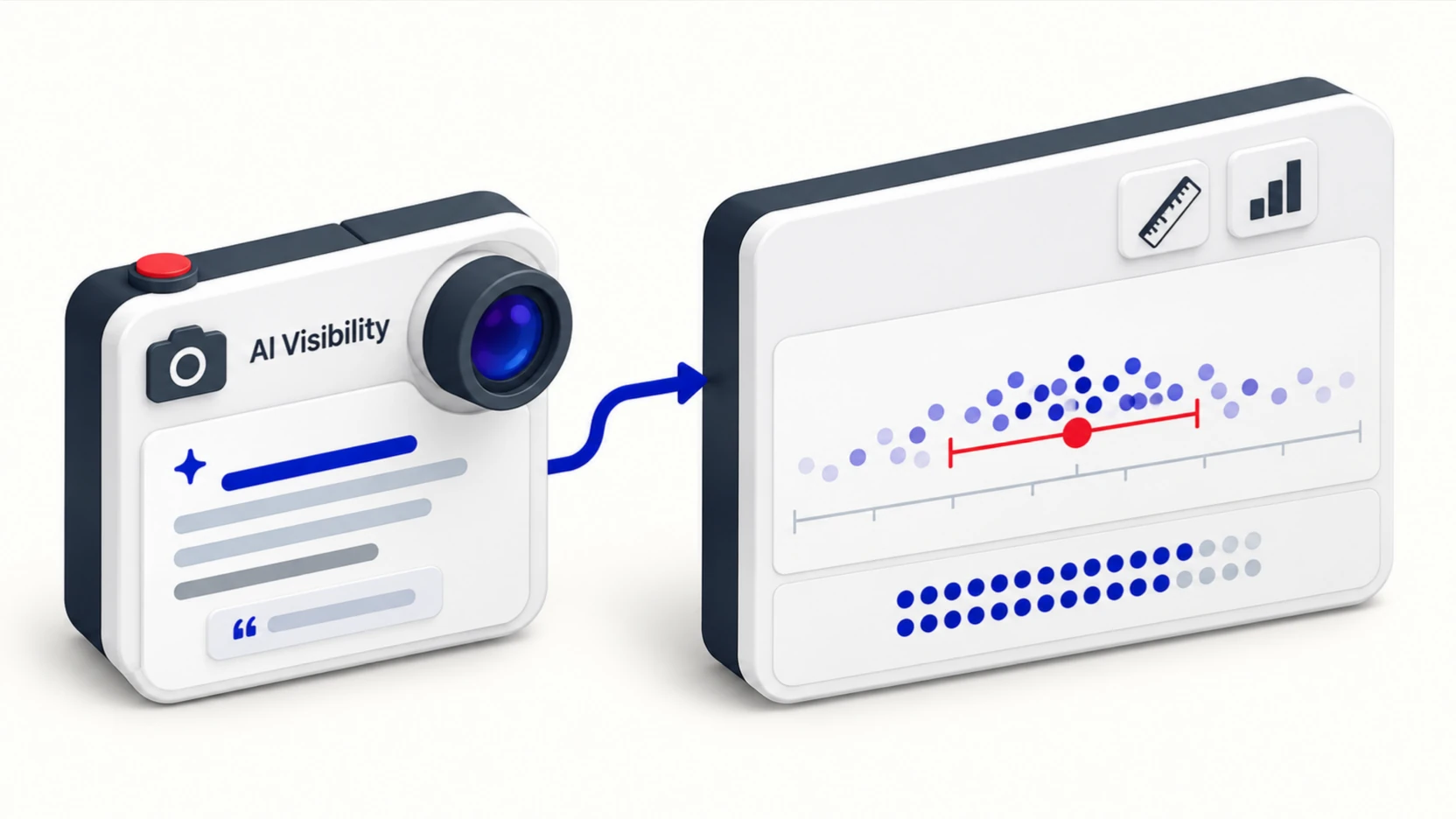
Key point. We use two instruments, and they answer different questions. Lenz, our product, asks ChatGPT and Gemini the buyer questions it drafts from your website, without naming you, and counts how often each engine names you in its answer; by default it asks each question once per engine, so a single Lenz report is a snapshot.
Our research measurements ask each question several times, keep every engine separate, fix the questions before any answer is collected, and report every figure with its sample size and its uncertainty. This page describes both and shows a worked example.
A buyer doing due diligence on any AI visibility vendor should be able to ask two things: show me how you measure, and show me which of your statements are measured and which are still hypotheses. This page is our answer to the first. The second lives in what we know versus what we are still testing and AI search claims we could not confirm . For where measurement fits in the bigger picture, start with the AI search visibility funnel.
What does Lenz measure?
Lenz measures how often two AI engines, ChatGPT and Gemini, name your company when a prospective buyer asks them a question about your category, without being told your name. A report runs in five steps.
- It drafts the questions from your own website, and you can edit them. Lenz reads your homepage and up to four other pages, choosing pages whose addresses suggest services, products, pricing, FAQ or about. A language model drafts buyer questions from that text, including comparison, pricing and "best X for Y" questions. You review the list before the run and can edit, remove, add or upload questions.
- It asks the engines without your name. The question drafter is told your company name so it can understand the site, and it is instructed not to put your name in any question. The engines receive only the question. You review every question before the run, so you can confirm it yourself.
- It collects the answers from ChatGPT and Gemini. By default the answers come from the ChatGPT and Gemini web interfaces, collected through a third-party data service, with a country-level location (the US unless you set another) and in English. ChatGPT is made to search the web; the Gemini interface has no such switch. A setting can route the questions through the providers' APIs instead.
- A separate, neutral pass reads each answer. A second model call lists every business the answer names, in order, and records how it was named, the tone and a short quote. A business that appears only as a cited source, not named as an option, is not counted. This pass is not told which business we care about, so it cannot lean towards finding you. If the reading call fails, that answer counts as naming no one.
- It scores each engine separately. Your score on an engine is the share of that engine's returned answers that named you; answers that failed to come back are left out. The report also shows an overall figure, which is the average of the two engine scores, and the competitors named most often.
Lenz measures mentions in the answer text. Our research measurements also record the pages each engine cited and the model it reports.
Why does Lenz leave our company name out of the questions?
Lenz leaves your name out because a question that contains your name measures whether the engine knows you, while a buyer at the shortlist stage does not know you yet. "What does [company] do?" tests recognition. "What is the best payroll tool for a 40-person startup?" tests whether you are recommended, which is the question that decides deals. We call these blind questions: the engine has to bring you up on its own.
Keeping the name out of the extraction step matters for the same reason. If the model that reads the answers were told who the client is, it could over-match near spellings or similar names in your favour. Lenz instead lists every business the answer names, and matching to your company happens afterwards by rule.
Branded questions are still worth asking, for a different purpose. They show whether an engine describes you correctly, which is the subject of when AI describes your company wrongly . We keep the two kinds of question separate and never state a result from one about the other. The glossary defines non-branded and branded queries, mentions and citations.
Is a Lenz report the same as what buyers see in ChatGPT?
A Lenz report is close to what a buyer sees. By default Lenz reads the answers the ChatGPT and Gemini web interfaces give, which is nearer to the consumer experience than an API call. Each buyer's answer also depends on their account, history, memory, exact wording and location, so Lenz asks every question the same way, every time.
Treat a Lenz report as a consistent stand-in for what the engines tell a buyer, measured the same way every time, and read differences between engines as real differences in what those engines read and say.
How many times does Lenz ask each question?
Lenz asks each question once per engine by default. A setting allows more asks, and the default is one. That makes a single Lenz report a snapshot: one answer per question per engine, on one day.
A snapshot is useful when you read it the right way. The score across many different questions is a rate, and a rate over many independent questions holds still far better than any one row of the report. The row that says "named" or "not named" for one specific question is a single event, and the same question asked again can come back differently. So read a Lenz report for its per-engine rate, and do not act on one question's result until it has been asked again.
To compare over time, keep the questions fixed. Lenz lets you save and reuse a question list, so a later report can ask the same questions as the first. If you edit the list between runs, a difference between reports mixes a change in the engines with a change in the questions. Why most AI visibility numbers mislead explains why single asks and changing questions produce numbers that move on their own.
How many runs does a measurement need?
It depends on what the number has to say. The most specific published guidance comes from a 2026 preprint by Schulte, Bleeker and Kaufmann, who tracked ChatGPT, Gemini, Google AI Mode and Perplexity for about 45 days on 32 German-language prompts in four Swiss consumer categories, collected from servers in Switzerland. They recommend at least 7 runs per prompt per day to estimate how often one brand is named on that prompt, and at least 8 when you need the cited sources, because that is where the standard error of their estimate drops below 0.10 (arXiv 2604.07585).
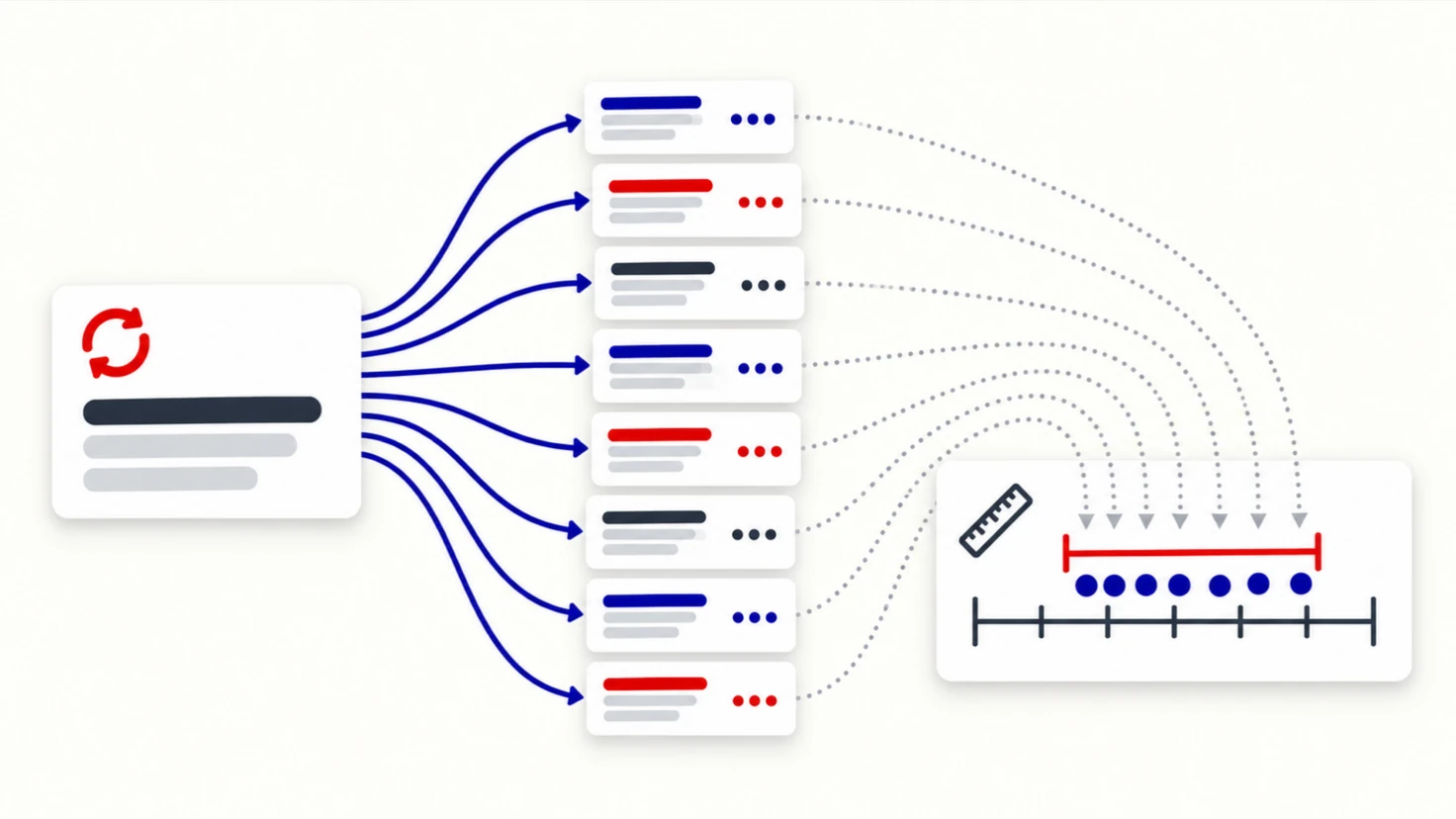
Read that recommendation for what it is. It is about one brand on one prompt, so it is the right bar when you want to make a claim about a single question. A standard error of 0.10 still means a 95% range roughly 20 points either side of the estimate, so even seven runs give a rough figure for one prompt. The same paper also recommends pooling over rolling windows of two to four weeks to get stable per-brand estimates. A rate across many different questions, which is what a Lenz report gives per engine, is a different quantity: each question adds independent evidence, so a wide list asked once can support a category-level rate that no single question could. Our research rule of at least three runs and a second day is therefore a floor for per-question work, and for a claim about one question we add runs until the interval is narrow enough to decide.
What do we do differently in our research measurements?
Our research measurements are slower and more expensive than a Lenz report, because they are built to support a claim. This is the part of our method nobody else can describe for us, so here it is in full.
We ask every question more than once. Each question is asked at least three times, and repeated on another day before we believe a change. We treat three as a floor, not a target, and the section above explains why published work points higher for some uses. Our own data shows why one ask is not enough. On Google AI Overviews, "when we checked the same 118 searches three times over two days, only 14 of them returned the exact same set of cited websites each time." On ChatGPT, collected through a third-party scraper of the ChatGPT interface, "asking ChatGPT the same question three times in a row, the sets of websites it cited overlapped by only about 30% on average, across 100 non-branded questions"; that is an overlap index averaged over 3,600 pairs of answers, not a share of answers.
We report each engine on its own and never pool them. Google AI Overviews, ChatGPT, Perplexity, Claude and Gemini read different parts of the web, and a result measured on one engine is never stated about another. Our register of findings records the engine each finding was measured on wherever we can defend one. If we cannot say which engine a finding came from, we do not attach it to any engine, and we never move a result from one engine to another.
We fix the question list before we look at any answer. The panel of questions is written and stored before collection starts, and new questions get new ids so earlier runs stay comparable. Choosing questions after seeing the answers is the easiest way to manufacture a result, so we take the choice away from ourselves. The questions drive the result: which questions you ask decides most of what you see. That is why Lenz lets you edit its drafted questions before the run, and why our research panels are written by people and fixed in advance.
We collect Google AI Overviews from the results page itself. Our research on Google AI Overviews captures the Google results page through a search-data provider, rather than asking a model API. A peer-reviewed study at ACM SIGIR 2026 tested this kind of collection on 100 queries and found that AI Overview source lists gathered through a search-data API matched a signed-in Chrome browser about as closely as two API collections matched each other (Grossman et al., 2026, arXiv 2604.27790).
We keep non-branded and branded questions apart. A finding measured on searches that do not name a company is never restated as a finding about searches that do.
We report the sample size and the uncertainty with every figure. Our rule is that every result carries its count of answers per engine and a 95% confidence interval, which is the range the true figure plausibly sits in given how many answers we have. Our rule for a pass or fail is strict in both directions: a result fails only if the whole interval sits below the bar, and passes only if the whole interval sits above it. If the interval straddles the bar, the result is "not enough data yet", and the answer is to collect more, not to declare a verdict. A small first run that only tests whether the method works is labelled a pilot, and a pilot is never allowed to produce a verdict.
We write the prediction down before the run. For an experiment, the expected result, the threshold that would count as success and the sample size needed to tell the difference are recorded before any data is collected. That makes a miss visible as a miss.
We record which model actually answered. Since late September 2026, every call records the model we asked for, the model the provider's server says answered, and the provider. We ask for dated model versions rather than names that the vendor can silently point at a newer model. Where a provider publishes no dated versions, we run a fixed test question at the start of each experiment and compare its answer with earlier runs, so a quiet model change shows up before it contaminates a result.
A finding is kept only with an audit trail and a recompute check. For anything we treat as established, we keep the raw answers with checksums, the version of the code that produced the number, and a recipe that recomputes the headline figure from the raw data. Since August 2026, a finding is not filed unless it has an audit trail and a recompute check that reproduces it. Every hypothesis gets a row in a register when it is launched, including the ones that fail, so a positive result can be read against how many things we tried.
Public claims pass through a separate gate. Each finding we may quote carries an evidence grade, the engine it was measured on, a date after which it expires (180 days for a finding about one engine, because the engines change; longer for a finding about method), and a flag saying whether it may leave the company at all. Anything not on that list may not be quoted, and a finding that has not passed that gate does not appear on this site.
What does our method look like on a real measurement?
The clearest example is the measurement we run on ourselves: what AI engines tell a buyer who asks about Elementera. We call it the verdict harness, and its design follows the rules above.
- A fixed question list. Twelve buyer questions, stored in a versioned file and fixed before the baseline run, such as whether we are trustworthy, what we do, how we compare, whether each founder is credible, and one long due-diligence question. These are branded questions on purpose, because the point is what engines say about us when asked.
- Two engines, never pooled. The OpenAI API with its web search tool, and the Perplexity Sonar API. Both are labelled in the report as APIs and not as the consumer apps.
- Three repeats of every question on every engine, asked in rounds so that the repeats of one question are spread over the run rather than fired back to back, with no caching. Seventy-two answers in the first baseline.
- The served model recorded on every answer, read from the provider's response, with an explicit "the server reported nothing" value that can never be mistaken for a confirmed model.
- A hard spending ceiling, checked before every call, and every run's cost logged.
- A judge model that labels, and does not opine. A separate, inexpensive model reads each answer into a fixed set of fields: which verdict the answer gave on each dimension it used (expertise, track record, independent verification and so on), whether it described our current business or our old one, whether it said there was little independent information, and which gaps it named. The sources each answer cited are taken from the engine's own response, not from the judge. The full answer text is kept next to every label, so any label can be checked by hand.
- Counts with their denominators. The report shows, for each question and each engine, how many of the three answers said what, rather than a single score.
Here is what that design shows in practice. "Asking the same 12 questions three times each on one day, the sites cited overlapped far more on the Perplexity API (0.92 average overlap) than on the OpenAI API (0.49)." Overlap here is the share of cited sites two answers to the same question have in common, out of all the sites either cited, averaged over 36 pairs of answers per engine (95% intervals 0.87 to 0.97 and 0.35 to 0.65). These were branded questions about us, asked through the two APIs. On the same questions, on the same day, one engine was close to repeatable and the other was not. That is the kind of difference our rule of never pooling engines exists for.
We describe what the baseline found, under the same publication rules as any other finding, in the AI due-diligence check.
What does Google's own report show, and how does it compare?
For Google Search, Google now offers a first-party measurement of its AI features. Search Console's Generative AI performance report, rolled out to all sites on August 31, 2026, counts how many times links to your site were shown in AI Overviews and AI Mode, and groups those impressions by page, country, date or device (Search Console Help). Google's guide to its AI features recommends it for monitoring and adds a warning: "Be wary of third-party tools that promise ranking success or claim to use 'internal' Google metrics. No third-party tool has access to our internal ranking or AI systems" (Google Search Central).
No outside tool has access to Google's systems, ours included. What a measurement like ours adds is different information. Google's report counts impressions of your links; it does not list the questions people asked, it does not record whether the answer named you without a link, and it does not cover ChatGPT, Gemini as a stand-alone app, Perplexity or Claude. A measurement that asks fixed questions can show which competitors were named and how you were described, on engines Google's report never sees. If a tool reports Google AI Overview figures for your site, read them next to Search Console's numbers.
Google's report also has an eligibility condition worth checking first. A page must be indexed and eligible to show with a snippet, and the site must be included under the Search generative AI setting in Search Console, which is on by default (Search Console Help). For Microsoft's AI experiences, Bing Webmaster Tools has an AI Performance report of its own, which we use for our own site: it "counted 5,260 citations of our site in Microsoft's AI experiences between March 8 and September 6, 2026, rising from about 3 a day in March to about 63 a day in August." Microsoft says the report covers Copilot, AI-generated summaries in Bing and select partner integrations, so we never read it as Copilot alone, and our site grew over that window, so the rise is not a measure of noise. None of these statements from Google carry over to other engines.
How do Lenz and our research answer the questions to ask any vendor?
We keep the full list of questions to put to any AI visibility vendor, and the research behind each one, in why most AI visibility numbers mislead . Here are our own answers to the core ones, for both instruments.
| Question | Lenz | Our research measurements |
|---|---|---|
| Which engines, and through what? | ChatGPT and Gemini, from their web interfaces through a data service by default; an API setting exists | Each engine separately; Google AI Overviews from the captured results page, others through each provider's API or a scraper of the app, labelled as such |
| How many times is each question asked? | Once per engine by default | At least three times, and again on another day before we call a change |
| One score per engine, or a blend? | A score per engine, plus an overall average of the two | Per engine only; never pooled |
| Who wrote the questions, and are they fixed? | Drafted by a model from your site, edited by you, reusable between runs | Written by people and fixed before any answer is collected |
| Branded and non-branded kept apart? | Questions are written without your name | Always reported separately |
| What counts as a hit? | Your company named in the answer text | Mentions and cited sources recorded separately |
| Sample size and margin of error? | A per-engine share of the answers returned | Count per engine and a 95% interval on every figure |
How can you check any AI visibility measurement this week?
These steps work whether the report comes from us, from another vendor or from your own team.
- Put the vendor questions to whoever produces your numbers, using the list in why most AI visibility numbers mislead , and ask for answers in writing.
- Open Search Console's Generative AI performance report and compare its trend for AI Overviews and AI Mode with any Google figures your tool reports. Keep in mind it covers Google Search only.
- Check that your site is included under the Search generative AI setting in Search Console, so Google's report and its AI features can show your pages at all.
- Ask the same question list twice, a few days apart, before you change anything. The difference between the two runs is your noise; a later change has to be bigger than that.
- Write down what you expect to change and by how much before you start new content work, so a miss shows up as a miss.
Frequently asked questions
Why not ask every question ten times in every Lenz report?
Cost and time, mainly. Ten asks of every question on every engine multiplies the cost of a report by ten. For the decision a first report supports, which is roughly where you stand on each engine across your category, a wide set of questions asked once is the better use of the budget. For anything that has to support a claim about a specific question, or a change over time, we use the repeated method.
Do you average the engines in Lenz?
Lenz reports a score for each engine and also a combined score that averages them. We read the per-engine scores, and we recommend you do the same, because the engines read largely different sources. In our research we never pool engines at all.
How do I know if my content is improving my AI visibility?
Fix the question list first and ask it twice, a few days apart, before you publish, so you know the normal spread. Write down what you expect to change and by how much. Once the new content is live and indexed, ask the same questions again on each engine separately. Count a change only when it is bigger than that spread. For Google, Search Console's Generative AI performance report adds impressions by page.
Can I see the raw answers?
In our research measurements, yes: we keep the full text of every answer next to every label, so any count can be checked by hand. For what a Lenz report includes, see the Lenz page.
How is Elementera's own research checked?
Every finding passes internal checks, including a recompute from raw data, before we publish it. When we cite outside research on this site we say whether it is peer reviewed or a preprint, and the same label applies to us. The per-site data behind our AI crawler access report is public as a dataset, so anyone can re-count it.
Work with us
There are two ways to work with us. Teams that want the measurement and the work done for them can use our managed AEO services: Book a call. Teams that want to see where they stand first can start with Lenz, our free analysis of how ChatGPT and Gemini answer their buyers' questions: Get your free AI visibility report.
How this page was made
Written by Dr. Maziar Gomrokchi. Reviewed by Soroush Mehri.
Sources
- Schulte, Bleeker and Kaufmann. "Don't Measure Once: Measuring Visibility in AI Search (GEO)." arXiv preprint, 2026. arXiv 2604.07585
- Grossman, Liu, Chen, Smith, Borcea and Chen. "How Generative AI Disrupts Search: An Empirical Study of Google Search, Gemini, and AI Overviews." ACM SIGIR 2026. arXiv 2604.27790
- Google Search Central, Optimizing your website for generative AI features on Google Search
- Search Console Help, Generative AI performance report (Search) and Search generative AI control
- OpenAI, Web search guide, OpenAI API documentation.
- Google, Grounding with Google Search, Gemini API documentation.
- Bing Webmaster Tools, AI Performance export for elementera.com, March 8 to September 6, 2026 (our own site)
- Elementera, measurements of Google AI Overviews (July 2026) and ChatGPT on non-branded searches, and of the OpenAI and Perplexity APIs on branded questions about Elementera (October 2026), quoted above.
- Elementera, why most AI visibility numbers mislead , for the external research on run-to-run variation, question wording and engine differences.

AI/ML scientist with 20+ years of research & industry experience. Ex-Google DeepMind, MIT, Harvard, Mila. McGill-Mila PhD.

Ex-Microsoft. 10+ years of experience in AI/ML, MSc from Université de Montréal (Mila). US patent holder.
Related articles
- Why ranking well on Google does not mean AI Overviews read your page
- How ChatGPT search finds and cites sources, and what a site owner controls
- How Google AI Overviews and AI Mode choose sources, and what a site owner controls
- What an AI Visibility Audit Actually Covers for SMBs
- Maximize Answer Visibility With Proven AEO Techniques
Latest articles
- Converting visitors who arrive from AI answers
- The AI due-diligence check: what AI tells a buyer who asks whether to hire you
- GEO services vs AEO services: is there a difference, and what should you ask a provider?
- Managed AEO services or AEO software: which does your company need?
- Being recommended over competitors: why AI knows your company and still recommends someone else