
Can You See an AEO Gain Without a Control Group? (Study)
Key point. In an Elementera simulation built on real Google AI Overview data, an analysis that did not know which searches had been worked on never detected an improvement, even a large one. Compared with searches left untouched, the same analysis caught large improvements every time. An AEO result needs a comparison group.
Most answer engine optimization (AEO) results are reported as a before and after: a visibility score went up in the weeks after the work, so the work paid off. That reading assumes the measure would have stayed still without the work. AI answers do not stay still. Elementera ran a simulation to find out how much a before-and-after reading can see, and read the guides that tell teams how to measure.
How much do AI answers move with nothing changed?
AI answers move a lot with nothing changed on your side. We checked the same set of non-branded Google searches three times over two days in July 2026.
"Whether an AI Overview appears at all also moves. In the same three checks over two days, 22 of 150 searches showed an AI Overview on some checks and not on others (15%; 95% interval 10% to 21%), so a KPI that counts AI Overview appearances can change with nothing changed on your side."
The websites inside an answer move even more. When we replayed our own Google AI Overview data with imaginary changes, the movement alone produced wins:
"In a replay over our Google AI Overviews data, a large share of imaginary changes, assigned to random websites where nothing was done, scored as wins under a simple before and after rule, and the share grew the longer the window, because AI Overview source lists turn over constantly. Requiring a gain to persist across two captures removed many of the false wins, but not enough on its own."
Can an analysis see an AEO gain without knowing what was worked on?
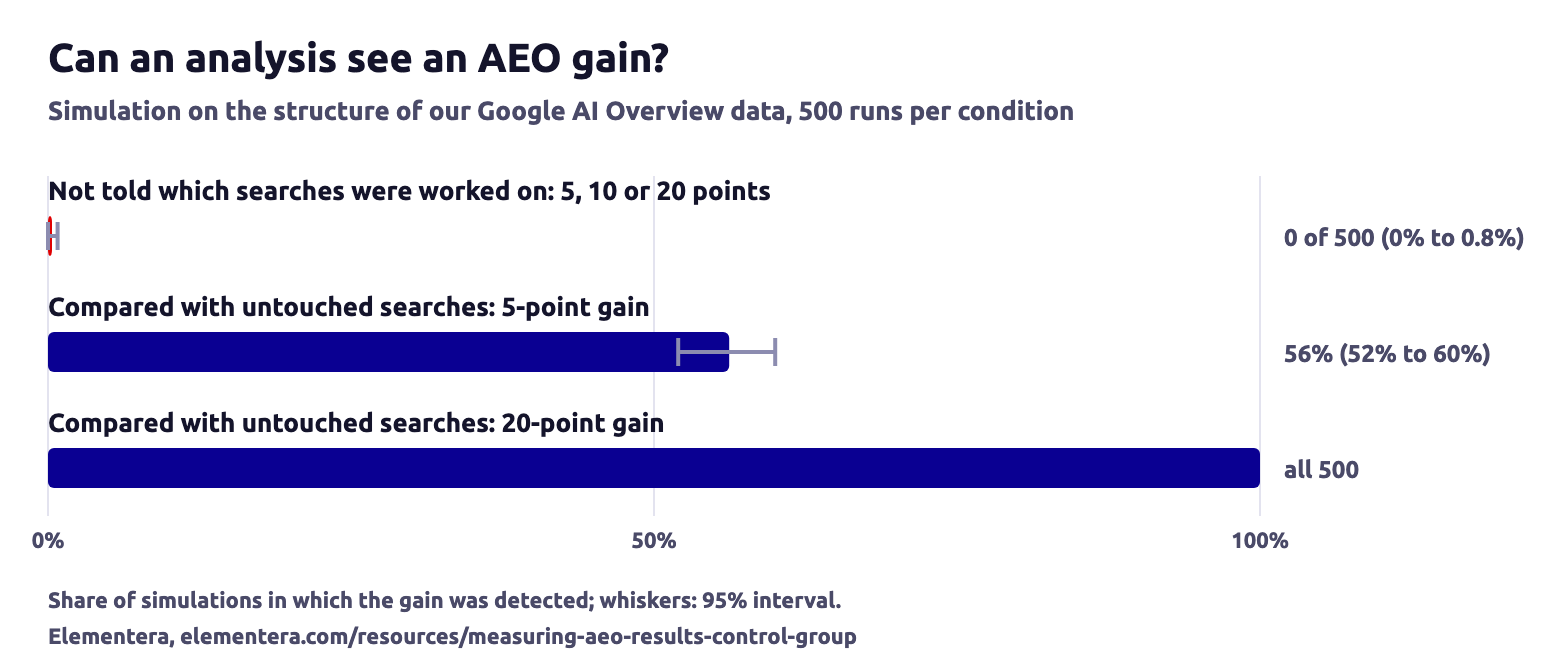
An analysis that does not know which searches were worked on cannot see an AEO gain in our simulation. We added improvements of known size to searches in a copy of our own data and asked whether an analysis could find them.
"In a simulation built on the structure of our own AI Overview data, an analysis that did not know which searches had been worked on never detected an injected improvement, even a 20-point one (0 of 500 simulations at each size; 95% interval 0% to 0.8%). Told which searches had been worked on, the same analysis detected a 5-point improvement in 56% of simulations (95% interval 52% to 60%) and a 20-point one in all 500."
| What the analysis knew | Injected improvement | Detected |
|---|---|---|
| Not which searches were worked on | 5, 10 or 20 points | 0 of 500 at each size (95% interval 0% to 0.8%) |
| Which searches were worked on, compared with the untouched ones | 5 points | 56% of 500 (95% interval 52% to 60%) |
| Which searches were worked on, compared with the untouched ones | 20 points | all 500 |
The difference is not the size of the effect. It is whether the analysis has a comparison: searches you worked on, next to comparable searches you left alone. Without that, a real gain and normal movement look the same.
Do the popular AEO guides tell you how to measure a gain?
The popular AEO guides we read do not tell you how to measure a gain. We read the guide pages an AI engine cited for three questions about AI search KPIs and ROI on October 8, 2026.
"The eight guides we read list sensible KPIs, but none of them says how to tell a real gain from that movement, and none recommends comparing the questions you worked on with questions you left untouched (0 of 8; 95% interval 0% to 32%)."
The guides cited for setting up an AEO program ("How do I set up an answer engine optimization program at my company?", "What should an AEO strategy include?" and "Where do I start with answer engine optimization?") came out the same way:
"We read the guide pages that Perplexity cited for these questions on October 8, 2026. Of 8 pages, 5 recommended a baseline or a test (5 of 8; 95% interval 31% to 86%), and 0 described measuring untouched questions or pages alongside the changed ones (0 of 8; 95% interval 0% to 32%). The results they reported, such as a rise in a visibility score within weeks or a traffic rise within days of a content refresh, came with no comparison group and no statement of how much the measure moves on its own. A result like that cannot show that the work caused the change."
How do you measure an AEO result properly?
You measure an AEO result properly by comparing the questions you worked on with questions you left untouched, decided before the work starts. Six steps:
- Fix the question list first. Write the buyer questions you will track before any work begins, and do not add to it mid-test.
- Split it in two. Pick the questions you will work on and keep a comparable set untouched, chosen the same way.
- Ask each question more than once, on more than one day, per engine. One check of an AI answer is a reading, not a measurement.
- Judge the difference between the two changes. A gain counts only if the worked-on questions moved more than the untouched ones.
- Report counts with an interval. "18 of 40 answers, 95% interval 31% to 60%" tells a reader how sure you are; "45%" does not.
- Write the pass and fail rule down before you look. Decide in advance what result would count as a win and how big a sample you need to see it.
Our free AI visibility change test compares a before and after against an untouched set, and the sample size calculator tells you how many answers you need. For Google's AI features, Google's own guide says "use the Generative AI performance report in Search Console" (Optimizing your website for generative AI features on Google Search, verified November 1, 2026): read it for the worked-on and the untouched pages alike. The AI search visibility funnel shows which stage each question measures.
How we measured
Elementera measured this in three parts, each with its own sample and date:
- The simulation ran offline, at no cost, over the structure of our own Google AI Overview data: 500 simulations for each condition, with improvements of 5, 10 and 20 points added to the worked-on searches. A result counted as detected when the analysis's test came out positive. It shows what an analysis can see, not whether any AEO work succeeds.
- The appearance count used 150 non-branded US English business searches on desktop, checked three times between July 16 and July 17, 2026.
- The replay used 4,809 histories of a website on a search from our July 2026 panel and scored our own earlier before-and-after rule, not any tool.
- The guide counts cover 8 pages for each question set, the pages Perplexity cited on October 8, 2026, not a survey of the web. We do not name the publishers.
Every count carries a 95% Wilson interval. Questions about the method: contact us.
How to cite this study: Elementera (2026). Can you see an AEO gain without a control group? https://www.elementera.com/resources/measuring-aeo-results-control-group
Frequently asked questions
Does this mean AEO does not work?
No. The simulation says nothing about whether AEO work succeeds. It shows that a before-and-after reading cannot tell a real gain from normal movement, while a comparison with untouched questions can.
How many questions should I leave untouched?
Enough that the untouched set is as large and as similar as the worked-on set, chosen by the same rule before the work starts. Our sample size calculator gives a number for the size of change you want to detect.
What if my visibility score rose after a content refresh?
It may be real. Check whether the questions you did not touch rose too over the same weeks. If they did, the rise is likely movement in the answers, not your refresh.
Can an AI visibility tool do this for me?
Some tools can track a fixed question list over time; few split it into worked-on and untouched sets for you. Ask your vendor whether its reports compare the two and show an interval.
Work with us
Work with Elementera in one of two ways. See how ChatGPT and Gemini answer your buyers' questions today with the free Lenz AI visibility report, or book a call about the Supervised plan, our managed AEO service, or about Originum, which turns your team's expertise into original content.

Sr. Engineering Leader with 15+ years of experience. Ex-ApplyBoard. AWS Certified Solutions Architect.

Ex-Microsoft. 10+ years of experience in AI/ML, MSc from Université de Montréal (Mila). US patent holder.
Related articles
- Can AI search engines fetch and index your pages? What you control
- Zero-click: when the AI answer replaces the visit
- Why ranking well on Google does not mean AI Overviews read your page
- How Microsoft Copilot finds and cites sources, and what a site owner controls
- How ChatGPT search finds and cites sources, and what a site owner controls
Latest articles
- How Google AI Overviews and AI Mode choose sources, and what a site owner controls
- How to advertise in AI assistants: what is live now
- How to choose an AEO agency: the questions to ask, the red flags, and what a managed AEO service should deliver
- AI search glossary: 55 terms, defined precisely
- Elementera receives angel investment to grow Lenz and the team behind it