
Who Writes the Best AI Visibility Tools Lists? (Study)
Key point. In an Elementera study, most of the best AI visibility tools lists that AI engines cite were written by companies that sell one of the tools, and each of those lists ranked its own product first. None of the lists we read published a test of the tools on the same questions, so a buyer should run that test before choosing.
When a marketing team asks ChatGPT, Perplexity or Google which AI visibility tool to buy, the answer is often built from a handful of "best AI visibility tools" lists. We wanted to know who writes those lists and what evidence they carry, so in October 2026 Elementera asked three buying questions, collected the lists the AI engines cited, and read every list we could fetch in full.
The three questions were:
- Which AI visibility tool should a B2B SaaS company use?
- What are the best AI search visibility tracking tools?
- How do I choose an AI visibility tool for my brand?
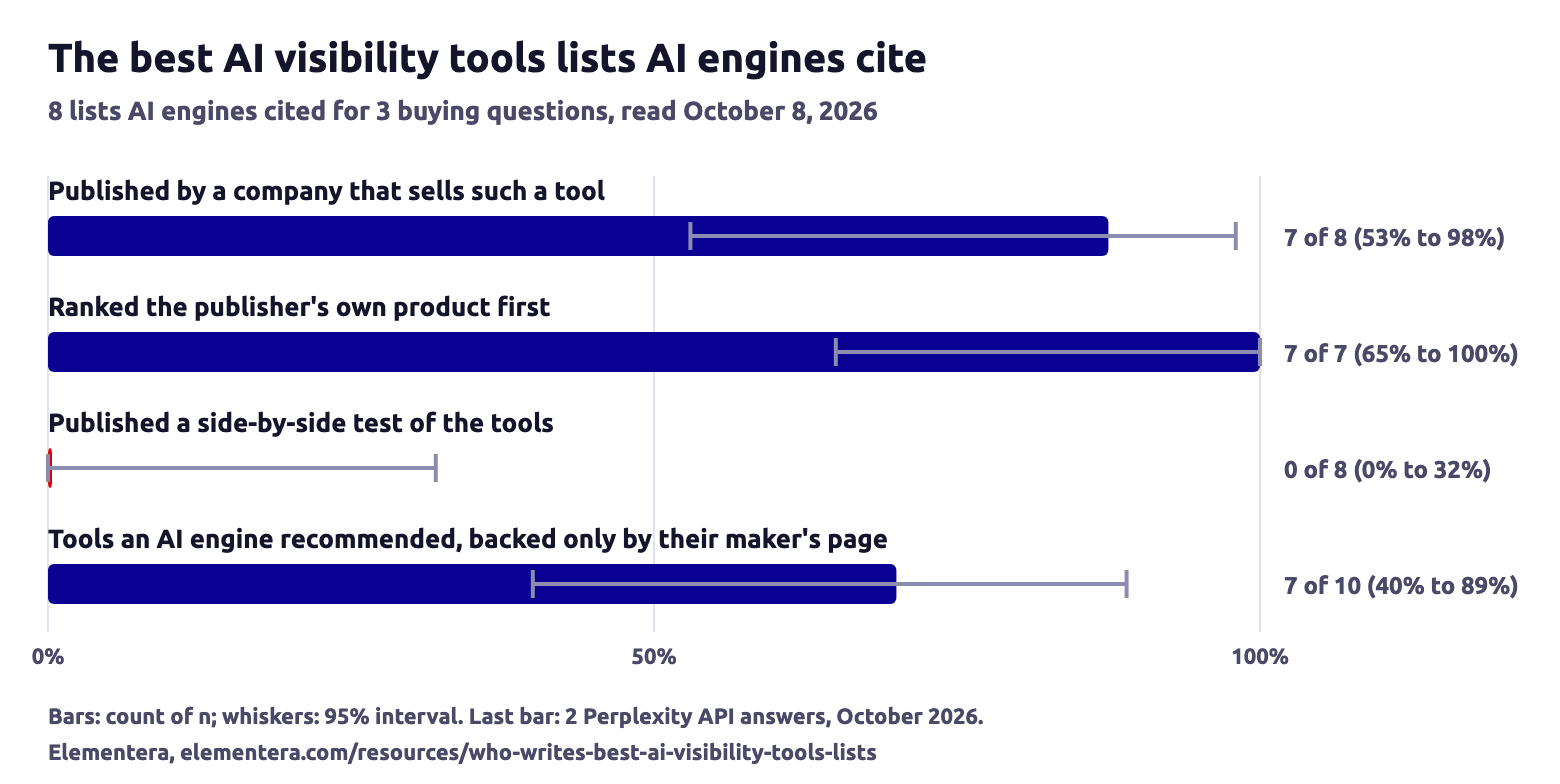
Who wrote the best AI visibility tools lists that AI engines cite?
The best AI visibility tools lists that AI engines cited were mostly written by tool sellers.
"When we read the lists that AI engines cited for these buying questions, seven of the eight were published by companies that sell an AI visibility or SEO tool (95% interval 53% to 98%), and all seven ranked their own product first (95% interval 65% to 100%)."
A list written by a vendor is not wrong because a vendor wrote it. A vendor often knows the category well, and its own product may well be a good choice. What the reader cannot see from the list is how the ranking was made, and that matters when the list becomes the source of an AI answer that names a winner.
| What we checked in the eight lists | Result | 95% interval |
|---|---|---|
| Published by a company that sells an AI visibility or SEO tool | 7 of 8 | 53% to 98% |
| Ranked the publisher's own product first | 7 of 7 | 65% to 100% |
| Published a side-by-side test of the tools on the same questions | 0 of 8 | 0% to 32% |
Did any best AI visibility tools list test the tools side by side?
No best AI visibility tools list we read published a side-by-side test. The fair way to rank tools that track AI answers is to run them on the same questions, on the same days, and publish what each one reported.
"None of the eight lists we read published such a test (0 of 8; 95% interval 0% to 32%). One said its author had used each tool on the same sites with similar prompts, and printed no result from that comparison. Another described its method as asking ChatGPT and other AI engines which tools they recommend."
The second method is circular. An AI engine asked which tools to recommend draws on lists like these, so a list built from that answer feeds the next answer.
Do the AI visibility tool lists agree with each other?
The AI visibility tool lists we read do not agree on the basics of measurement.
"The lists also disagree with each other. Some say that collecting answers through the AI providers' developer interfaces (APIs) is the reliable method; others say that collecting what the consumer app shows is the accurate one; none of them publishes data either way. They also give different figures for the same tool's entry price and prompt database."
That disagreement is a real question for a buyer. An answer collected through a developer interface and an answer shown in the consumer app can differ, and a tool built on one method can report a different picture from a tool built on the other. A list that takes a side without data leaves the buyer to find out after paying.
What does an AI engine recommend when it reads these lists?
An AI engine asked which tools to use recommended tools mostly on the strength of each maker's own page.
"When we asked an AI search engine which tools to use, 7 of the 10 tools it recommended by name were supported only by a page from that tool's own maker (Perplexity API, two answers, October 2026; 95% interval 40% to 89%)."
Two answers is a small sample, so read this as an illustration of how the recommendation was built, not as a rate for AI answers in general or for other engines. It shows the loop in one place: the maker writes the page, the engine cites the page, and the buyer reads the engine.
How should you choose an AI visibility tool, then?
You should choose an AI visibility tool by testing two or three of them on your own questions before you sign. The lists can give you a shortlist; they cannot give you the comparison. A test a team can run in two weeks:
- Write 20 to 50 real buyer questions for your category, the way a customer would ask them, without your company's name.
- Run the same questions through each shortlisted tool, on the same days and the same engines.
- Ask each question more than once. AI answers change between asks, so one reading is not a measurement.
- Check a sample by hand. Open the engine yourself for five or ten questions and compare what you see with what each tool reports.
- Keep some questions untouched if you plan to measure your own work later, so you can tell a real gain from normal movement.
- Ask each vendor how its numbers are collected: through a developer interface or the consumer app, how often, and from where.
What should a tool maker or an agency take from this?
A tool maker or an agency that publishes a best AI visibility tools list should publish its test with it. Google's ranking systems guide says its reviews system "aims to better reward high quality reviews, content that provides insightful analysis and original research" (verified November 1, 2026). Its guidance on writing high quality reviews asks reviewers to "share quantitative measurements about how something measures up in various categories of performance" (verified November 1, 2026). A list that shows the same questions, the dates and each tool's result gives an AI engine something no other list has: a measurement it can quote.
How we measured
We measured the lists on October 8, 2026: we asked the three questions above and read eight cited lists in full. Two more cited lists could not be fetched and are not counted. "Sells a tool" means the publisher sells an AI visibility or SEO product, and "a test" means a published result of the tools run on the same questions. The eight lists are the ones the engines cited for these questions, not a sample of every list on the web, and we do not name the publishers. The tool-recommendation count covers two Perplexity Sonar API answers, one ask each, on the same day. Every count carries a 95% Wilson interval. Questions about the method: contact us.
How to cite this study: Elementera (2026). Who writes the best AI visibility tools lists that AI engines cite? https://www.elementera.com/resources/who-writes-best-ai-visibility-tools-lists
Frequently asked questions
Are vendor-written best AI visibility tools lists wrong?
Not necessarily. A vendor can know its category well, and its own product may suit many buyers. The issue is that seven of the eight lists we read ranked their own product first and none showed a test, so the reader cannot tell a measured ranking from a preferred one.
Which AI visibility tools did the lists recommend?
We do not name the tools or the publishers. This study is about how the lists are made, not about which product is best. Run your own side-by-side test on your own questions to choose.
Why do AI engines cite these lists?
A list titled "best AI visibility tools" answers the buyer's question in its own words, so an engine searching for that question finds it. Few other pages answer the question as directly, which is why a list with a published test would stand out.
How can I check what AI engines say about my category?
Ask the same buyer questions in each engine, more than once, without your company's name, and note who gets named and which pages are cited. Lenz, our free AI visibility report, does this on ChatGPT and Gemini.
Work with us
Work with Elementera in one of two ways. See how ChatGPT and Gemini answer your buyers' questions today with the free Lenz AI visibility report, or book a call about the Supervised plan, our managed AEO service, or about Originum, which turns your team's expertise into original content.

AI/ML scientist with 20+ years of research & industry experience. Ex-Google DeepMind, MIT, Harvard, Mila. McGill-Mila PhD.

Known professionally as Dr. Med with 12+ years of experience implementing AI products. Strategic advisor to multiple successful founders including a unicorn, US patent holder. Ex-SOTI, UC Berkeley PhD.
Related articles
- Dental Practice Software in 2026: A Practical Guide to PMS Platforms and AI Tools (US and Canada)
- Google Preferred Sources and AEO: what it is and how it affects your AI visibility
- What an AI Visibility Audit Actually Covers for SMBs
- Maximize Answer Visibility With Proven AEO Techniques
- User Intent Optimization: What It Is and Why It Matters in AEO (AI SEO and AI Brand Visibility)
Latest articles
- How Microsoft Copilot finds and cites sources, and what a site owner controls
- How ChatGPT search finds and cites sources, and what a site owner controls
- How Google AI Overviews and AI Mode choose sources, and what a site owner controls
- Can AI search engines fetch and index your pages? What you control
- How to advertise in AI assistants: what is live now