
Do AI Engines Cite the Same Sources Twice? (Study)
Key point. In an Elementera test, asking the same question three times gave nearly the same cited websites on the Perplexity API and far fewer shared websites on the OpenAI API. One check of one engine is not a measurement, and two engines should never be pooled into one number.
Every AI visibility report rests on an assumption: that asking an engine a question tells you what it says about that question. If the same question asked again cites different websites, a single reading is a sample, and its size matters. Elementera asked the same questions three times on two AI engines to see how much the cited websites stay put.
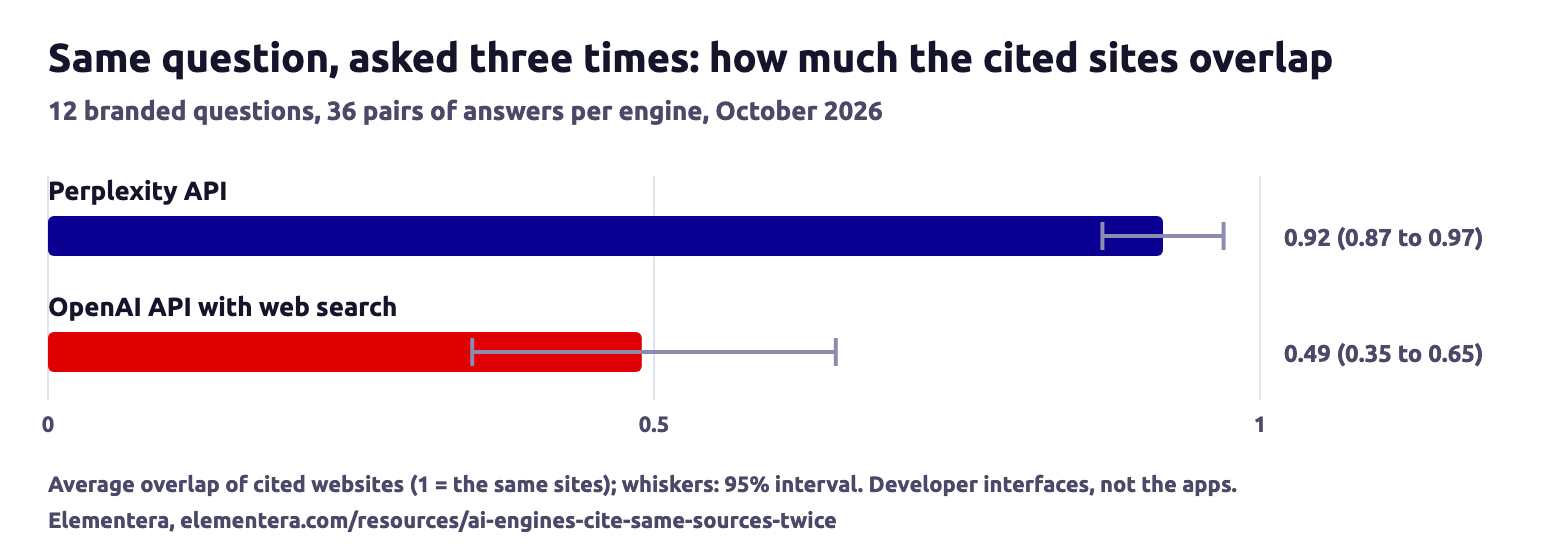
How much do cited sources change when you ask the same question again?
When we asked the same question again, the cited sources changed far more on one AI engine than on the other.
"Asking the same 12 questions three times each on one day, the sites cited overlapped far more on the Perplexity API (0.92 average overlap) than on the OpenAI API (0.49)."
The 95% intervals were 0.87 to 0.97 for the Perplexity API and 0.35 to 0.65 for the OpenAI API, so the gap between the two engines is far larger than the uncertainty in either one.
Overlap here is the share of cited websites two answers have in common, out of all the websites either answer cited (the Jaccard index). An overlap of 1 means the two answers cited the same websites; 0 means they shared none.
| Engine (developer interface) | Average overlap of cited websites between repeats | 95% interval | Pairs of answers |
|---|---|---|---|
| Perplexity API | 0.92 | 0.87 to 0.97 | 36 |
| OpenAI API with web search | 0.49 | 0.35 to 0.65 | 36 |
What does citation overlap mean for measuring AI visibility?
Citation overlap tells you how many times you need to ask an AI engine before a reading means anything. On an engine whose cited websites barely move, a few asks settle the picture. On an engine whose cited websites change from ask to ask, one ask can show you in or out by chance. Five rules follow:
- Ask each question at least three times, and on more than one day, before you read anything into it.
- Report each engine on its own. Our two engines behaved so differently that an average of the two would describe neither.
- Report overlap next to visibility. A share of answers that name you means more when you also know how much the answers move.
- Say which channel you measured. A developer interface and the consumer app can differ; this test used the developer interfaces.
- Compare with untouched questions when you measure your own work, so movement is not mistaken for a gain.
Our free AI visibility sample size calculator turns the size of change you want to detect into a number of answers, and the AI share of voice calculator reports your share of voice with its interval.
Why do Perplexity and OpenAI differ?
Perplexity and OpenAI differ in ways this test did not separate, so we do not claim a cause. The two services search the web differently and write their answers differently, and either can change which websites get cited. What the test does show is that the difference is large and stable enough to plan around: an engine's repeat behaviour is a property to measure, not to assume. Perplexity's developer documentation describes Sonar as a "grounded search model" (verified November 17, 2026). OpenAI's web search documentation says the model "can choose to search the web or not based on the content of the input prompt" (verified November 17, 2026).
How we measured
We measured 12 questions about one company, our own. Each was asked three times on the Perplexity Sonar API and on the OpenAI API with web search (model gpt-5.5-2026-04-23), on one day (October 5 to 6, 2026, UTC). For each question we compared the cited websites of every pair of the three answers, which gives 36 pairs per engine, and averaged the overlap. The 95% intervals come from resampling the questions (a question-cluster bootstrap). The questions named the company, so the result describes branded questions about one business, through developer interfaces rather than the consumer apps, and the two engines are reported separately, never pooled. Questions about the method: contact us.
How to cite this study: Elementera (2026). Do AI engines cite the same sources twice? https://www.elementera.com/resources/ai-engines-cite-same-sources-twice
Frequently asked questions
Does ChatGPT give the same answer every time?
Not necessarily, and the cited websites can change too. In our test, the OpenAI API with web search shared about half of its cited websites between repeats of the same question. The ChatGPT app may behave differently from the developer interface.
Is Perplexity more reliable than ChatGPT?
Our test measured consistency, not accuracy. The Perplexity API cited nearly the same websites each time; that says nothing about whether those websites were the best ones.
How many times should I ask a question to measure AI visibility?
At least three times per engine, on more than one day. Use more asks on an engine whose answers move a lot, and use our sample size calculator for the size of change you want to detect.
Does this apply to non-branded questions?
This test used questions that named one company. Questions that do not name a company are where most buyers start, and they need their own measurement per engine.
Work with us
Work with Elementera in one of two ways. See how ChatGPT and Gemini answer your buyers' questions today with the free Lenz AI visibility report, or book a call about the Supervised plan, our managed AEO service, or about Originum, which turns your team's expertise into original content.

Ex-Microsoft. 10+ years of experience in AI/ML, MSc from Université de Montréal (Mila). US patent holder.

Sr. Engineering Leader with 15+ years of experience. Ex-ApplyBoard. AWS Certified Solutions Architect.
Related articles
- How Microsoft Copilot finds and cites sources, and what a site owner controls
- How ChatGPT search finds and cites sources, and what a site owner controls
- How Google AI Overviews and AI Mode choose sources, and what a site owner controls
- Can AI search engines fetch and index your pages? What you control
- Google Preferred Sources and AEO: what it is and how it affects your AI visibility
Latest articles
- The AI due-diligence check: what AI tells a buyer who asks whether to hire you
- GEO services vs AEO services: is there a difference, and what should you ask a provider?
- Managed AEO services or AEO software: which does your company need?
- Being recommended over competitors: why AI knows your company and still recommends someone else
- AEO From Zero for a B2B SaaS: The Order We Would Follow